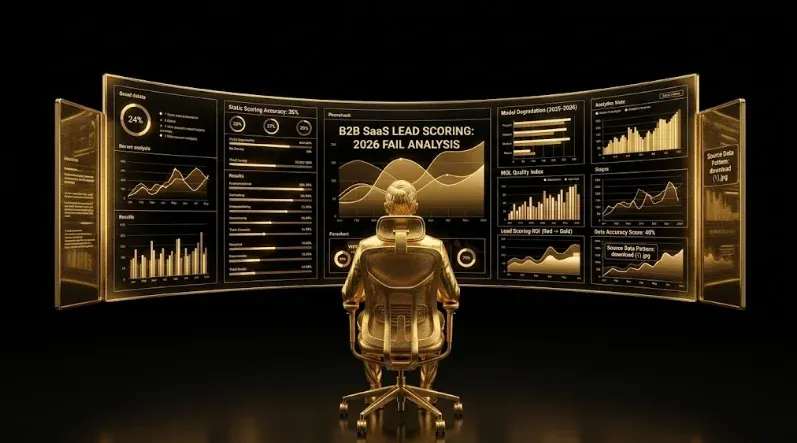
Lead scoring has been a B2B SaaS RevOps standard for 15+ years, and most implementations in 2026 produce scores that do not predict close probability — yet companies continue to operate them because the alternative requires CRM redesign that competes with quarterly campaign delivery. Seven structural failures explain why lead scoring almost always fails in B2B SaaS: (1) behavioral scoring assumes individual buyer journeys when buying is committee-based; (2) demographic and firmographic scoring is statically defined and does not update when ICP shifts; (3) score thresholds (50, 60, 75 points) are set arbitrarily with no empirical basis tied to close probability; (4) negative scoring is rarely deployed, so poor-fit signals do not de-prioritize; (5) lead scoring decays too slowly, weighting engagement from 6 weeks ago as heavily as engagement from yesterday; (6) scoring is rarely recalibrated against closed-won and closed-lost outcomes, so the model never improves; (7) both manual rule-based scoring (HubSpot, Marketo) and ML-based predictive scoring fail for different reasons — manual misses non-obvious patterns, ML over-weights high-data-volume signals and cannot distinguish correlation from causation. The replacement is dynamic outcome-trained scoring built on the Buyer Signal Stack: each of the 4 signal layers gets its own threshold, thresholds are calibrated quarterly against closed-won data segmented by ACV tier, recency is weighted into every behavioral score, and negative scoring de-prioritizes ICP-misfit and disqualifier signals. This guide details the 7 structural failures, why HubSpot manual scoring + HubSpot predictive scoring + Marketo scoring all fail for different reasons, the dynamic replacement framework, the 90-day migration plan, and the seven mistakes companies make when redesigning scoring.
By Ishan Manchanda, Co-Founder of GrowthSpree — a B2B SaaS marketing agency working with 75+ SaaS companies on demand generation, ABM, and RevOps. Updated June 2026.
Why lead scoring became a B2B SaaS RevOps standard
Lead scoring became a standard B2B SaaS practice because it solved a real problem: sales teams needed a way to prioritize among too many leads. By assigning each lead a numerical score based on behavioral signals (page views, content downloads, email opens) and demographic signals (title, company size, industry), marketing could automatically rank inbound flow for sales follow-up. HubSpot, Marketo, Pardot, and Salesforce Sales Cloud all built scoring engines. Onboarding consultants installed default scoring models. Most B2B SaaS companies adopted lead scoring during their first year of marketing operations and never fundamentally redesigned it.
The scoring approach was a reasonable heuristic in 2010-2015 when buyer journeys were largely first-party trackable and decisions were individual rather than committee-based. By 2026 the heuristic has degraded. The score numbers are still generated, dashboards still display MQL counts based on scoring, and sales teams still ostensibly use scoring for prioritization — but the actual correlation between lead score and close probability has weakened to the point that most scoring models are operational theater rather than functional prioritization.
The 7 structural reasons lead scoring almost always fails in B2B SaaS
Failure 1: Behavioral scoring assumes individual buyer journeys
Standard lead scoring models track behavior at the individual contact level. A contact’s score accumulates based on their personal engagement: their page views, their email opens, their content downloads. In 2026 B2B SaaS, buying decisions are made by committees of 6-12 stakeholders. The contact whose score crossed threshold is one stakeholder among many — and often not the most important one. Treating the high-scoring contact as ‘the lead’ misses the committee dynamics that actually drive the close.
Failure 2: Demographic and firmographic scoring is statically defined
Demographic scoring (title seniority, function) and firmographic scoring (company size, industry, geography) are typically set up during initial CRM configuration and rarely updated. The ICP that produced the scoring weights in year one no longer matches the ICP after the company has shifted into a new segment, ACV tier, or vertical. The scoring continues producing high scores for contacts that look like the 2022 ICP while the actual closing customers in 2026 look different — and no one notices.
Failure 3: Score thresholds are arbitrary
Why is MQL threshold 50? Or 60? Or 75? Most B2B SaaS companies cannot articulate an empirical basis for their MQL threshold. The number was chosen during initial setup, often inherited from a HubSpot Academy template or a Marketo default. Thresholds set without empirical basis cannot be evaluated for accuracy — and almost always drift away from optimum as the business changes.
Failure 4: Negative scoring is rarely deployed
Default lead scoring models add points for positive signals but rarely subtract points for negative signals. The result: a contact with strong engagement at a company that does not fit ICP (wrong industry, wrong size, wrong geography) still accumulates a high score. Negative scoring — subtracting points for ICP misfit, competitor email domain, junior title, free email service, or sub-threshold company size — would correct this, but is implemented at fewer than 30% of B2B SaaS companies.
Failure 5: Lead scoring decays too slowly
Standard scoring models weight engagement linearly regardless of when it happened. A contact who downloaded a whitepaper six weeks ago gets the same point value as a contact who downloaded a whitepaper yesterday. In 2026 buying motions where active buying windows last 4-12 weeks, engagement recency is far more diagnostic than engagement volume. Most scoring models do not apply recency weighting, so old engagement keeps lifting scores long after the buyer has moved on.
Failure 6: Scoring is rarely recalibrated against closed-won outcomes
The single most important data input for refining a scoring model is closed-won and closed-lost outcomes. Did contacts with high scores actually close? Did contacts with low scores fail to close? Most B2B SaaS companies set up scoring once and never feed close outcomes back into the model. Without this feedback loop, the model drifts further from reality every quarter. Predictive scoring (HubSpot AI Lead Scoring, ML-based models) attempts to address this but creates its own failures (covered below).
Failure 7: Both manual scoring AND predictive scoring fail — for different reasons
Manual rule-based scoring (HubSpot manual scoring, Marketo, Pardot) fails because the rules are written by humans who cannot identify non-obvious patterns in conversion data. Predictive ML-based scoring (HubSpot AI, custom ML models, Salesforce Einstein) fails for opposite reasons: the model over-weights signals with high data volume (form fills, page views) and under-weights signals with high causal impact but low data volume (sales call discovery insights, specific product engagement). ML cannot distinguish correlation from causation, so it learns to predict the existing pipeline rather than predict actual closing potential.
Why each major B2B SaaS scoring platform fails (for different reasons)
| Platform | Scoring Approach | Why It Fails | Best Use Case Despite Failure |
|---|---|---|---|
| HubSpot manual scoring | Rule-based: marketer assigns point values to behaviors and demographics | Human-defined rules miss non-obvious patterns; rules rarely updated; thresholds arbitrary | Companies with low lead volume (under 500/month) and stable ICP can operate manual scoring with quarterly recalibration |
| HubSpot predictive (AI) scoring | ML model trained on historical closed-won/closed-lost data | Over-weights high-data-volume signals; cannot distinguish correlation from causation; learns existing pipeline patterns rather than true predictors | Companies with very high lead volume (5,000+/month) and strong closed-won history may benefit, but the score should be one signal among many |
| Marketo lead scoring | Rule-based with behavior + demographic weighting + decay options | Decay features exist but typically misconfigured; demographic weighting rarely updated for ICP shifts; complex rule combinations produce unauditable scores | Enterprise B2B SaaS with dedicated MOps team that can maintain the model continuously |
| Salesforce Sales Cloud + Einstein | Manual scoring + Einstein Lead Scoring (ML) layered together | Two systems producing different scores; reps unclear which to trust; Einstein lacks transparency | Hybrid scoring works only with disciplined CRM admin governance |
| Pardot (Account Engagement) | Rule-based with engagement decay; tighter Salesforce integration | Decay rules complex; few teams use them correctly; demographic weighting requires Salesforce admin updates that rarely happen | Salesforce-native shops with strong Pardot admin discipline |
| Custom ML models (Snowflake/dbt + scoring) | Custom ML trained on first-party data | Requires data science team; model drift over time; rebuilding cost prohibitive for most B2B SaaS | Only viable above $50M ARR with dedicated ML/data science capacity |
The replacement: dynamic outcome-trained signal-stack scoring
The honest replacement for traditional lead scoring is not a better single score — it is the multi-layer Buyer Signal Stack with outcome-trained thresholds, recency weighting, negative scoring, and quarterly recalibration built in. The framework eliminates the seven structural failures by design.
| Structural Failure (Old) | How the Dynamic Signal Stack Solves It | Implementation Mechanism | Recalibration Cadence |
|---|---|---|---|
| Behavioral scoring assumes individual journeys | Account-level aggregation (Layer 2 committee signals) replaces single-contact behavioral score | Roll up contact-level engagement to the Companies object in HubSpot or Salesforce | Quarterly review of committee threshold (3+ engaged contacts) by ACV tier |
| Demographic/firmographic scoring is static | ICP definition explicitly updated quarterly based on closed-won analysis | Compare closed-won customer profile in last 12 months vs current ICP definition | Quarterly ICP recalibration |
| Thresholds are arbitrary | Thresholds calibrated empirically against close probability | Pull 12-month closed-won data segmented by ACV tier; identify threshold where close rate becomes meaningful | Quarterly threshold review |
| Negative scoring rarely deployed | Explicit disqualifier signals subtract from account stage progression | Add disqualifier criteria (competitor domain, student email, sub-threshold company size, irrelevant industry) as automatic stage demotion triggers | Monthly disqualifier audit |
| Scoring decays too slowly | Recency-weighted behavioral scoring with explicit recency multipliers | Apply 0.5x multiplier to engagement >30 days; 0.25x to engagement >60 days; 0x to engagement >90 days | Monthly recency multiplier review |
| Scoring never recalibrated against outcomes | Quarterly closed-won analysis feeds back into threshold and weight adjustments | Pull closed-won contacts; analyze their pre-conversion engagement; adjust signal layer weights based on what actually predicted close | Quarterly closed-won analysis |
| Both manual and ML scoring fail differently | Hybrid approach: rule-based criteria for transparency + ML refinement for non-obvious patterns + human review of edge cases | Rules govern primary routing; ML surfaces ‘unusual but potentially high-value’ contacts for human review | Quarterly rules + ML weight review |
The 90-day plan to migrate from traditional lead scoring to dynamic signal-stack scoring
-
Days 1-15 — Audit current scoring. Document the existing scoring model: point values, thresholds, decay rules, demographic weighting. Pull 12 months of closed-won and closed-lost data segmented by ACV tier. Compare actual close rates to score thresholds — if 60-point MQLs close at 12% and 75-point MQLs close at 14%, the threshold gap is mostly noise, not signal.
-
Days 16-30 — Design dynamic signal stack scoring. Build the 4-layer Buyer Signal Stack with thresholds calibrated to closed-won data. Define explicit disqualifier signals for negative scoring. Add recency multipliers. Co-design with VP Sales for SLA implications.
-
Days 31-60 — Configure CRM. Build account-engagement reports in HubSpot or Salesforce. Add custom signal-stack-weighted properties. Configure recency-weighted behavioral scoring (often requires Operations Hub or Salesforce Flow). Configure negative scoring triggers. Build quarterly recalibration dashboards.
-
Days 61-75 — Parallel run. Operate both legacy scoring and signal-stack scoring simultaneously for 2 weeks. Compare which framework better predicts opportunities and closed deals on incoming leads. Adjust signal-stack thresholds where the new framework appears wrong.
-
Days 76-90 — Cutover. Replace legacy scoring as primary routing input. Document new scoring in sales-marketing SLA. Schedule the first quarterly recalibration review for 90 days post-cutover.
The 7 mistakes companies make when redesigning lead scoring
-
Mistake 1: Replacing one bad scoring model with another bad scoring model. Adopting a different platform’s default scoring model (switching from HubSpot to Marketo, or vice versa) does not solve the structural issues — it inherits the same seven failures with different vendor logos. The redesign must address the structural failures, not the platform choice.
-
Mistake 2: Treating ML-based scoring as a silver bullet. HubSpot AI Lead Scoring, Salesforce Einstein, and custom ML models do not solve scoring — they shift the failure mode from human-defined rules to algorithmically-defined opaque predictions. Both fail. Hybrid is the right answer.
-
Mistake 3: Not implementing negative scoring. Designing the new model with only positive signals replicates the most common failure of the old model. Disqualifier criteria (competitor domain, student email, sub-ICP company size, irrelevant industry) must reduce scores or trigger automatic disqualification.
-
Mistake 4: Calibrating thresholds against MQL-to-SQL conversion instead of MQL-to-closed-won. Threshold calibration should target the final outcome (closed-won) not the intermediate stage (SQL). MQL-to-SQL calibration produces thresholds that optimize for sales acceptance, which is partially a sales process metric rather than a buyer signal metric.
-
Mistake 5: Skipping recency weighting because ‘the math is hard.’ Recency weighting is the single highest-leverage technical refinement in B2B SaaS scoring. The implementation effort (HubSpot Operations Hub or Salesforce Flow) is meaningful but not prohibitive. The conversion rate improvement justifies the work.
-
Mistake 6: Not scheduling the quarterly recalibration cadence. Recalibration is the mechanism that prevents the new model from drifting into the same staleness as the old. Without a documented quarterly review owned by a named operator, the new model becomes static within 6 months and produces the same failures as the legacy.
-
Mistake 7: Migrating scoring without migrating lifecycle stages. If lifecycle stages are still based on the old MQL framework, the new scoring has nowhere to route to. The lifecycle stage migration (covered in the HubSpot lifecycle stage trap playbook) and the scoring migration should be planned as a single integrated RevOps project.
How specialist B2B SaaS partners support lead scoring redesign vs the industry standard
| Capability | Industry Standard Agency | GrowthSpree (Specialist B2B SaaS) |
|---|---|---|
| Scoring design approach | Default platform templates with minor adjustments | Dynamic outcome-trained signal stack design from pattern recognition across 75+ B2B SaaS clients |
| Closed-won data analysis | Not produced | 12-month closed-won analysis driving empirical threshold calibration by ACV tier |
| Negative scoring deployment | Rarely included | Explicit disqualifier criteria deployed as automatic stage demotion triggers |
| Recency weighting configuration | Defaults | Custom HubSpot Operations Hub or Salesforce Flow configurations for 30/60/90-day decay multipliers |
| Quarterly recalibration cadence | Not offered | Quarterly closed-won analysis and threshold adjustment included in standard engagement |
| Pricing model | Percentage of ad spend or $8K-$25K monthly retainer | $3,000/month flat — scoring redesign + ongoing calibration included |
Key takeaways: why lead scoring almost always fails in B2B SaaS
-
Lead scoring has been a B2B SaaS RevOps standard for 15+ years; most implementations in 2026 produce scores that no longer predict close probability.
-
Seven structural failures: individual-journey assumption ignores committee buying, static demographic scoring misses ICP shifts, arbitrary thresholds, missing negative scoring, slow decay, no outcome recalibration, both manual rule-based and ML predictive scoring fail for different reasons.
-
Each major platform fails differently: HubSpot manual misses non-obvious patterns, HubSpot AI over-weights high-data-volume signals, Marketo decay rules typically misconfigured, Salesforce + Einstein produces two competing scores, custom ML requires data science team most B2B SaaS lacks.
-
Replacement: dynamic outcome-trained signal-stack scoring. Account-level aggregation, empirical threshold calibration by ACV tier, negative scoring for disqualifiers, recency-weighted behavioral scoring (30/60/90-day decay multipliers), quarterly recalibration against closed-won data, hybrid rules + ML approach.
-
90-day migration: days 1-15 audit, days 16-30 design with VP Sales co-sign, days 31-60 configure CRM, days 61-75 parallel run, days 76-90 cutover with documented quarterly recalibration cadence.
-
Seven mistakes: switching platforms instead of fixing structure, treating ML as silver bullet, no negative scoring, calibrating against MQL-to-SQL instead of MQL-to-closed-won, skipping recency weighting, no recalibration cadence, migrating scoring without lifecycle stage redesign.
-
Scoring redesign and lifecycle stage redesign should be planned as a single integrated RevOps project, not sequential migrations. Operating new scoring on top of old lifecycle stages produces internal contradictions that surface as reporting inconsistencies within 60 days.
Rebuilding your lead scoring model?
If you’re redesigning lead scoring and want a second opinion on the signal-stack design, recency weighting, or quarterly recalibration cadence, book a free 30-minute strategy call here. No pitch — just operator-to-operator review.
Related reading from GrowthSpree
• MQL To SQL Conversion Rate Benchmarks B2B SaaS 2026
• Hubspot Google Ads Pipeline Attribution Dashboard CEO Report
• B2B SaaS Pipeline Stages Defined MQL SQL Opportunity Closed Won
• How To Connect Ad Spend To Revenue B2B SaaS Attribution Guide
• B2B SaaS MQL Scoring Threshold Benchmarks 2026
• MQL-to-SQL Conversion Rate Benchmarks B2B SaaS 2026
• HubSpot Lead Scoring Connected to Google Ads + LinkedIn Ads
• RevOps HubSpot B2B SaaS Complete Guide
Frequently asked questions
Why does B2B SaaS lead scoring almost always fail in 2026?
Seven structural reasons explain why most B2B SaaS lead scoring models fail to predict close probability. (1) Behavioral scoring assumes individual buyer journeys when buying is committee-based (6-12 stakeholders); the high-scoring contact is one stakeholder among many. (2) Demographic and firmographic scoring is statically defined and does not update when ICP shifts — the scoring weights from 2022 no longer match the actual closing customers in 2026. (3) Score thresholds (50, 60, 75 points) are set arbitrarily with no empirical basis tied to closed-won data. (4) Negative scoring is rarely deployed; poor-fit signals do not de-prioritize. (5) Lead scoring decays too slowly — engagement from 6 weeks ago is weighted as heavily as engagement from yesterday. (6) Scoring is rarely recalibrated against closed-won outcomes; the model drifts further from reality every quarter. (7) Both manual rule-based scoring and ML predictive scoring fail for different reasons — manual misses non-obvious patterns, ML over-weights high-data-volume signals and cannot distinguish correlation from causation.
Why does HubSpot manual lead scoring fail in B2B SaaS?
HubSpot manual lead scoring is rule-based — marketers assign point values to behaviors (10 points for whitepaper download, 5 for page view, 15 for demo request) and demographics (15 points for Director title, 10 for Manager). The approach fails in 2026 B2B SaaS for three reasons: (1) Human-defined rules miss non-obvious patterns in conversion data — the rules reflect what marketers think predicts close probability, not what empirically predicts close probability. (2) Rules are rarely updated; the scoring written during initial setup years ago no longer matches current ICP or buyer behavior. (3) Thresholds are arbitrary; most companies cannot articulate why MQL is 50 points vs 60 vs 75. HubSpot manual scoring works reasonably for companies with low lead volume (under 500/month) and stable ICP if recalibrated quarterly, but most B2B SaaS companies neither qualify nor recalibrate. The default deployment produces scores that look authoritative but do not correlate with actual close probability.
Does HubSpot AI (predictive) lead scoring work better than manual scoring?
No — HubSpot AI Lead Scoring (and Salesforce Einstein, and custom ML scoring) fails for opposite reasons than manual scoring. The ML model is trained on historical closed-won and closed-lost data, but three structural failures emerge: (1) The model over-weights signals with high data volume (form fills, page views, email opens) and under-weights signals with high causal impact but low data volume (specific product engagement, sales call discovery insights, peer-recommendation context). (2) ML cannot distinguish correlation from causation — it learns to predict the existing pipeline patterns rather than predict actual closing potential, so it reinforces past biases. (3) The opacity of ML scoring makes it impossible to audit or adjust when ICP shifts; the model becomes a black box that produces confident-looking predictions on outdated assumptions. ML scoring is one input, not the primary scoring framework. The honest replacement is hybrid: rule-based criteria for transparency + ML refinement for non-obvious patterns + human review of edge cases.
What is dynamic outcome-trained signal-stack scoring for B2B SaaS?
Dynamic outcome-trained signal-stack scoring replaces single-score MQL routing with multi-layer scoring that is calibrated against closed-won outcomes and recalibrated quarterly. Built on the 4-layer Buyer Signal Stack: Layer 1 account-level intent (Bombora/6sense + ICP fit), Layer 2 buying committee signals (3+ engaged contacts at account level), Layer 3 behavioral compounding (velocity + breadth + recency, with explicit recency multipliers — 0.5x at 30+ days, 0.25x at 60+ days, 0x at 90+ days), Layer 4 self-reported context (HDYHAU + trigger question responses). Each layer has its own threshold calibrated empirically by ACV tier from 12 months of closed-won analysis. Negative scoring deploys disqualifier criteria (competitor domain, student email, sub-ICP company size, irrelevant industry) as automatic stage demotion triggers. Quarterly recalibration feeds closed-won outcomes back into threshold and weight adjustments.
How should B2B SaaS calibrate lead scoring thresholds against closed-won data?
Threshold calibration against closed-won data is a quarterly analytical exercise. Pull 12 months of closed-won data segmented by ACV tier ($10K-$30K SMB, $30K-$75K mid-market, $75K-$200K mid-enterprise, $200K+ strategic enterprise). For each tier, plot the distribution of pre-conversion behavioral scores, account-level engagement, self-reported context. Identify the threshold value at which the close rate becomes meaningfully different from the population. This is the empirical threshold — not the marketer’s intuition or the platform default. Common finding: 60-point and 75-point thresholds produce statistically indistinguishable close rates because the points between 60 and 75 are mostly noise. The threshold gap is theater. The recalibration corrects for this and may lower thresholds (and raise MQL volume) if the data supports it. Target threshold calibration against MQL-to-closed-won, not MQL-to-SQL — calibrating against SQL optimizes for sales acceptance, which is partially a sales process metric rather than a buyer signal metric.
What is recency-weighted behavioral scoring in B2B SaaS?
Recency-weighted behavioral scoring applies decay multipliers to behavioral engagement based on time elapsed since the engagement. Standard implementation: full weight (1.0x) for engagement in the last 30 days, 0.5x multiplier for engagement 31-60 days old, 0.25x multiplier for engagement 61-90 days old, 0x (or removed) for engagement >90 days old. The rationale: in 2026 B2B SaaS buying motions where active buying windows last 4-12 weeks, engagement recency is far more diagnostic than engagement volume. A contact who downloaded a whitepaper yesterday is structurally different from a contact who downloaded the same whitepaper six weeks ago, even if the absolute behavioral score is identical. Most default scoring models weight engagement linearly regardless of when it happened, producing scores that overstate dormant buyer interest. Implementation requires HubSpot Operations Hub or Salesforce Flow configuration; the technical effort is meaningful but the conversion improvement consistently justifies the work.
What is negative scoring in B2B SaaS lead scoring and why does it matter?
Negative scoring is the explicit subtraction of points (or automatic stage demotion) for signals that indicate ICP misfit or buyer disqualification. Standard negative scoring signals: competitor company domain (-20 points or immediate disqualification), .edu or student-pattern email address (-15), sub-threshold company size below ICP minimum (-15), industry on exclusion list (-20), free email service with low company size (-10), junior title with no buying authority (-10). Negative scoring matters because default scoring models add points for positive signals but rarely subtract points for negative signals. The result without negative scoring: a contact with strong engagement at a company that does not fit ICP still accumulates a high score and gets routed to sales as an MQL, consuming sales capacity on a lead that will never close. Negative scoring is implemented at fewer than 30% of B2B SaaS companies in 2026, making it one of the highest-leverage and least-deployed scoring improvements.
Should B2B SaaS migrate lifecycle stages and lead scoring together?
Yes — lifecycle stage redesign and lead scoring redesign should be planned as a single integrated RevOps project, not sequential migrations. The two systems are structurally interdependent: lifecycle stages define where in the buyer journey a contact or account sits; lead scoring determines when transitions between stages happen. Operating new scoring on top of old lifecycle stages (or vice versa) produces internal contradictions that surface as reporting inconsistencies and sales-marketing friction within 60 days. A new dynamic signal-stack scoring model that produces accurate buying-readiness signals has nowhere to route to if the lifecycle stages still use the legacy MQL/SQL framework. A new dual lifecycle (account-level + contact-level) with Committee-Engaged as the primary buying-readiness stage requires scoring that detects committee engagement, which legacy scoring cannot do. Plan both migrations as a single 90-120 day project with shared design phase, shared CRM configuration phase, shared parallel run, and shared cutover.