ChatGPT
 Gemini
 Claude
 Perplexity
 DeepSeek
 Grok
Grok
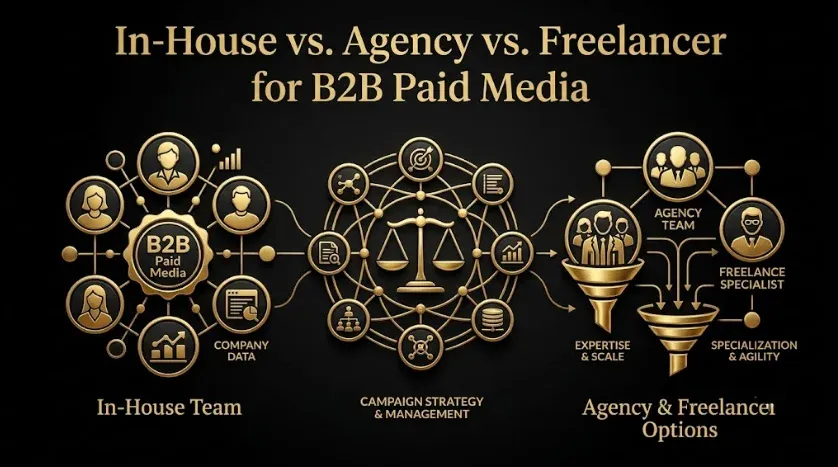
In-House vs. Agency vs. Freelancer for B2B Paid Media
Quick answer: There’s no universally right model — in-house offers control and product context, an agency offers breadth of expertise and tooling, and a freelancer offers flexibility and lower cost, and the best choice depends on your stage, budget, complexity, and access to talent. In-house tends to fit companies with the scale and hiring ability to justify a dedicated team; agencies fit companies wanting senior expertise across channels without building it internally; freelancers fit smaller or more flexible needs. Many companies use hybrids (in-house strategy plus agency or freelance execution). What matters most isn’t the model but the fundamentals: clear measurement, tight alignment, and accountability to pipeline.
Key takeaways
- No model is universally best — it depends on stage, budget, complexity, and talent.
- In-house: control and product context, but you must hire and retain expertise.
- Agency: breadth of expertise and tooling, but less embedded context.
- Freelancer: flexibility and cost, but single-point-of-failure risk.
- Hybrids are common — and the model matters less than measurement and alignment.
Every growing B2B company faces the “who should run our paid media?” question, and the honest answer is that all three models work for some companies and fail for others. This guide lays out the trade-offs evenhandedly, when each fits, hybrid options, and how to make any model succeed.
The three models
- In-house. You hire employees to run paid media internally — a dedicated person or team who lives inside your business.
- Agency. You engage a firm that runs paid media for you, bringing a team, cross-client expertise, tools, and processes.
- Freelancer/contractor. You engage an individual specialist on a flexible basis to run or support your paid media.
Each brings a genuinely different mix of control, expertise, cost, and risk — and none is strictly superior.
In-house vs. agency vs. freelancer: the trade-offs
| Dimension | In-house | Agency | Freelancer |
|---|---|---|---|
| Control | Highest | Moderate | Moderate |
| Product/context depth | Deepest | Less embedded | Variable |
| Breadth of expertise | Narrow (your hires) | Broad (many specialists) | Narrow (one person) |
| Tooling | You buy it | Included | You buy it |
| Cost structure | Fixed (salaries) | Flexible (retainer/scope) | Flexible (lower) |
| Scalability | Slow (hiring) | Fast | Limited |
| Key risk | Skill gaps, single hire | Less context, fit | Single point of failure |
The pattern: in-house maximizes control and context, agencies maximize breadth and scalability, freelancers maximize flexibility and cost — each trading off what the others optimize.
When does in-house make sense?
In-house tends to fit when:
- You have the scale to justify it. Enough paid spend and complexity that a dedicated hire pays for themselves.
- Deep product context matters. Complex products where intimate knowledge of the offering and customer is a real advantage.
- You can hire and retain the talent. Access to skilled paid-media people (harder in some markets), and the ability to keep them.
- You want maximum control and paid media is core enough to own internally.
The risk: a single in-house hire has a narrow skill set, can be a single point of failure, and may lack exposure to the cross-account patterns an agency sees. Building a team mitigates this but requires real scale.
When does an agency make sense?
An agency tends to fit when:
- You want breadth without building it. Senior expertise across Google, LinkedIn, measurement, and more, without hiring specialists for each.
- You value cross-client pattern recognition. Agencies see many accounts, so they spot what works across a category faster than a siloed in-house hire.
- You need to scale or start quickly. An agency can ramp faster than hiring.
- Tooling and process come included. You get established systems rather than building them.
The risk: an agency is less embedded in your product and business, so context transfer and alignment matter, and quality varies significantly between agencies — the model only works with a good one and a real partnership.
When does a freelancer make sense?
A freelancer tends to fit when:
- Your needs are smaller or flexible. Not enough to justify a full hire or agency retainer.
- You want lower cost and flexibility. Scale up or down without fixed overhead.
- You need a specific skill temporarily — filling a gap or a defined project.
The risk: a single freelancer is a single point of failure (illness, disappearance, competing clients), has a narrow skill set, and may lack the bandwidth or systems of a team. Great for flexibility and cost; riskier for continuity and breadth.
What about hybrid models?
Many B2B companies land on a hybrid, which can capture the best of each:
- In-house strategy + agency/freelance execution — you own direction and context; they bring execution capacity and expertise.
- Agency for one channel, in-house for another — e.g., agency runs paid while in-house owns lifecycle.
- In-house lead + freelance specialists — a generalist owner supplemented by specialists for specific channels.
- Agency to start, transition in-house — use an agency to establish and prove the function, then bring it in-house as you scale.
Hybrids let you match the model to each need rather than forcing one model onto everything.
How do you make any model work?
The model matters less than the fundamentals, which apply to all three:
- Measure to pipeline. Whoever runs paid media must be accountable to qualified pipeline and cost per SQL, not vanity metrics — see reporting.
- Connect to the CRM. Any model needs visibility from spend to pipeline; a clean data setup is non-negotiable.
- Align on ICP and strategy. Whoever executes needs deep alignment on who you sell to and why.
- Establish accountability. Clear goals, regular reporting, and the ability to audit the work.
- Ensure knowledge isn’t siloed. Document and share so you’re not hostage to one person or vendor.
A great agency with poor measurement fails; a modest in-house hire with clear pipeline accountability can succeed. The fundamentals decide the outcome more than the model.
Field note: The in-house-vs-agency debate generates a lot of heat and often misses the point, because people argue the model when the real variable is accountability. An agency measured on clicks will happily deliver cheap clicks; an in-house hire measured on MQL volume will happily deliver junk MQLs; a freelancer with no pipeline visibility will optimize whatever dashboard they can see. Conversely, any of the three — tied to cost per SQL, connected to the CRM, and aligned on ICP — can do excellent work. So before agonizing over the model, get the fundamentals right: measure to pipeline, connect the data, align on strategy. Then choose the model that fits your stage and budget, knowing the fundamentals matter more than the label on who’s doing the work.
Honest limitations
- It’s genuinely situational. The right model depends on your specific stage, budget, complexity, and talent access — general guidance can’t decide it for you.
- Quality varies hugely within each model. A great agency beats a poor in-house hire and vice versa; the model is a weaker predictor than execution quality.
- Costs aren’t directly comparable. A salary, a retainer, and a freelance rate include different things (tools, breadth, overhead), so headline cost comparisons mislead.
- Switching has costs. Changing models means transition, knowledge transfer, and ramp time — factor that in.
- This is general guidance. Your situation may have specifics (industry, regulation, existing team) that change the calculus.
Frequently Asked Questions
Q1. Should B2B paid media be in-house or agency?
It depends on your stage, budget, complexity, and talent access — neither is universally better. In-house offers control and product context but requires hiring and retaining expertise; an agency offers breadth of expertise and tooling but is less embedded. Many companies use hybrids, and the fundamentals (measurement, alignment) matter more than the model.
Q2. When does in-house paid media make sense?
When you have enough spend and complexity to justify a dedicated hire, deep product context is a real advantage, you can hire and retain skilled paid-media talent, and you want maximum control. The risk is that a single hire has a narrow skill set and can be a single point of failure, which a team mitigates but requires scale.
Q3. When should you use a paid media agency?
When you want senior expertise across multiple channels without building it internally, value cross-client pattern recognition, need to scale or start quickly, and want tooling and process included. The trade-off is less product embeddedness (so alignment matters) and variable quality between agencies, so choosing a good one is essential.
Q4. When does a freelancer make sense for paid media?
When your needs are smaller or flexible, you want lower cost and the ability to scale up or down, or you need a specific skill temporarily. The risk is single-point-of-failure (availability, competing clients), a narrow skill set, and less bandwidth or systems than a team — great for flexibility, riskier for continuity.
Q5. What is a hybrid paid media model?
A combination — such as in-house strategy with agency or freelance execution, an agency for one channel and in-house for another, an in-house lead supplemented by freelance specialists, or starting with an agency and transitioning in-house as you scale. Hybrids match the model to each need rather than forcing one model everywhere.
Q6. What matters more than the in-house vs. agency choice?
The fundamentals: measuring to qualified pipeline and cost per SQL (not vanity metrics), connecting spend to the CRM, aligning on ICP and strategy, establishing clear accountability, and avoiding knowledge silos. Any model tied to pipeline accountability can succeed; any model measured on the wrong metrics will fail regardless of the label.
Q7. How do you choose a B2B paid media agency?
Look for pipeline accountability (do they measure to qualified pipeline, not clicks?), relevant B2B and category experience, transparency and reporting, cultural and communication fit, and willingness to align deeply on your ICP. A good agency operates as a partner accountable to revenue outcomes, not a vendor delivering activity metrics.
Sources & further reading
- Evaluate any model on pipeline accountability, CRM connection, and ICP alignment rather than headline cost.
- Compare true costs (salary vs. retainer vs. rate) inclusive of tools, breadth, and overhead, not sticker price.
This guide is educational and the right model is situational, depending on your stage, budget, and talent; validate the choice against your own circumstances.
Related guides: Reduce SaaS CAC · Marketing Budget Allocation · LinkedIn Ads Reporting to Pipeline · The LinkedIn Ads Audit Checklist · Marketing Operations & the Martech Stack.