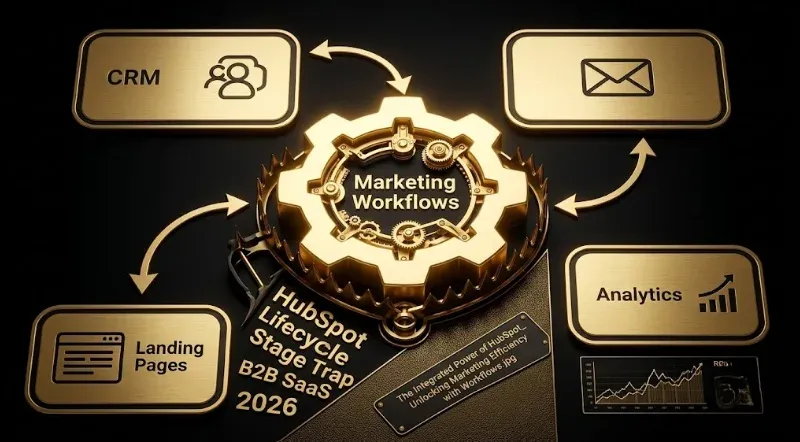
HubSpot’s default lifecycle stages — Subscriber, Lead, MQL, SQL, Opportunity, Customer, Evangelist — are the most pervasive B2B SaaS pipeline framework in 2026 and one of the most quietly destructive. The default stages were designed for a 2015-era inbound buying motion in which individual contacts moved linearly through awareness, consideration, and decision. The 2026 B2B SaaS buying motion is none of those things — it is committee-based, non-linear, dark-funnel-heavy, and account-level rather than contact-level. The trap: most B2B SaaS marketing functions adopt HubSpot defaults during onboarding and never revisit them, producing six structural failures that mislead pipeline operations. (1) The ‘Lead’ stage aggregates newsletter subscribers with demo requesters into the same bucket; (2) MQL transitions happen via behavioral score thresholds that no longer correlate with buying readiness; (3) the SQL-Opportunity gap conflates sales acceptance with opportunity creation; (4) Customer-Evangelist transitions are theoretical and rarely operational; (5) lifecycle stages live at the contact level when buying happens at the account level; (6) default automations cascade misleading stage progression into reporting that downstream systems trust. The replacement: an account-level + contact-level dual lifecycle that aligns with the Buyer Signal Stack model — accounts move through Surface, Active, Committee-Engaged, Opportunity, Customer, Expansion-Active, Advocate while contacts move through Anonymous, Identified, Engaged, Champion, Decision-Maker. This guide details the 6 structural failures of HubSpot default stages, the dual lifecycle model, the 90-day migration plan, and the seven mistakes companies make when redesigning lifecycle stages.
By Ishan Manchanda, Co-Founder of GrowthSpree — a B2B SaaS marketing agency working with 75+ SaaS companies on demand generation, ABM, and RevOps. Updated June 2026.
Why HubSpot’s default lifecycle stages became the dominant B2B SaaS pipeline framework
HubSpot’s seven default lifecycle stages — Subscriber, Lead, Marketing Qualified Lead, Sales Qualified Lead, Opportunity, Customer, Evangelist — became the de facto B2B SaaS pipeline framework for legitimate reasons. They were designed in the inbound marketing era to mirror how an individual buyer progressed through awareness, consideration, and decision. They came preconfigured. They were documented in HubSpot Academy, modeled in default reports, and assumed by HubSpot integrations. Onboarding consultants installed them. Marketing operations teams inherited them. Most B2B SaaS companies adopted them by default and never revisited the choice.
The framework worked reasonably well in 2015. It assumed: (1) the buyer is an individual, not a committee; (2) the buying journey moves linearly from low intent to high intent; (3) marketing qualification can be measured through behavioral scoring of one contact; (4) the handoff from marketing to sales happens at a discrete moment (the MQL-to-SQL transition); (5) customer status begins at contract signature and ends only when the customer becomes an evangelist. None of those assumptions match how B2B SaaS buying happens in 2026.
The trap is the gap between the framework’s invisibility (it is just ‘how lifecycle works’) and its actual incorrectness. Most B2B SaaS operators do not consciously think about whether the default stages match their business — they accept the stages as a given and design downstream operations around them. The downstream operations then propagate the framework’s distortions into reporting, automation, sales-marketing SLAs, and board narratives.
The 6 structural ways HubSpot’s default lifecycle stages mislead B2B SaaS operations
Failure 1: The ‘Lead’ stage aggregates radically different intents into one bucket
In HubSpot’s default model, anyone who submits any form becomes a ‘Lead.’ This includes: newsletter subscribers, ebook downloaders, webinar registrants, pricing page form-fillers, and demo requesters. These are not the same kind of contact. A newsletter subscriber and a demo requester differ by 50-100x in close probability, and yet both occupy the ‘Lead’ stage simultaneously in default HubSpot.
The downstream consequence: ‘Lead volume’ reported to executives represents an unstable aggregate. Two companies with 1,000 Leads can have wildly different pipeline impact depending on what kind of Leads dominate. Reporting Lead volume without categorical breakdown produces misleading dashboards.
Failure 2: MQL transitions happen via behavioral score thresholds that no longer correlate with buying readiness
Default HubSpot MQL transitions happen when a contact’s behavioral score crosses a threshold — typically 50, 60, or 75 points. The score aggregates page views, email opens, form fills, and content downloads. This was a defensible heuristic in 2015 when buyer journeys were predominantly first-party trackable. In 2026, with 50-70% of buyer education happening in the dark funnel, behavioral score is a weak signal of buying readiness.
The result: MQL volume can be high while SQL conversion is low; companies hit MQL targets and miss pipeline targets. The MQL stage becomes operational theater — a number marketing reports that does not correlate with the number sales needs.
Failure 3: The SQL-Opportunity gap conflates sales acceptance with opportunity creation
In HubSpot’s default model, SQL means ‘sales has accepted this lead’ and Opportunity means ‘a deal record has been created.’ These are different operational events that often happen weeks apart. A lead can be SQL for 14-28 days before becoming an Opportunity if the sales rep is in discovery. The SQL-to-Opportunity gap is rarely reported, but the gap reveals where leads stall.
Worse: many sales teams skip SQL and create Opportunities directly from MQLs, leaving the SQL stage as a phantom layer in reporting. Or sales teams mark SQL and Opportunity simultaneously, collapsing what should be a 14-28 day operational distinction into a single timestamp that loses diagnostic value.
Failure 4: Customer-to-Evangelist transitions are theoretical and rarely operational
The Customer-to-Evangelist transition assumes a customer who is sufficiently engaged becomes an active advocate — willing to provide case studies, references, reviews, and word-of-mouth recommendations. In default HubSpot, this transition is rarely automated and even more rarely manually managed. The Evangelist stage often sits at 0% of customer base in reports.
The cost: companies miss meaningful customer marketing motions because the framework does not surface advocate-readiness signals. Expansion revenue, reference availability, and case study production all benefit from explicit advocate identification — but the default stage that should track this lies dormant.
Failure 5: Lifecycle stages live at the contact level when buying happens at the account level
HubSpot’s default lifecycle is a contact property. Each contact at an account has their own lifecycle stage. In a B2B SaaS deal with a 7-person buying committee, the same account might have one contact at ‘Opportunity,’ three at ‘MQL,’ two at ‘Lead,’ and one at ‘Subscriber.’ What is the account’s lifecycle stage? Default HubSpot does not answer this — and most reporting that aggregates ‘MQLs’ or ‘Opportunities’ counts the contact, not the account, producing misleading volume metrics.
Failure 6: Default automations cascade misleading stage progression into downstream reporting
HubSpot ships with default workflows that automatically advance lifecycle stages based on triggers (e.g., ‘become an MQL when score crosses 75’). Once installed, these workflows run silently — and most B2B SaaS marketing operators never audit them. The result: stage progressions happen for reasons that do not reflect actual buyer behavior, and downstream systems (Salesforce sync, reporting dashboards, ABM platforms, attribution tools) trust the stages as ground truth.
The replacement: an account-level + contact-level dual lifecycle for B2B SaaS
The honest replacement separates the lifecycle into two parallel tracks. The account-level lifecycle tracks the buying entity through its journey from anonymous interest to active customer to advocate. The contact-level lifecycle tracks individual stakeholder roles within the account. The two tracks combine to produce reporting that reflects how B2B SaaS buying actually works in 2026.
The account-level lifecycle (7 stages)
| Account Stage | Definition | Transition Criteria (in) | Transition Criteria (out) |
|---|---|---|---|
| 1. Anonymous | Account exists in TAM data; no identified engagement yet | Account matches ICP firmographic criteria; not yet in CRM | First identified contact engagement |
| 2. Surface | Account has any identified engagement or shows intent signal | 1+ identified contact engagement OR intent platform signal (Layer 1) | Multi-stakeholder engagement OR sustained intent |
| 3. Active | Account showing sustained engagement; intent + initial contact engagement | Layer 1 (intent + ICP fit) sustained 14+ days OR 1-2 contacts engaging consistently | Buying committee signals emerge |
| 4. Committee-Engaged | Multiple stakeholders from the account engaging; clear buying committee evidence | 3+ unique contacts engaging in 30 days with Director-level+ included (Layer 2) | Opportunity created in CRM |
| 5. Opportunity | Active sales pursuit with documented opportunity record | Sales has created an opportunity record with stage 2+ qualification | Opportunity closes won or lost |
| 6. Customer | Closed-won; in onboarding or active product use | Opportunity closed won; contract signed | Material product engagement drop OR contract approaches renewal |
| 7. Expansion-Active | Customer demonstrating expansion signals; multi-product or seat-expansion potential | NRR > 110% trajectory OR product expansion signal OR multiple user growth | Expansion completed; revert to Customer |
| 8. Advocate | Customer providing references, case studies, reviews, or referrals | Documented advocate behavior in CRM (reference call, case study published, review submitted) | Advocate behavior dormant for 12 months OR churn |
The contact-level lifecycle (5 stages)
| Contact Stage | Definition | Transition Criteria (in) | Role in Account Lifecycle |
|---|---|---|---|
| 1. Anonymous | Visitor on website not yet identified | Web traffic + cookie + identity resolution producing account but no contact record | Feeds account ‘Surface’ identification when matched |
| 2. Identified | Contact has submitted any form OR been added to CRM through enrichment | Form submission OR data enrichment matching CRM contact | Initial signal for account-level surface or active stages |
| 3. Engaged | Contact has shown sustained engagement beyond initial submission | 3+ behavioral events in 30 days (page views, content opens, ad clicks, demo views) | Signal of contact-level interest within the account |
| 4. Champion | Contact has self-identified as a buyer or champion (multiple engagement events including high-intent actions) | Demo request OR pricing page form OR sales call with stated need | Triggers account to Active or Committee-Engaged based on stakeholder count |
| 5. Decision-Maker | Contact identified as decision-maker through sales discovery | Sales confirms decision-making authority via discovery call notes structured field | Senior-title contact required for Committee-Engaged account threshold |
How the dual lifecycle solves what the HubSpot defaults fail
| HubSpot Default Failure | How Dual Lifecycle Fixes It | Operational Improvement |
|---|---|---|
| ’Lead’ aggregates radically different intents | Contact-level stages separate Identified, Engaged, Champion, Decision-Maker | Reporting on ‘engaged contacts’ shows meaningful intent variation |
| MQL behavioral threshold no longer correlates with buying | Account-level transitions use Buyer Signal Stack — not single behavioral score | Committee-Engaged stage correlates with close probability 2-3x baseline |
| SQL-Opportunity gap conflated | Eliminated — Committee-Engaged is the account stage, Opportunity is the deal record; no phantom SQL layer | Pipeline reporting reflects actual sales motion |
| Customer-Evangelist transition dormant | Advocate is an explicit, criteria-defined account stage with documented activity triggers | Customer marketing motion has clear target list |
| Contact-level when buying is account-level | Account lifecycle IS the primary lifecycle; contact lifecycle is secondary tracking | Reporting reflects how buying actually works |
| Default automations cascade misleading progression | Account stage transitions are auditable, criteria-based, and reviewed quarterly | Reporting integrity restored |
The 90-day plan to migrate from HubSpot defaults to the dual lifecycle
-
Days 1-15 — Audit current lifecycle. Document all current lifecycle stages, transition automations, dependent reports, dependent integrations (Salesforce sync, ABM platforms, attribution tools). Identify the systems that will break when stage names or transition logic change.
-
Days 16-30 — Design account-level + contact-level stages with sales-marketing alignment. Stages must be co-signed by VP Marketing and VP Sales. Document transition criteria for each stage including thresholds, automations, and manual override paths. Get CEO sign-off on the design.
-
Days 31-60 — Configure HubSpot. Create new contact-level custom properties for the 5 contact stages. Create custom account-level properties (Companies object in HubSpot) for the 8 account stages. Configure transition workflows. Sync to Salesforce if applicable. Test on a sample of accounts.
-
Days 61-75 — Parallel run. Run new lifecycle alongside legacy lifecycle for 2 weeks. Compare daily for accounts where the new framework produces materially different stage assignments. Adjust transition criteria where the new framework appears wrong.
-
Days 76-90 — Cutover. Switch primary reporting to new lifecycle. Retire default HubSpot stages from primary dashboards (keep them as legacy fields for 90 days to reconcile reporting trends). Train sales and marketing teams on new framework. First Friday pipeline review with new lifecycle marks completion.
The 7 mistakes companies make when redesigning lifecycle stages
-
Mistake 1: Renaming default stages without changing transition logic. Calling ‘MQL’ ‘Marketing Engaged’ produces no operational improvement — the stage transitions still happen via the same behavioral score threshold. The change must include redesigned transition criteria, not just cosmetic relabeling.
-
Mistake 2: Designing the new framework in marketing isolation. Lifecycle stages are the contract between marketing and sales. Designs that emerge from marketing alone produce frameworks sales will not adopt. Co-design with the VP Sales is mandatory.
-
Mistake 3: Skipping the account-level lifecycle in favor of just renaming contact-level stages. The biggest structural failure of HubSpot defaults is the contact-level framing of an account-level buying motion. Solutions that stay at the contact level only partially solve the problem.
-
Mistake 4: Cutting over without parallel running. Cutover-only migrations break dashboards, alerting, and integrations the moment they happen. The 2-week parallel run is the most common compressed phase in the 90-day plan — and the most expensive to skip.
-
Mistake 5: Not retiring the legacy framework after cutover. Companies that keep both frameworks live indefinitely produce dual reporting that everyone references inconsistently. The legacy framework must be retired from primary dashboards within 90 days of cutover.
-
Mistake 6: Designing too many stages. The dual lifecycle has 8 account + 5 contact stages = 13 total. Some operators try to add 4-6 sub-stages within Committee-Engaged or Opportunity. This produces over-engineered stage flow that no one references. Resist sub-stages — use stage + opportunity stage instead.
-
Mistake 7: No advocate stage activation post-migration. The Advocate stage is the most-skipped operational change because it requires customer marketing motion that did not exist before. Activate the Advocate stage with documented criteria and a customer marketing playbook, not just a property field.
How specialist B2B SaaS partners support lifecycle redesign vs the industry standard
| Capability | Industry Standard Agency | GrowthSpree (Specialist B2B SaaS) |
|---|---|---|
| Lifecycle redesign experience | Tactical HubSpot configuration | Account-level + contact-level dual lifecycle design from pattern recognition across 75+ B2B SaaS clients |
| Sales-marketing alignment facilitation | Not offered | Co-design facilitation with VP Sales; SLA renegotiation included |
| HubSpot configuration depth | Workflows + properties only | Custom Company object stages + sync to Salesforce + integration with attribution and ABM tools |
| Parallel running support | Not offered | 2-week parallel run with daily reconciliation reporting |
| Migration risk management | Not addressed | Pre-migration audit of dependent dashboards, reports, integrations |
| Pricing model | Percentage of ad spend or $8K-$25K monthly retainer | $3,000/month flat — lifecycle redesign included in onboarding for new clients |
Key takeaways: the HubSpot lifecycle stage trap
-
HubSpot’s default lifecycle stages (Subscriber, Lead, MQL, SQL, Opportunity, Customer, Evangelist) were designed for 2015-era inbound buying and do not match 2026 B2B SaaS buying motions.
-
Six structural failures: ‘Lead’ aggregates radically different intents; MQL behavioral threshold no longer correlates with buying; SQL-Opportunity gap is conflated; Customer-Evangelist transitions are theoretical; lifecycle lives at contact level when buying is account-level; default automations cascade misleading progression.
-
The replacement: an account-level + contact-level dual lifecycle. Account stages (8): Anonymous, Surface, Active, Committee-Engaged, Opportunity, Customer, Expansion-Active, Advocate. Contact stages (5): Anonymous, Identified, Engaged, Champion, Decision-Maker.
-
Account lifecycle is the primary; contact lifecycle is secondary. Reporting on accounts (not just contacts) reflects how B2B SaaS buying actually works.
-
90-day migration: days 1-15 audit, days 16-30 design with sales co-sign, days 31-60 configure, days 61-75 parallel run, days 76-90 cutover.
-
Seven mistakes: rename without changing transition logic, marketing-isolated design, skipping account-level redesign, cutover without parallel run, not retiring legacy framework, too many stages, no advocate stage activation.
-
Lifecycle redesign is one of the highest-leverage RevOps projects at $5-25M ARR B2B SaaS companies — and one of the most-deferred because it requires sales-marketing renegotiation, CRM reconfiguration, and integration updates.
Redesigning your lifecycle stages?
If you’re considering migrating off HubSpot default lifecycle stages and want a second opinion on the account-level vs contact-level split, transition automations, or rollout sequence, book a free 30-minute strategy call here. No pitch — just operator-to-operator review.
Related reading from GrowthSpree
• MQL Dead B2B SaaS 2026 Pipeline Metrics That Matter
• B2B SaaS Pipeline Coverage Ratio Benchmarks 2026 By Stage ACV Win Rate Quarter Start
• How To Connect Ad Spend To Revenue B2B SaaS Attribution Guide
• RevOps HubSpot B2B SaaS Complete Guide
• B2B SaaS MQL Scoring Threshold Benchmarks 2026
• MQL-to-SQL Conversion Rate Benchmarks B2B SaaS 2026
• Account Based Marketing Ai Agents Execution 2026
• HubSpot Lead Scoring Connected to Google Ads + LinkedIn Ads
Frequently asked questions
Why do HubSpot default lifecycle stages fail B2B SaaS in 2026?
Six structural failures make HubSpot default lifecycle stages misleading for B2B SaaS in 2026. (1) The ‘Lead’ stage aggregates newsletter subscribers with demo requesters — radically different intents with 50-100x close probability gap occupying the same bucket. (2) MQL transitions happen via behavioral score thresholds (typically 50-75 points) that no longer correlate with buying readiness in committee-based, dark-funnel-heavy 2026 buying. (3) The SQL-Opportunity gap conflates sales acceptance with opportunity creation; many sales teams skip SQL entirely or mark SQL and Opportunity simultaneously, collapsing meaningful operational distinction. (4) Customer-Evangelist transitions are theoretical and rarely operational; the Evangelist stage often sits at 0% of customer base. (5) Lifecycle stages live at the contact level when buying happens at the account level — a 7-person committee produces contacts spread across multiple lifecycle stages with no clear account-level state. (6) Default automations cascade misleading stage progression into downstream reporting most operators never audit.
What should B2B SaaS use instead of HubSpot default lifecycle stages?
An account-level + contact-level dual lifecycle. The account-level lifecycle has 8 stages: Anonymous (in TAM, not yet engaged), Surface (any identified engagement or intent signal), Active (sustained engagement 14+ days), Committee-Engaged (3+ stakeholders engaging with Director+ included), Opportunity (sales-created deal record), Customer (closed-won), Expansion-Active (expansion signals), Advocate (references, case studies, reviews). The contact-level lifecycle has 5 stages: Anonymous (visitor not identified), Identified (form fill or enrichment), Engaged (3+ behavioral events in 30 days), Champion (demo or pricing form or stated need), Decision-Maker (sales-confirmed buying authority). Account lifecycle is primary; contact lifecycle is secondary tracking. Reporting on accounts (not just contacts) reflects how B2B SaaS buying actually works in 2026.
Why is the ‘Lead’ stage in HubSpot misleading for B2B SaaS?
The ‘Lead’ stage in HubSpot aggregates anyone who submits any form into a single bucket — newsletter subscribers, ebook downloaders, webinar registrants, pricing page form-fillers, and demo requesters all become ‘Leads’ simultaneously. These are not the same kind of contact. A newsletter subscriber and a demo requester differ in close probability by 50-100x, but they occupy the same lifecycle stage in default HubSpot. The downstream consequence: ‘Lead volume’ reported to executives represents an unstable aggregate. Two B2B SaaS companies with 1,000 Leads each can have wildly different pipeline impact depending on what kind of Leads dominate the count. The dual lifecycle replacement separates these distinctions by moving low-intent contacts (newsletter subscribers, ebook downloaders) to Identified and high-intent contacts (demo requesters, pricing form-fillers) to Champion.
Should B2B SaaS lifecycle stages live at the contact level or account level?
Both — but the account level is primary in B2B SaaS, not the contact level. HubSpot’s default lifecycle treats lifecycle stage as a contact property, which made sense in 2015 when individual contacts were treated as roughly equivalent to buying entities. In 2026 B2B SaaS, buying is committee-based: 6-12 stakeholders from the same account collectively make the decision. The account is the buying entity. The contact is a stakeholder within the buying entity. The dual lifecycle places the primary lifecycle at the account level (using HubSpot’s Companies object) tracking how the buying entity progresses through Anonymous, Surface, Active, Committee-Engaged, Opportunity, Customer, Expansion-Active, Advocate. The contact lifecycle is secondary tracking that maps individual stakeholder roles within the account (Anonymous, Identified, Engaged, Champion, Decision-Maker).
How should B2B SaaS migrate from HubSpot default lifecycle stages?
A 90-day phased migration. Days 1-15: Audit current lifecycle by documenting all stages, transition automations, dependent reports, and dependent integrations (Salesforce sync, ABM platforms, attribution tools) — identify systems that will break when stage names or transition logic change. Days 16-30: Design account-level + contact-level stages with VP Marketing + VP Sales co-sign + CEO approval. Document transition criteria including thresholds, automations, and manual override paths. Days 31-60: Configure HubSpot — create custom contact properties for 5 contact stages, custom Company properties for 8 account stages, configure transition workflows, sync to Salesforce if applicable. Days 61-75: Parallel run alongside legacy lifecycle for 2 weeks with daily reconciliation. Days 76-90: Cutover — switch primary reporting to new lifecycle, retire default HubSpot stages from primary dashboards, train teams, first Friday pipeline review with new lifecycle marks completion.
What is the Committee-Engaged stage in the B2B SaaS account lifecycle?
Committee-Engaged is the critical account-level stage that replaces both MQL and SQL from the HubSpot default lifecycle. Transition criteria: 3+ unique contacts from the account engaging within a 30-day window, with at least one Director-level or above. This corresponds to Layer 2 of the Buyer Signal Stack — buying committee signals. The stage exists because B2B SaaS buying decisions are made by committees of 6-12 stakeholders, not individuals. An account with one heavily engaged contact is structurally different from an account with three or more engaged stakeholders representing the buying committee. Committee-Engaged accounts close at 2-3x baseline rates because the buying motion is visible in the data. Opportunities created from Committee-Engaged accounts have higher win rates than opportunities created from accounts that skipped this stage. The transition from Committee-Engaged to Opportunity is the cleanest operational handoff between marketing and sales in the dual lifecycle.
What is the biggest mistake B2B SaaS companies make when redesigning lifecycle stages?
The most common mistake is renaming HubSpot default stages without changing the underlying transition logic. Calling ‘MQL’ ‘Marketing Engaged’ produces no operational improvement — the stage transitions still happen via the same behavioral score threshold; the same misleading aggregation persists under a different name. The change must include redesigned transition criteria, not cosmetic relabeling. Other major mistakes: designing the new framework in marketing isolation without VP Sales co-sign (lifecycle is the contract between marketing and sales; sales-isolated designs are not adopted), skipping the account-level redesign in favor of just renaming contact-level stages (misses the biggest structural failure), cutting over without 2-week parallel run (breaks dashboards and integrations), not retiring legacy framework within 90 days (dual reporting creates ongoing inconsistency), designing too many sub-stages (over-engineered flow no one references), and not activating the Advocate stage with a customer marketing playbook (skipped because it requires motion that did not exist before).
Are HubSpot lifecycle stages compatible with the Buyer Signal Stack model?
Default HubSpot lifecycle stages are not compatible with the Buyer Signal Stack model — the structural assumptions conflict. Default stages assume individual-contact behavioral progression; the Buyer Signal Stack assumes account-level, multi-layer signal triangulation. The dual lifecycle replacement explicitly aligns with the Buyer Signal Stack: account stages map to signal stack layers (Surface corresponds to Layer 1 account intent, Committee-Engaged corresponds to Layer 2 buying committee signals, Champion contact stage corresponds to Layer 4 self-reported context). Companies migrating to the Buyer Signal Stack model typically need to redesign lifecycle stages as part of the same migration — operating signal stack routing on top of default HubSpot lifecycle stages produces internal contradictions that surface as reporting inconsistencies and sales-marketing friction within 60 days. The two migrations (Buyer Signal Stack + dual lifecycle) should be treated as a single integrated RevOps redesign rather than sequential projects.