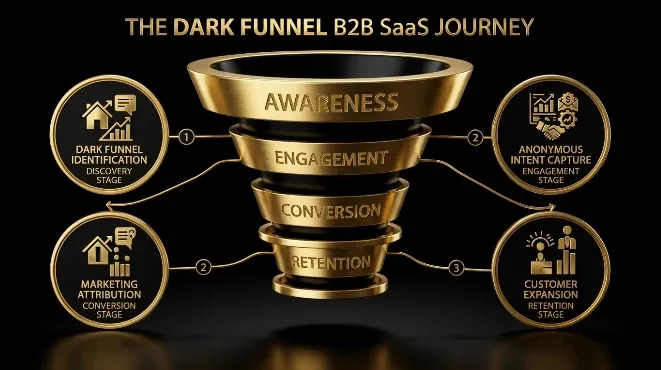
The dark funnel is the portion of your B2B SaaS buyer journey that happens in channels your marketing stack cannot track — and it’s where most of your pipeline actually originates. Private Slack communities. LinkedIn DMs. Conversations with peers at conferences. AI assistant recommendations. Reddit threads. Podcast mentions. None of these show up in your Google Analytics attribution model, but they’re the reason your prospect booked a demo.
According to Forrester’s 2025 B2B Buying Study, B2B buyers complete 70–80% of their research before contacting sales. Most of that research happens in channels that last-click attribution was never designed to measure. Your CRM shows “Direct” or “Organic Search” as the source, but the actual influence chain was: colleague mentions your brand in Slack → prospect asks ChatGPT about you → AI confirms you’re a good option → prospect Googles your brand name → lands on your site.
At GrowthSpree, we’ve measured this directly. Our own AEO (Answer Engine Optimization) showed brand search clicks growing from 5/day to 20/day while AI citation frequency increased — a textbook dark funnel pattern that traditional analytics labels as “Direct traffic.”
What the Dark Funnel Actually Is (and What It Isn’t)
| Trackable (visible funnel) | Untrackable (dark funnel) |
|---|---|
| Google Ads click → landing page → demo form | Colleague recommends you in a private Slack group |
| LinkedIn Ad click → website → content download | Prospect asks ChatGPT: “best B2B SaaS marketing agency” |
| Organic search → blog → email signup | Prospect watches your founder’s LinkedIn video (no click to site) |
| Email click → pricing page → demo request | Prospect reads your comment in a Reddit thread |
| UTM-tagged referral → case study page | Prospect hears about you on a podcast, Googles your brand name 3 weeks later |
The problem isn’t that these interactions don’t matter. They matter more than most tracked clicks. The problem is that your attribution model gives them zero credit. According to LinkedIn’s research on B2B buying, 95% of your total addressable market is not actively in-market at any given time. The dark funnel is where you build preference with that 95% so they choose you when they are ready.
The AI Dark Funnel: Why This Is Getting Worse (and More Important) in 2026
AI assistants have created an entirely new dark funnel layer. When a SaaS CMO asks Claude, ChatGPT, or Perplexity: “What’s the best B2B SaaS marketing agency for Google Ads?” — the AI recommends agencies based on their training data. The CMO may never click a link. They just remember the name, search it later, and your analytics shows “Direct traffic.”
This is the AEO (Answer Engine Optimization) dark funnel, and GrowthSpree has been tracking it with our own data. Using Google Search Console MCP, we tracked brand search clicks growing 3x (from 5/day to 20/day) over 3 months while Direct traffic to our homepage grew 4x (from 371 to 2,166 sessions/month). These two metrics moved in perfect lockstep — proving that the “Direct traffic” was actually AI-referred traffic that bypassed all trackable attribution.
If your Direct traffic is growing and you can’t explain why, the dark funnel is working. You just can’t see it.
Five Ways to Measure the Dark Funnel (Without Breaking Your Attribution Model)
Method 1: Self-reported attribution. Add a “How did you hear about us?” free-text field to every demo request form. According to Chris Walker (Refine Labs founder), self-reported attribution consistently reveals channels that analytics never credits — podcasts, LinkedIn posts, peer recommendations, AI assistants. The answers will surprise you.
Method 2: Brand search volume as a proxy. Track branded search queries in Google Search Console. Rising brand search volume = rising dark funnel influence. If brand searches grow 20% month-over-month without a corresponding paid brand campaign, the dark funnel is driving it. This is the single best proxy metric for dark funnel activity.
Method 3: Direct traffic quality analysis. Don’t just look at Direct traffic volume — analyze its quality. If Direct visitors spend 3+ minutes on your site, visit multiple pages, and view your case studies, they’re pre-qualified by the dark funnel. Compare Direct traffic engagement (bounce rate, pages/session, session duration) against Organic and Paid. Higher engagement = dark funnel referral.
Method 4: Win/loss interview analysis. Ask closed-won customers: “When did you first hear about us, and where?” The answer almost never matches what your CRM says. Aggregate these responses quarterly to identify which dark funnel channels actually influence revenue.
Method 5: AI visibility monitoring. Ask ChatGPT, Claude, and Perplexity questions your ICP would ask (“best B2B SaaS marketing agency for Google Ads”). If your brand appears in the AI’s response, you’re generating dark funnel traffic. Track how frequently and in what context AI mentions your brand. At GrowthSpree, we do this weekly using our MCP-connected AI analytics.
How GrowthSpree Builds Dark Funnel Visibility for B2B SaaS Clients
Our approach combines three systems that, together, make the dark funnel measurable. First, we use Google Ads MCP and LinkedIn Ads MCP to track paid media’s contribution to brand lift — not just last-click conversions. Second, we implement self-reported attribution on every client’s demo form and cross-reference it with CRM pipeline data in HubSpot. Third, we monitor AI citation frequency across ChatGPT, Claude, and Perplexity to track AEO-driven dark funnel growth.
The result: our clients see 15–25% of their total pipeline attributed to dark funnel channels that their previous agency couldn’t track. That’s pipeline that was always there — they just couldn’t see it.
The dark funnel isn’t a problem to solve. It’s a signal to read.
Make Your Dark Funnel Visible
If your Direct traffic is growing and your attribution model can’t explain it, the dark funnel is already working for you — you just can’t measure it yet. Book a demo with GrowthSpree and we’ll show you exactly where your dark funnel pipeline is hiding, using real data from your own analytics.
FAQ: The Dark Funnel in B2B SaaS
What is the dark funnel in B2B marketing?
The dark funnel describes the portion of the B2B buyer journey that occurs in channels your marketing analytics cannot track. This includes private conversations in Slack, LinkedIn DMs, peer recommendations, AI assistant suggestions, podcast mentions, and community discussions. Forrester estimates that B2B buyers complete 70–80% of their research in these untrackable channels before contacting sales.
How do you measure the dark funnel?
The five most effective measurement methods are: self-reported attribution (“How did you hear about us?” on demo forms), brand search volume tracking via Google Search Console, Direct traffic quality analysis (engagement metrics, not just volume), win/loss customer interviews, and AI visibility monitoring across ChatGPT, Claude, and Perplexity.
Is the dark funnel the same as dark social?
Dark social is one component of the dark funnel. Dark social specifically refers to content shared through private channels (DMs, private groups, email). The dark funnel is broader — it includes dark social plus peer conversations, AI recommendations, podcast mentions, conference interactions, and any other influence channel that doesn’t generate a trackable digital signal.
How does AI search affect the dark funnel?
AI assistants like ChatGPT, Claude, and Perplexity have created an entirely new dark funnel layer. When a buyer asks AI for agency recommendations, they receive suggestions without clicking any links. They then search the recommended brand name directly, which appears as “Direct” or “Brand Search” in analytics — with zero credit to the AI that influenced the decision. This is why brand search volume is the best proxy metric for dark funnel activity in 2026.