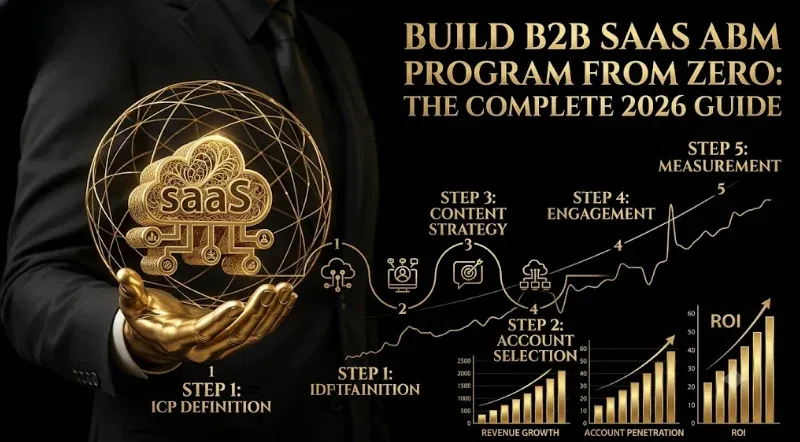
Most B2B SaaS companies under $25M ARR can build an effective ABM program from zero in 90 days using HubSpot + LinkedIn Matched Audiences + Bombora intent data, without buying a dedicated ABM platform that costs $50K-$250K annually. The structural mistake B2B SaaS companies make when building ABM is buying the platform first (6sense, Demandbase, RollWorks, Terminus, Mutiny) and then asking ‘what should we do with this?’ The platform answers no strategic questions on its own — it provides infrastructure for executing a motion that must be designed separately. The honest build sequence is the inverse: design the 4-tier motion first (1:1 Strategic + 1:Few Cluster + 1:Many Signal-Triggered + Expansion), build it on available infrastructure (HubSpot Companies object + LinkedIn Matched Audiences + Bombora or G2 Intent + Clearbit/ZoomInfo enrichment), embed sales coordination from day one, and only evaluate a dedicated ABM platform investment after the motion has been running for 6-12 months and the company has identified specific capabilities the existing infrastructure cannot deliver. This playbook details the 90-day build sequence from zero-state to operational ABM motion, the no-platform tech stack ($300-$2,000 monthly vs $50K-$250K annual platform cost), account selection methodology, the 4-tier treatment structure, sales coordination design, account-specific content brief production, signal triggering wiring, and outcome measurement framework. Includes the seven mistakes B2B SaaS companies make when building ABM from zero — the most common being target list size too large for the team to serve, which produces spray-and-pray ABM regardless of platform.
By Ishan Manchanda, Co-Founder of GrowthSpree — a B2B SaaS marketing agency working with 75+ SaaS companies on demand generation, ABM, and RevOps. Updated June 2026.
Why build ABM signal-led without a dedicated platform
The dedicated ABM platform category (6sense, Demandbase, RollWorks, Terminus, Mutiny) costs $50K-$250K annually depending on the company size and platform tier. The platforms provide centralized account engagement reporting, multi-channel orchestration, signal-triggered automation, and account-level reporting. These capabilities are valuable at scale — but most B2B SaaS companies under $25M ARR build ABM motions with 100-300 named accounts that can be effectively executed using HubSpot + LinkedIn Matched Audiences + Bombora or G2 Intent + Clearbit/ZoomInfo enrichment at $300-$2,000 monthly all-in.
The platform-first mistake is the most expensive ABM error at most B2B SaaS companies. Buying 6sense or Demandbase at $80K+ annual cost before the ABM motion is designed produces a platform looking for a use case. Companies that buy platforms first typically use 10-25% of platform capability while paying full license cost, and end up with the same ungoverned ABM motion they had before the platform, with more dashboards. Reverse the order: design the motion first, build it on available infrastructure, evaluate a dedicated platform only when the motion exceeds what existing infrastructure can support.
The other reason to build signal-led without a platform: the 4-tier ABM motion structure does not require platform capability that HubSpot does not natively provide. The Companies object in HubSpot supports account-level properties, account-level engagement scoring, account-level workflows, and account-level reporting. LinkedIn Matched Audiences supports company-list-based targeting. Bombora or G2 Intent provides intent signals via API or CSV. Clearbit or ZoomInfo provides firmographic enrichment. The pieces add up to a functional ABM stack at modest cost.
The no-platform tech stack for B2B SaaS ABM in 2026
| Component | Tool Recommendation | Monthly Cost (B2B SaaS Series A-B) | Purpose |
|---|---|---|---|
| CRM + account-level data model | HubSpot Marketing Hub Pro or Enterprise (Companies object) | $800-$3,600/month depending on contact volume | Account-level properties, workflows, lifecycle stages, account engagement reporting |
| Intent data (Layer 1 signals) | Bombora Company Surge OR G2 Intent OR 6sense Intent (entry tier without full platform) | $1,000-$3,500/month | Account-level intent surge signals for ICP-fit account selection |
| Firmographic enrichment | Clearbit, ZoomInfo, or Apollo | $200-$800/month at this scale | Populate firmographic data from email + company name; enable account scoring |
| Paid channel targeting (LinkedIn) | LinkedIn Ads + Matched Audiences (company lists + retargeting + intent-augmented audiences) | Variable spend; tool itself is free with LinkedIn Ads account | Account-list-based ad targeting |
| Outbound sequencing | Outreach, Salesloft, or Apollo Sequences | $50-$200/seat/month | LinkedIn + email outbound execution coordinated with marketing |
| Account engagement reporting | Built in HubSpot Companies + custom dashboards | Included in HubSpot license | Account engagement view aggregating contact engagement, intent signals, ad exposure |
| Total monthly cost | All components combined | $2,050-$8,100/month ($25K-$100K annually) | All-in vs $50K-$250K dedicated ABM platform |
The no-platform stack delivers the 80% of ABM capability that most B2B SaaS companies under $25M ARR actually need. The remaining 20% (cross-channel orchestration automation, advanced account engagement scoring, programmatic display network targeting at scale) becomes relevant at Series B+ or with 300+ named accounts.
Phase 1 (Days 1-30): Design the ABM motion
Step 1: Define ICP with explicit intent and committee criteria
-
Firmographic criteria: company size + industry + geography + tech stack (clear ICP definition is foundational; without it, all subsequent ABM execution targets the wrong accounts).
-
Intent criteria: Bombora surge OR 6sense buying stage above Awareness OR G2 Intent score above ICP threshold (Layer 1 of the Buyer Signal Stack).
-
Committee criteria: target accounts where 3+ relevant personas exist (avoiding accounts where only 1 person matches buying persona — those rarely produce close-won deals in committee-based B2B SaaS buying).
-
Exclusion list: competitors, existing customers (separate Expansion ABM motion), failed previous outreach within last 6 months, geographies not yet serviceable.
Step 2: Design the 4-tier ABM motion
-
Tier 1 1:1 Strategic ABM: 10-50 named accounts; account-specific content briefs (1-2 pages per account); dedicated AE + ABM Lead; executive-sponsor outreach; custom landing pages; custom case studies. Channels: LinkedIn 1:1 + sales-led email + executive briefings + custom content + paid retargeting.
-
Tier 2 1:Few Cluster ABM: 50-200 named accounts in 5-15 clusters; cluster-specific content briefs (per industry, segment, or use case); shared playbook within cluster. Channels: LinkedIn cluster targeting + sales-coordinated email + cluster-specific content + paid retargeting.
-
Tier 3 1:Many Signal-Triggered ABM: 200-500 named accounts; generic content delivered when signal triggers fire (intent surge, committee engagement, self-reported trigger). Channels: programmatic paid + automated email + LinkedIn retargeting + intent-triggered outreach.
-
Tier 4 Expansion ABM: customer accounts with expansion signals; product-usage-triggered campaigns; customer success coordination; executive-sponsor outreach. Channels: in-product nudges + customer success outreach + executive briefings + LinkedIn.
Step 3: Co-design with sales
-
AE ownership defined per Tier 1 account; AE participates in account selection and signs off on content brief.
-
Cluster ownership defined per Tier 2 cluster; AE pod owns 1-3 clusters with shared playbook.
-
Signal-triggered handoff defined for Tier 3 — when signal fires, AE receives alert + recommended outreach within 24 hours.
-
Sales-marketing SLA documented covering ABM execution: outreach response time, demo show rate accountability, win-loss reporting commitments.
Phase 2 (Days 31-60): Build the no-platform stack
Step 4: Configure HubSpot Companies object for ABM
-
Custom Company properties: ABM Tier (1/2/3/4), ABM Cluster (free text for cluster assignment), AE Owner, ABM Lead Owner, Account Engagement Score (calculated from contact engagement rollup), Intent Status (from Bombora/G2 API), Last Signal Date, Disqualifier Flag.
-
Account lifecycle stages: Anonymous → Surface → Active → Committee-Engaged → Opportunity → Customer → Expansion-Active → Advocate (per the dual lifecycle framework in the HubSpot lifecycle stage trap playbook).
-
Workflow automation: contact engagement rolls up to Company; signal fires when account crosses Committee-Engaged threshold; AE alert triggered when Tier 1 or Tier 2 account reaches Active stage.
-
Reporting dashboards: ABM Tier engagement view, account-level pipeline by Tier, opportunity-to-closed-won by Tier, ACV uplift on named accounts vs control.
Step 5: Wire intent data into HubSpot
-
Bombora: API integration into HubSpot via Operations Hub Pro or third-party connector (e.g., Tray.io). Daily sync of company-level surge signals into custom HubSpot Company property.
-
Alternative: G2 Intent via CSV upload or Zapier integration; cheaper than Bombora API integration but less real-time.
-
Configure intent threshold: define what level of intent signal triggers Layer 1 ‘Surface’ stage transition; calibrate quarterly against actual close-won data.
Step 6: Wire LinkedIn Matched Audiences for tier-specific targeting
-
Upload Tier 1 named accounts as Company List audience (10-50 accounts). Create dedicated campaign with 1:1-style messaging and custom creative per account if scale allows.
-
Upload Tier 2 cluster lists as separate Company List audiences (one per cluster). Run cluster-specific campaigns with cluster-themed messaging.
-
Configure intent-augmented audiences: LinkedIn’s algorithmic targeting + ABM Tier 3 list + Bombora surge accounts = signal-triggered targeting.
Phase 3 (Days 61-75): Build content + outbound execution
Step 7: Build account-specific content briefs
-
Tier 1 briefs: 1-2 pages per account covering account context (current situation, recent news, leadership), buying questions (likely concerns based on industry + size + tech stack), competitive context (incumbent vendors, alternative solutions), messaging angle, asset list (landing page, case study, executive outreach script).
-
Tier 2 cluster briefs: 1-2 pages per cluster covering cluster characteristics, common buying questions, shared messaging angle, asset list.
-
Tier 3 content library: generic but high-quality assets (case studies, comparison content, ROI calculators) deployed when signal triggers fire.
-
Brief approval: AE signs off on Tier 1 briefs; AE pod signs off on Tier 2 cluster briefs.
Step 8: Launch signal-triggered outbound
-
Tier 1 outbound: AE-led with ABM Lead support; high-touch LinkedIn + email + executive outreach; 6-10 touches over 60-90 days.
-
Tier 2 outbound: AE pod-coordinated; LinkedIn + email cadence with cluster-themed messaging; 5-8 touches over 60-90 days.
-
Tier 3 outbound: BDR-led with automated cadences; LinkedIn + email triggered by signal events; 4-6 touches over 30-45 days.
-
Tier 4 expansion: customer success-led outreach + executive briefings + in-product nudges.
Phase 4 (Days 76-90): Deploy measurement and operating rhythm
Step 9: Deploy ABM-specific measurement
-
Outcome metrics by Tier: pipeline created per named account, opportunity-to-closed-won per named account, ACV uplift on named accounts vs control (matched non-named accounts with similar firmographic profile), expansion revenue from named accounts (for Tier 4).
-
Activity metrics (secondary): accounts reached, accounts engaged, account engagement score trends — useful for diagnosis but not primary reporting.
-
Control group setup: identify 50-100 non-named accounts with similar firmographic profile; track their pipeline contribution and ACV; compare to named accounts to calculate ACV uplift attributable to ABM motion.
Step 10: Establish weekly ABM operating rhythm
-
Weekly ABM standup: ABM Lead + 2-3 senior AEs + marketing rep; review signal-triggered accounts from the week, recent wins/losses, blockers, Tier 1 account-specific updates.
-
Monthly ABM review: CMO + VP Sales + ABM Lead + Demand Gen Director; review tier-level performance, account-level outcomes, content brief effectiveness, channel allocation.
-
Quarterly recalibration: ICP definition refinement, named account list refresh (add accounts showing emerging signals, remove accounts that have gone cold), tier reassignment based on engagement patterns, content brief library audit.
The 7 mistakes B2B SaaS companies make when building ABM from zero
-
Mistake 1: Buying the ABM platform before designing the motion. The platform answers no strategic questions on its own. Design the 4-tier motion first; deploy a dedicated platform only when the motion exceeds what HubSpot + LinkedIn + intent data can support.
-
Mistake 2: Target list larger than the team can serve. List size must be calibrated against per-account attention budget. 1,000 accounts on a 3-person ABM team is spray-and-pray regardless of platform. Most Series A B2B SaaS companies should build with 100-300 named accounts; Series B 200-500.
-
Mistake 3: Firmographic-only account selection without intent filter. Without intent filtering, the list is structurally a TAM database. Apply Bombora or G2 Intent during account selection, not after.
-
Mistake 4: Marketing-only ownership. ABM motion designed in marketing isolation lacks the sales-marketing operating rhythm that produces compound results. The VP Sales is a co-owner from day one; AE ownership per Tier 1 account is non-negotiable.
-
Mistake 5: Generic content distributed through ABM channels. Account-specific or cluster-specific content briefs are the differentiator between ABM and filtered paid acquisition. Skip the brief production and you have filtered paid acquisition labeled as ABM.
-
Mistake 6: Activity-metric measurement only. ‘Accounts reached’ and ‘engagement score’ do not measure ABM outcomes. Pipeline per account, opportunity-to-closed-won per account, and ACV uplift vs control are the outcome metrics. Control group setup is necessary even if it adds operational complexity.
-
Mistake 7: No quarterly recalibration. Account lists go stale within 6 months as accounts move into and out of buying windows. Quarterly recalibration (refresh named accounts, reassign tiers, refresh content briefs) is the maintenance discipline that keeps the motion performant.
When to evaluate a dedicated ABM platform investment
The no-platform stack works well up to a certain scale. Beyond that scale, specific capabilities of dedicated ABM platforms (6sense, Demandbase, RollWorks, Terminus, Mutiny) start producing meaningful incremental value. Evaluate platform investment when 3+ of the following are true:
-
Named account count exceeds 500 across all tiers.
-
ABM team size is 4+ FTEs with specialization across account selection, content production, signal monitoring, and reporting.
-
ABM motion is running in 3+ market segments or geographies that require segment-specific orchestration.
-
Need for cross-channel orchestration automation (programmatic display + LinkedIn + email + outbound + content delivery coordinated programmatically) exceeds what HubSpot workflows can deliver.
-
Need for advanced account engagement scoring with custom weighting that HubSpot calculated properties cannot produce.
-
Sales team requires native CRM-embedded account engagement view (account-level engagement reporting visible directly in Salesforce/HubSpot opportunity record without context-switching to a separate ABM platform).
When 3+ are true, platform investment may produce ROI. When fewer than 3 are true, platform investment typically produces dashboards that look better than the underlying motion improvement.
How specialist B2B SaaS partners support ABM builds from zero vs the industry standard
| Capability | Industry Standard Agency | GrowthSpree (Specialist B2B SaaS) |
|---|---|---|
| ABM motion design | Generic ‘we run ABM’ offering | 4-tier motion design (1:1 + 1:Few + 1:Many + Expansion) from pattern recognition across 75+ B2B SaaS clients |
| Platform-first vs motion-first | Recommends ABM platform purchase upfront | Builds on HubSpot + LinkedIn + intent for first 6-12 months; evaluates platform only when motion exceeds existing infrastructure |
| Account selection methodology | Firmographic filter only | Bombora/6sense intent filter + ICP fit + committee criteria |
| Account-specific content briefs | Generic content distributed through ABM channels | 1-2 page briefs per Tier 1 account or per Tier 2 cluster with AE sign-off |
| Sales co-design | Marketing-only execution | AE ownership per Tier 1 account; sales-marketing SLA renegotiation included |
| Outcome measurement | Accounts reached / engaged dashboards | Pipeline per account, opportunity-to-closed-won per account, ACV uplift vs matched control group |
| Pricing model | Percentage of ad spend or $8K-$25K monthly retainer + ABM platform license | $3,000/month flat — full ABM motion design + execution included |
Key takeaways: how to build a B2B SaaS ABM program from zero
-
Most B2B SaaS companies under $25M ARR can build effective ABM programs from zero using HubSpot + LinkedIn Matched Audiences + Bombora or G2 Intent + Clearbit/ZoomInfo enrichment at $2,050-$8,100/month all-in, without buying a dedicated $50K-$250K ABM platform.
-
Platform-first builds are the most expensive ABM mistake. Buy the platform after designing the motion, not before.
-
4-tier motion design: Tier 1 1:1 Strategic (10-50 accounts), Tier 2 1:Few Cluster (50-200 accounts in 5-15 clusters), Tier 3 1:Many Signal-Triggered (200-500 accounts), Tier 4 Expansion (customer accounts with expansion signals).
-
90-day build: Phase 1 (Days 1-30) motion design, Phase 2 (Days 31-60) tech stack configuration, Phase 3 (Days 61-75) content + outbound execution, Phase 4 (Days 76-90) measurement + operating rhythm.
-
Account selection: firmographic ICP + intent filter (Bombora/G2/6sense Intent) + committee criteria. List size 100-300 at Series A; 200-500 at Series B. Per-account attention budget under 1 hour per quarter is spray-and-pray regardless of platform.
-
Sales co-design from day one: AE ownership per Tier 1 account, cluster ownership per Tier 2, weekly ABM standup with sales participation, monthly tier-level review, quarterly recalibration.
-
Outcome measurement: pipeline per named account, opportunity-to-closed-won per account, ACV uplift vs matched control. Activity metrics (accounts reached / engaged) are secondary diagnostics, not primary reporting.
-
Evaluate dedicated ABM platform investment when 3+ are true: named account count exceeds 500, ABM team 4+ FTEs, motion in 3+ segments/geographies, cross-channel automation needs exceed HubSpot workflows, advanced engagement scoring needs, native CRM-embedded account view needed by sales.
-
Seven build mistakes: platform-first, target list too large, firmographic-only selection, marketing-only ownership, generic content via ABM channels, activity-metric measurement only, no quarterly recalibration.
Building ABM from zero?
If you’re building a B2B SaaS ABM program from zero and want a second opinion on tier design, account list size, signal triggers, or whether you need a dedicated ABM platform, book a free 30-minute strategy call here. No pitch — just operator-to-operator review.
Related reading from GrowthSpree
• Why Most B2B SaaS Bing Ads Agencies fail At Lead Quality
• Account-Based Marketing Complete Claude AI Guide
• How to Build a B2B SaaS Demand Generation Engine From Scratch
• MQL To SQL Conversion Rate Benchmarks B2b SaaS 2026
• HubSpot Lifecycle Stage Stages setup B2B SaaS B2B 2026 Definitions Progression Criteria Benchmarks
• 10 Best B2B SaaS marketing AgenciesFor Google Ads In 2026
• Dark Funnel ABM Attribution B2B 2026
• B2B SaaS MQL Scoring Threshold Benchmarks 2026
Frequently asked questions
Does B2B SaaS need a dedicated ABM platform to build an ABM program?
No — most B2B SaaS companies under $25M ARR can build effective ABM programs without a dedicated ABM platform. The no-platform stack: HubSpot Marketing Hub Pro/Enterprise (Companies object for account-level data and workflows; $800-$3,600/month) + Bombora Company Surge OR G2 Intent OR 6sense entry-tier Intent for Layer 1 signals ($1,000-$3,500/month) + Clearbit/ZoomInfo/Apollo for firmographic enrichment ($200-$800/month) + LinkedIn Matched Audiences for account-list targeting (free with LinkedIn Ads) + Outreach/Salesloft/Apollo Sequences for outbound ($50-$200/seat/month). Total monthly cost $2,050-$8,100 ($25K-$100K annually) vs $50K-$250K annual cost of dedicated ABM platforms. The no-platform stack delivers 80% of ABM capability most B2B SaaS companies actually need. Evaluate a dedicated platform when 3+ are true: 500+ named accounts, 4+ FTE ABM team, motion in 3+ segments/geographies, advanced cross-channel automation needs, advanced engagement scoring needs, sales requires native CRM-embedded account engagement view.
How long does it take to build a B2B SaaS ABM program from zero?
90 days for initial build to operational state; 12-18 months for compounding maturity. The 90-day phased build: Phase 1 (Days 1-30) motion design — ICP with intent + committee criteria, 4-tier motion structure (1:1 Strategic + 1:Few Cluster + 1:Many Signal-Triggered + Expansion), sales co-design with AE ownership per Tier 1 account. Phase 2 (Days 31-60) tech stack configuration — HubSpot Companies object setup with account lifecycle stages and ABM Tier properties, intent data wiring (Bombora/G2 API), LinkedIn Matched Audiences for tier-specific targeting. Phase 3 (Days 61-75) content + outbound execution — account-specific content briefs (1-2 pages per Tier 1 account or per Tier 2 cluster), signal-triggered outbound launch across all tiers. Phase 4 (Days 76-90) measurement + operating rhythm — outcome metrics deployment (pipeline per account, opportunity-to-closed-won per account, ACV uplift vs control), weekly ABM standup + monthly tier review + quarterly recalibration. Compounding maturity over 12-18 months as account lists tighten, content briefs improve from feedback, and signal triggers calibrate against close-won data.
What is the 4-tier B2B SaaS ABM motion?
Four parallel ABM tiers structuring different account treatment depth at different list sizes. Tier 1 1:1 Strategic ABM (10-50 named accounts): account-specific content briefs (1-2 pages per account), dedicated AE + ABM Lead, executive-sponsor outreach, custom landing pages, custom case studies. Channels: LinkedIn 1:1 + sales-led email + executive briefings + custom content + paid retargeting. Tier 2 1:Few Cluster ABM (50-200 named accounts in 5-15 clusters): cluster-specific content briefs (per industry, segment, or use case), shared playbook within cluster. Channels: LinkedIn cluster targeting + sales-coordinated email + cluster-specific content + paid retargeting. Tier 3 1:Many Signal-Triggered ABM (200-500 named accounts): generic content delivered when signal triggers fire (intent surge, committee engagement, self-reported trigger). Channels: programmatic paid + automated email + LinkedIn retargeting + intent-triggered outreach. Tier 4 Expansion ABM (customer accounts with expansion signals): product-usage-triggered campaigns, customer success coordination, executive-sponsor outreach.
How should B2B SaaS select target accounts for an ABM program?
Three-step account selection. Step 1 firmographic ICP filter: company size + industry + geography + tech stack matching defined ICP criteria. Step 2 intent filter: only accounts with active intent platform signals stay on the list (Bombora surge OR 6sense buying stage above Awareness OR G2 Intent score above ICP threshold). Without intent filtering, the list is structurally indistinguishable from a TAM database. Step 3 committee criteria: target accounts where 3+ relevant personas exist; avoid accounts where only 1 person matches buying persona because those rarely produce close-won deals in committee-based B2B SaaS buying. Apply exclusion list: competitors, existing customers (separate Expansion ABM motion), failed previous outreach within last 6 months, geographies not yet serviceable. Final account list size at Series A: 100-300 accounts across all tiers. Series B: 200-500. Per-account attention budget (total ABM team hours per quarter divided by account count) under 1 hour per account per quarter indicates the list is too large for the team to serve.
How should B2B SaaS structure HubSpot for ABM without a dedicated platform?
Custom HubSpot Companies object configuration. Custom Company properties: ABM Tier (1/2/3/4 dropdown), ABM Cluster (free text for cluster assignment), AE Owner, ABM Lead Owner, Account Engagement Score (calculated from contact engagement rollup), Intent Status (synced from Bombora/G2 via API or Operations Hub Pro integration), Last Signal Date, Disqualifier Flag. Account lifecycle stages (custom, replacing HubSpot defaults): Anonymous → Surface → Active → Committee-Engaged → Opportunity → Customer → Expansion-Active → Advocate. Workflow automation: contact engagement rolls up to Company via Operations Hub or HubSpot calculated properties; signal fires when account crosses Committee-Engaged threshold (3+ unique engaged contacts in 30 days with Director-level+ included); AE alert workflow triggers when Tier 1 or Tier 2 account reaches Active stage. Reporting dashboards: ABM Tier engagement view, account-level pipeline by Tier, opportunity-to-closed-won by Tier, ACV uplift on named accounts vs matched control group. Implementation requires Operations Hub Pro or third-party Zapier/Tray.io for intent data integration.
What is the right account-list size for a B2B SaaS ABM program from zero?
100-300 named accounts at Series A; 200-500 at Series B; 300-800 at Series C. Tier breakdown at Series A: Tier 1 10-30 strategic accounts + Tier 2 50-150 cluster accounts + Tier 3 100-200 signal-triggered accounts + Tier 4 (customer expansion) variable based on customer base. The mathematical test: calculate per-account attention budget by dividing total ABM team hours per quarter by account count. Disciplined ABM produces 3-6 hours of cumulative attention per account per quarter. Programs operating under 1 hour per account per quarter are spray-and-pray regardless of platform. At Series A with a 1-2 person ABM team contributing 200-400 hours per quarter to ABM, the math supports 100-300 accounts total. Companies attempting larger lists at the same team size produce filtered paid acquisition labeled as ABM. Most B2B SaaS companies that fail at ABM build with 1,000-2,000+ accounts on their list — too large to serve, indistinguishable from a TAM database.
When should B2B SaaS evaluate buying a dedicated ABM platform?
When 3+ of the following are true. (1) Named account count exceeds 500 across all tiers — list size where central orchestration value increases meaningfully. (2) ABM team size is 4+ FTEs with specialization across account selection, content production, signal monitoring, and reporting — team coordination needs increase. (3) ABM motion runs in 3+ market segments or geographies — segment-specific orchestration value increases. (4) Need for cross-channel orchestration automation exceeds what HubSpot workflows can deliver — programmatic display + LinkedIn + email + outbound + content delivery coordinated programmatically. (5) Need for advanced account engagement scoring with custom weighting that HubSpot calculated properties cannot produce — multi-signal weighted scoring with predictive analytics. (6) Sales team requires native CRM-embedded account engagement view — account-level engagement reporting visible directly in Salesforce/HubSpot opportunity record without context-switching. When 3+ are true, platform investment may produce ROI. Below 3, platform investment typically produces dashboards that look better than the underlying motion improvement.
What is the biggest mistake B2B SaaS companies make when building ABM from zero?
Buying the ABM platform before designing the motion. Companies install 6sense or Demandbase first at $50K-$250K annual cost, then ask ‘what should we do with this?’ The platform answers no strategic questions on its own — it provides infrastructure for executing a motion that must be designed separately. Companies that buy platforms first end up using 10-25% of platform capability while paying full license cost, and end up with the same ungoverned ABM motion they had before the platform, with more dashboards. Reverse the order: design the 4-tier motion first, build it on HubSpot + LinkedIn + Bombora + Clearbit for 6-12 months, evaluate dedicated platform investment only when the motion exceeds what existing infrastructure can support. Other major mistakes: target list larger than the team can serve (1,000+ accounts on a 3-person ABM team is spray-and-pray), firmographic-only account selection without intent filter, marketing-only ownership without sales co-design, generic content distributed through ABM channels, activity-metric measurement only (accounts reached, engaged) without outcome measurement (pipeline per account, ACV uplift vs control), and no quarterly recalibration cadence.