Best AI Marketing MCP Servers for B2B SaaS (2026)
Quick answer: An AI marketing MCP server connects your marketing platforms to an AI assistant through the Model Context Protocol (MCP), so you can analyze campaigns in plain English instead of stitching dashboards together. The ones that matter for B2B SaaS in 2026 fall into four buckets: official platform servers (HubSpot, Amazon Ads, and the Google/LinkedIn/Meta ecosystem), specialized marketing layers that unify several channels for marketers (e.g., GrowthSpree), enterprise connectivity for data teams (e.g., CData), and automation for read-write actions (e.g., Zapier). Pick by who’s using it and what job it does — not by a single “best.”
TL;DR: MCP is the open standard (from Anthropic, November 2024) that lets AI assistants like Claude, ChatGPT, and Gemini read — and sometimes act on — your live marketing data. By early 2026 there are 10,000+ MCP servers, but only a handful matter for B2B SaaS marketing. This guide maps the real 2026 landscape and compares the options by category and buyer: official platform servers (HubSpot, Amazon Ads in Feb-2026 beta, plus the Google/LinkedIn/Meta ecosystem), specialized marketing servers that unify channels for marketers, enterprise-connectivity servers like CData built for data engineers, and automation servers like Zapier for read-write workflows. It also covers the distinction that trips people up: read-only (safe for analysis) versus read-write (can take action).
The 2026 MCP landscape at a glance
| Fact | Detail |
|---|---|
| What MCP is | Open standard from Anthropic (Nov 2024) |
| Works with | Claude, ChatGPT, Gemini, any MCP-compatible assistant |
| Servers in existence (early 2026) | 10,000+ across all categories |
| Official ad/CRM servers | HubSpot, Amazon Ads (Feb 2026 beta), plus Google/LinkedIn/Meta ecosystem |
| Also building servers | ActiveCampaign, Zapier, SegmentStream |
| Key distinction | Read-only (analysis) vs read-write (action) |
Ecosystem facts as of mid-2026; the MCP space is moving fast, so confirm current availability and beta status on each vendor’s docs.
Two years ago, analyzing cross-channel marketing meant exporting CSVs and building pivot tables. MCP replaced that with a live connection between your AI assistant and your marketing stack. The question is no longer “should we use MCP” — it’s “which servers, for which job.” Here’s the honest map.
What is an AI marketing MCP server?
It’s a system that connects marketing platforms — ad networks, analytics, CRM — to an AI assistant using the Model Context Protocol, the open standard introduced by Anthropic. Instead of reading a dashboard, you ask a question like “which campaigns wasted budget last month?” and the AI retrieves the live data and answers. For the full primer, see our complete guide to MCP servers for B2B SaaS marketing.
The categories that matter for B2B SaaS
| Category | What it’s for | Best buyer |
|---|---|---|
| Official platform servers | One platform’s own data/actions | Teams deep on one platform |
| Specialized marketing layer | Unify several channels for marketers | Marketing teams wanting cross-channel |
| Enterprise connectivity | SQL/governed access to hundreds of sources | Data engineering teams |
| Automation | Read-write actions across many apps | Teams automating workflows |
| Custom build | Fully bespoke integration | Teams with engineering resources |
Official platform servers
The platforms are embracing MCP directly. HubSpot’s official server lets AI interact with your CRM — contacts, deals, lifecycle stages, workflows, and reporting — so you can pull pipeline and deal-velocity answers without opening HubSpot. Amazon Ads launched an official server in February 2026 (open beta) covering Sponsored Products/Brands/Display, DSP, and Amazon Marketing Cloud with 50+ tools — mostly relevant to B2C and marketplace SaaS, but a signal that major ad platforms are standardizing on MCP. Google Ads, LinkedIn Ads, and Meta are all in the ecosystem too; see our setup deep-dives for How To Get Started With Google Ads MCP Model Context Protocol The Complete Guide, LinkedIn Ads MCP, and GSC + GA4 MCP.
Key takeaway: Official single-platform servers are great when your work lives inside one platform. The gap they leave is cross-channel: none of them can answer “which LinkedIn-engaged accounts also visited pricing and converted in Google?” on their own.
Specialized marketing MCP layers
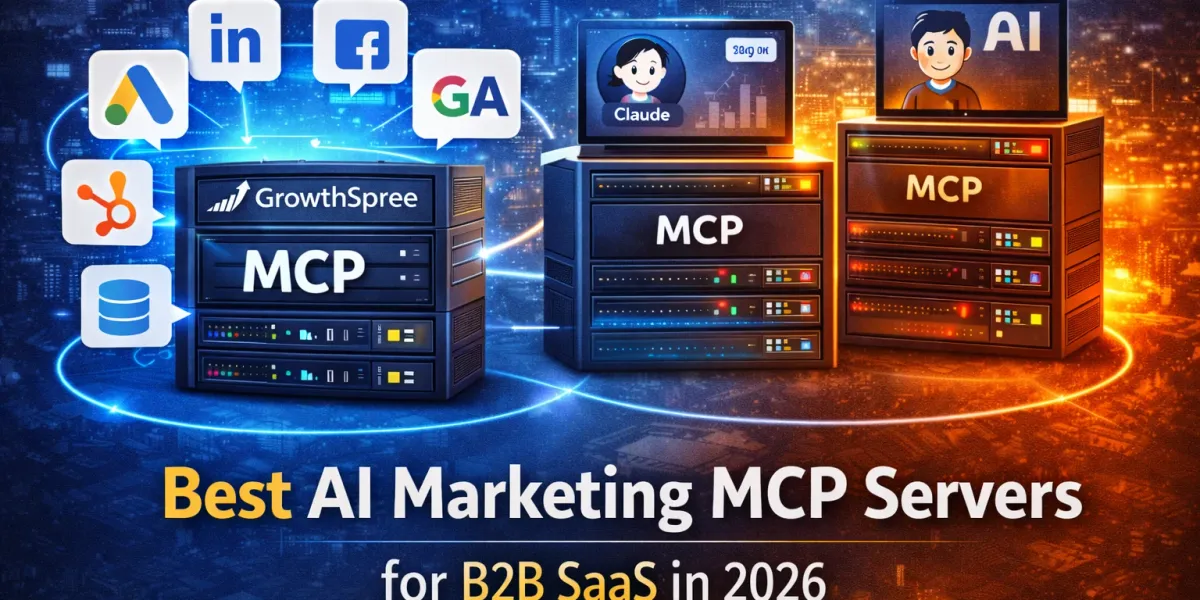
Specialized servers exist to close that cross-channel gap for marketers specifically. GrowthSpree, for example, runs a set of MCP servers spanning Google Ads, LinkedIn Ads, Meta Ads, HubSpot, GA4, and Search Console, unified so an AI assistant can reason across channels — answering questions like “which target accounts engaged with our LinkedIn Ads and visited the pricing page this week?” in one query. It’s designed for marketing teams rather than data engineers, and it’s offered free for marketers. The trade-off versus a raw platform server is scope: a specialized layer curates the channels marketers actually use rather than exposing every field of every API.
Enterprise connectivity: CData
CData offers an MCP server as part of its enterprise data-connectivity platform, with hundreds of connectors across databases, SaaS apps, and analytics systems queried through a SQL-style interface. Its genuine strength is breadth and governance — if you’re a data engineering team that needs governed, standardized access to many sources, CData is built for you. The trade-off for marketers is configuration complexity: it’s a data-platform tool, so wiring it up for a marketing analytics workflow takes more setup than a purpose-built marketing server. For a head-to-head on the LinkedIn side, see GrowthSpree vs CData for LinkedIn Ads MCP.
Automation: Zapier
Where the servers above mostly read data, Zapier’s MCP is built for read-write actions across thousands of apps — letting an AI assistant trigger workflows, create records, and move data between tools. Its strength is action and breadth, not deep marketing analytics. If your need is “have the AI do something across my stack” rather than “analyze my campaigns,” automation is the right category. See Growthspree Google Ads MCP Vs Zapier Google Ads MCP Which One Actually Works For Marketers for when each fits.
Custom builds
Some teams build their own MCP servers on internal infrastructure, connecting proprietary databases, pipelines, and CRM to an AI assistant. This offers maximum flexibility but requires meaningful engineering resources to build and maintain. For most B2B SaaS marketing teams, a specialized or official server gets you there faster; reserve custom builds for genuinely proprietary data or unusual requirements.
Read-only vs read-write: the distinction that matters
This is the single most important thing to check before connecting any server. Read-only servers can analyze your data but can’t change anything — safe for reporting, audits, and analysis (most analytics-focused marketing servers, including GrowthSpree’s ad servers, are read-only by design). Read-write servers (like Zapier, and CRM servers with write scopes) can take action — powerful, but they require more care around permissions and approvals. Match the access level to the job: analysis wants read-only; automation needs read-write.
Key takeaway: Before connecting any MCP server, confirm its access scope. A read-only analytics server can’t break your campaigns; a read-write server can change them — which is exactly why it needs tighter controls.
How to choose
- You live in one platform. Use that platform’s official server (HubSpot, Google Ads, etc.).
- You’re a marketer who needs cross-channel answers. Use a specialized marketing layer that unifies your channels.
- You’re a data team needing governed access to many sources. Use enterprise connectivity like CData.
- You want the AI to take actions. Use an automation server like Zapier (read-write).
- You have unique proprietary data + engineering capacity. Consider a custom build.
Common mistakes to avoid
- Chasing a single “best” server. The right choice depends on your team and job — most stacks use more than one.
- Ignoring read/write scope. Connecting a read-write server without permission controls is a real risk.
- Forcing a data-engineering tool into a marketing workflow. Enterprise connectivity is powerful but heavy for day-to-day marketing analysis.
- Expecting one platform server to be cross-channel. Single-platform servers can’t answer cross-channel questions alone.
- Assuming MCP requires ChatGPT specifically. MCP is assistant-agnostic — it works with Claude, ChatGPT, Gemini, and others.
Frequently Asked Questions
Q1. What is an AI marketing MCP server?
A system that connects marketing platforms (ad networks, analytics, CRM) to an AI assistant using the Model Context Protocol, so you can retrieve and analyze marketing data with natural-language questions instead of manual dashboards.
Q2. What is MCP and who created it?
MCP (Model Context Protocol) is an open standard introduced by Anthropic in November 2024. It lets AI assistants like Claude, ChatGPT, and Gemini connect directly to external tools and data.
Q3. Which MCP servers matter for B2B SaaS marketing?
Official platform servers (HubSpot, Amazon Ads, plus the Google/LinkedIn/Meta ecosystem), specialized marketing layers that unify channels for marketers, enterprise-connectivity servers like CData for data teams, and automation servers like Zapier for read-write actions.
Q4. What is the difference between CData and a specialized marketing MCP?
CData is an enterprise data-connectivity platform with hundreds of connectors and a SQL-style interface, built for data engineering teams. A specialized marketing MCP curates the channels marketers actually use and is designed for marketing analytics workflows, so it’s simpler for marketers to run.
Q5. What is Zapier’s MCP best for?
Read-write actions across thousands of apps — triggering workflows, creating records, and moving data. It’s built for automation rather than deep marketing analytics.
Q6. Is there an official Amazon Ads MCP server?
Yes — Amazon Ads launched an official MCP server in February 2026 (open beta), covering Sponsored Products/Brands/Display, DSP, and Amazon Marketing Cloud with 50+ tools. It’s mostly relevant to B2C and marketplace SaaS.
Q7. What is read-only vs read-write in MCP?
Read-only servers can analyze data but not change it — safe for reporting and audits. Read-write servers can take actions like creating records or triggering workflows — more powerful, but they need tighter permission controls.
Q8. Do I need to build a custom MCP server?
Usually not. Custom builds offer maximum flexibility but require engineering resources. For most marketing teams, an official or specialized server is faster; reserve custom builds for proprietary data or unusual needs.
Q9. Can one MCP server give me cross-channel answers?
Not a single official platform server — it only sees its own platform. Cross-channel questions (e.g., LinkedIn engagement plus Google conversions plus CRM stage) need a specialized layer or multiple servers connected to the same assistant.
Q10. Are marketing MCP servers free?
Some are. Several official platform servers and specialized marketing servers (including GrowthSpree’s) are free for marketers; enterprise-connectivity and automation platforms are typically paid. Confirm pricing on each vendor’s site.
Where to start
If you’re a B2B SaaS marketer wanting cross-channel answers, the fastest start is a specialized marketing server: connect the free Google Ads MCP and LinkedIn Ads MCP, then read the complete MCP servers guide to plan your full stack.
About the author: Ishan Manchanda is Co-Founder at GrowthSpree, a B2B SaaS marketing agency (Google Partner, HubSpot Solutions Partner, 4.9/5 on G2). GrowthSpree uses the MCP stack as its operating system for managing 300+ B2B SaaS accounts and $60M+ in ad spend, connecting Google Ads, LinkedIn Ads, Meta, HubSpot, GA4, and Search Console to AI assistants for cross-channel analysis.