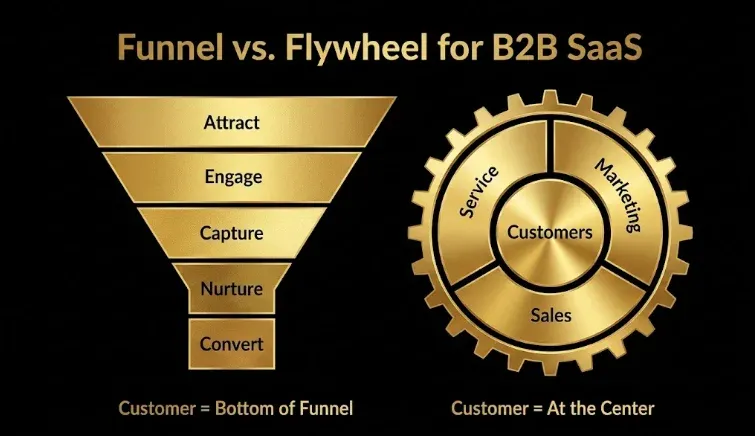
Funnel vs. Flywheel for B2B SaaS: Rethinking Growth
Quick answer: The funnel treats growth as a linear path that ends at conversion; the flywheel treats it as a continuous cycle where satisfied customers drive more growth — through retention, expansion, and advocacy — rather than being the end point. The core shift is what happens after conversion: the funnel treats a closed customer as the finish line, while the flywheel treats them as the beginning of a cycle where their success generates retention, expansion, and word-of-mouth that fuel more growth. For B2B SaaS especially — where retention and expansion drive the economics — the flywheel better reflects reality: customers aren’t the output of growth but a driver of it. But the flywheel isn’t a rejection of the funnel; it’s a broader model that includes the funnel’s conversion path while adding the crucial post-conversion cycle. Use both: the funnel for conversion, the flywheel for the compounding whole.
Key takeaways
- Funnel: linear, ends at conversion. Flywheel: continuous cycle.
- The flywheel makes customers growth drivers, not the end point.
- The shift is what happens after conversion — retention, expansion, advocacy.
- The flywheel fits SaaS economics — retention and expansion drive growth.
- Use both — funnel for conversion, flywheel for the compounding whole.
The funnel has dominated marketing thinking for a century — but it ends where SaaS growth really begins: with the customer. The flywheel reframes growth as a cycle customers drive. This guide covers how the models differ, what the flywheel adds, why it fits SaaS, and using both together.
What’s the difference between a funnel and a flywheel?
- The funnel models growth as a linear, one-directional path — prospects enter at the top (awareness), move down through stages (interest, consideration), and convert at the bottom (customer). It ends at conversion: the customer is the output, the finish line. To grow, you pour more prospects in the top.
- The flywheel models growth as a continuous cycle — you attract prospects, convert them to customers, and then those satisfied customers drive more growth (through retention, expansion, and advocacy), feeding back into attracting and converting more. The customer isn’t the end point but a driver of the ongoing cycle.
The fundamental difference is what happens at (and after) conversion. The funnel treats the customer as the end — growth’s output, the finish. The flywheel treats the customer as the center — the driver of continued growth through their success, retention, expansion, and advocacy. The flywheel is essentially the funnel plus the crucial post-conversion cycle that the funnel ignores, reframed as a continuous, self-reinforcing motion rather than a linear one-way path. It’s a specific application of growth-loop thinking to the whole customer relationship.
What does the flywheel add that the funnel misses?
The flywheel’s key addition is the post-conversion cycle — everything that happens after the customer converts, which the funnel treats as outside its scope:
- Retention. Keeping customers, which the funnel (ending at conversion) ignores but which is central to SaaS.
- Expansion. Growing customer value over time (upsell, cross-sell) — a major growth source the funnel doesn’t capture.
- Advocacy. Satisfied customers generating referrals, reviews, and word-of-mouth that fuel new customer acquisition — closing the loop.
- The feedback into acquisition. Customer success and advocacy feeding back to attract and convert more customers, making the cycle self-reinforcing.
The funnel’s blind spot is that it ends at conversion, treating the customer as the finish line — but in SaaS, the customer relationship is where most value is created (through retention and expansion) and where a major growth driver lives (advocacy). The flywheel adds exactly this: the recognition that satisfied customers drive growth, not just result from it. This is the crucial dimension the funnel misses — the post-conversion cycle where customers generate the retention, expansion, and advocacy that make growth compound. The flywheel makes visible and central what the funnel treats as out of scope.
Why does the flywheel fit SaaS especially well?
Because SaaS economics are fundamentally built on the post-conversion relationship — retention and expansion — which is exactly what the flywheel centers and the funnel ignores. In a subscription model:
- Retention is everything. SaaS makes money over the customer’s lifetime, so retention (the flywheel’s core, the funnel’s blind spot) is central to the economics.
- Expansion drives growth. Expansion revenue (existing customers growing) is a major SaaS growth source — a flywheel dynamic the funnel doesn’t capture.
- Advocacy fuels efficient acquisition. Satisfied SaaS customers driving referrals and reviews is a powerful, efficient acquisition source — the flywheel’s feedback loop.
- Customers as growth drivers. In SaaS, customers genuinely drive growth (through retention, expansion, advocacy), which the flywheel centers and the funnel misses.
Because SaaS growth depends so heavily on what happens after conversion (retention, expansion, advocacy), the flywheel — which centers exactly this — is a better fit for SaaS than the funnel, which stops at conversion. The funnel was designed for a world of one-time transactions where conversion was the end; SaaS is a keep-and-grow business where conversion is the beginning of the value-creating relationship, which the flywheel captures and the funnel doesn’t. This is why the flywheel resonates so strongly in SaaS: it matches the reality that SaaS customers are drivers of growth, not the finish line of it.
Does the flywheel replace the funnel?
Not entirely — the smartest view uses both, because they capture different (complementary) things:
- The funnel is still useful for understanding and optimizing the conversion path — how prospects become customers, and how to improve conversion at each stage. This linear-conversion view remains valid and useful.
- The flywheel captures the whole compounding cycle — including the post-conversion retention, expansion, and advocacy the funnel ignores — reframing growth as a continuous, customer-driven motion.
- Together — use funnel thinking to optimize conversion (a part of the flywheel), and flywheel thinking to see and drive the whole compounding cycle.
So the flywheel doesn’t reject the funnel; it contains it (the funnel’s conversion path is part of the flywheel) while adding the post-conversion cycle. The funnel is a useful lens on one part (conversion); the flywheel is the fuller model of the whole (compounding, customer-driven growth). The mistake is thinking only in funnels (missing the post-conversion cycle that drives SaaS growth) — the fix is adding flywheel thinking, not discarding the funnel. Optimize your conversion funnel and build your flywheel; the funnel handles the linear conversion, the flywheel captures the compounding whole. In practice, funnel and flywheel thinking together give the complete picture.
Field note: The funnel’s most damaging legacy in SaaS is the idea that the customer is the finish line — that once you’ve converted someone, the growth job is done and you move on to filling the top of the funnel again. This made sense when businesses sold one-time products, but it’s actively harmful in SaaS, where the customer isn’t the output of growth but the engine of it: their retention keeps the revenue, their expansion grows it, and their advocacy brings the next customers. A company that thinks purely in funnel terms treats conversion as the end, under-invests in everything after it, and then wonders why growth is so expensive — because it’s ignoring the compounding flywheel that satisfied customers could be driving. The flywheel reframe is simple but profound: conversion isn’t the finish line, it’s the moment a customer joins the cycle that drives further growth. This changes where you invest (heavily in customer success, retention, expansion, and advocacy, not just acquisition), how you measure (the whole cycle, not just conversion), and how you think (customers as growth drivers, not endpoints). You still need the funnel to convert — it’s not wrong, just incomplete — but bolting on the flywheel view, especially the post-conversion cycle, is what aligns your growth model with how SaaS actually grows. Stop treating customers as the end of the funnel and start treating them as the center of the flywheel.
Honest limitations
- The flywheel doesn’t replace the funnel. The funnel’s conversion view remains useful; the flywheel adds the post-conversion cycle rather than discarding conversion optimization.
- It’s a mental model, not a formula. The flywheel is a way of thinking about growth, not a precise system; its value is in reframing, not mechanics.
- The cycle must genuinely work. The flywheel only compounds if customers are genuinely successful (driving retention, expansion, advocacy); it can’t manufacture a cycle from unhappy customers.
- It requires post-conversion investment. Realizing the flywheel requires genuine investment in customer success, retention, and advocacy, not just acquisition.
- Both models simplify reality. Funnel and flywheel are both simplifications; real growth is messier than either model, so hold them as useful lenses.
Frequently Asked Questions
Q1. What’s the difference between a funnel and a flywheel?
The funnel models growth as a linear, one-directional path — prospects enter at awareness, move through stages, and convert at the bottom, where the customer is the output and finish line. The flywheel models growth as a continuous cycle — you attract and convert prospects, and then satisfied customers drive more growth through retention, expansion, and advocacy, feeding back into attracting more. The key difference is what happens after conversion: the funnel ends there; the flywheel makes customers growth drivers.
Q2. What does the flywheel add that the funnel misses?
The post-conversion cycle — retention (keeping customers, which the funnel ignores), expansion (growing customer value, a major growth source), advocacy (satisfied customers generating referrals and reviews that fuel acquisition), and the feedback of customer success into acquisition, making growth self-reinforcing. The funnel’s blind spot is ending at conversion; the flywheel adds the recognition that satisfied customers drive growth rather than just resulting from it.
Q3. Why does the flywheel fit SaaS especially well?
Because SaaS economics are built on the post-conversion relationship — retention and expansion — which the flywheel centers and the funnel ignores. In a subscription model, retention is central to the economics, expansion is a major growth source, and advocacy fuels efficient acquisition — all flywheel dynamics. SaaS is a keep-and-grow business where conversion is the beginning of the value-creating relationship, not the end, which the flywheel captures and the funnel doesn’t.
Q4. Does the flywheel replace the funnel?
Not entirely — the smartest view uses both. The funnel remains useful for understanding and optimizing the conversion path (how prospects become customers), while the flywheel captures the whole compounding cycle including the post-conversion retention, expansion, and advocacy the funnel ignores. The flywheel contains the funnel (conversion is part of the flywheel) while adding the post-conversion cycle. Use funnel thinking to optimize conversion and flywheel thinking to drive the whole cycle.
Q5. What is the marketing flywheel?
The marketing (or growth) flywheel is a model treating growth as a continuous, self-reinforcing cycle where you attract prospects, convert them to customers, and then those satisfied customers drive more growth through retention, expansion, and advocacy, which feeds back into attracting and converting more. Unlike the linear funnel that ends at conversion, the flywheel makes customers the center and driver of ongoing, compounding growth — a specific application of growth-loop thinking to the whole customer relationship.
Q6. Is the funnel outdated?
Not outdated, but incomplete — the funnel remains useful for understanding and optimizing the conversion path, but it misses the post-conversion cycle (retention, expansion, advocacy) that drives much of SaaS growth. The problem isn’t that the funnel is wrong; it’s that thinking only in funnels treats the customer as the finish line and ignores the compounding flywheel satisfied customers drive. The fix is adding flywheel thinking, not discarding the funnel.
Q7. How do you use funnel and flywheel together?
Use funnel thinking to understand and optimize the conversion path — improving how prospects move through awareness to conversion — as this remains a valid, useful lens on one part of growth. Use flywheel thinking to see and drive the whole compounding cycle, including the post-conversion retention, expansion, and advocacy that the funnel ignores. The funnel handles linear conversion (a part of the flywheel); the flywheel captures the compounding whole. Together they give the complete picture.
Sources & further reading
- Adopt flywheel thinking to treat customers as growth drivers (through retention, expansion, and advocacy), not the funnel’s finish line — while keeping the funnel for conversion.
- The flywheel fits SaaS economics; invest in the post-conversion cycle and use both models together, validating the compounding against your own retention and advocacy.
This guide is educational; the flywheel is a mental model that only compounds with genuinely successful customers, so invest in the post-conversion cycle and validate against your own results.
Related guides: Growth Loops for B2B SaaS · Network Effects for B2B SaaS · Customer Marketing & Retention for B2B SaaS · Customer Advocacy & Referral Marketing for B2B SaaS · The Marketing & Sales Funnel for B2B SaaS.