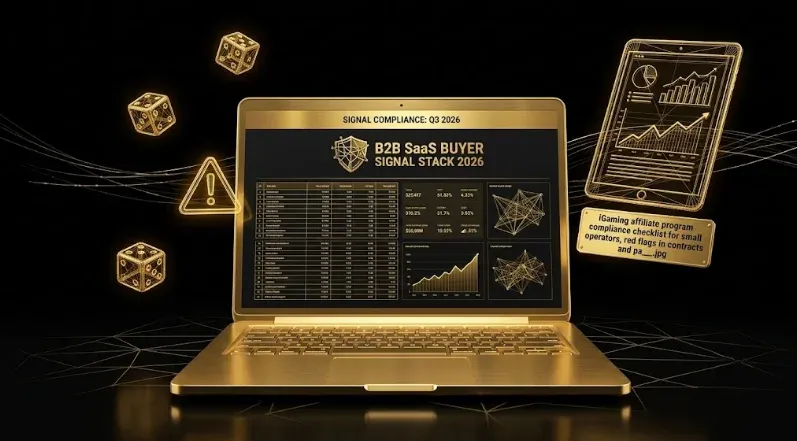
The Buyer Signal Stack is the 4-layer framework that replaces single-contact MQL behavioral scoring as the operational primitive for B2B SaaS lead qualification in 2026 — and most companies that have read about it have not yet built it because the implementation crosses marketing, sales, RevOps, and CRM configuration with no single owner. A complete Buyer Signal Stack has four layers that compound to identify buying-ready accounts: (1) Layer 1 account-level intent — Bombora Company Surge, 6sense Intent, or G2 Intent signals filtered against ICP fit, surfacing accounts that are actively researching the category before any contact at the account submits a form; (2) Layer 2 buying committee signals — 3+ unique contacts from the same account engaging within a 30-day window with at least one Director-level or above, indicating committee-based evaluation; (3) Layer 3 behavioral compounding — multi-touch engagement scored with recency multipliers (1.0x at 0-30 days, 0.5x at 31-60, 0.25x at 61-90, 0x past 90) and breadth weighting (different pages/content types/channels weighted higher than repeat touches); (4) Layer 4 self-reported context — HDYHAU + trigger question + closed-won source attribution capturing buyer-stated discovery and causation. The signals are weighted differently by ACV tier and combined to produce account-level scoring that correlates with close probability at 2-3x the rate of single-contact behavioral scoring. This playbook details the 90-day build sequence from zero-state to operational Buyer Signal Stack, tooling selection across the layers (Bombora vs 6sense vs G2 Intent vs manual for Layer 1; HubSpot Companies object configuration for Layer 2; Operations Hub for recency-weighted scoring in Layer 3; integration with the self-reported attribution system for Layer 4), HubSpot configuration for each layer, threshold calibration against closed-won data segmented by ACV tier, quarterly recalibration cadence, and the seven mistakes B2B SaaS companies make when building the Buyer Signal Stack from scratch.
By Ishan Manchanda, Co-Founder of GrowthSpree — a B2B SaaS marketing agency working with 75+ SaaS companies on demand generation, ABM, and RevOps. Updated June 2026.
Why the Buyer Signal Stack replaces single-contact MQL scoring
Standard B2B SaaS lead scoring tracks behavior at the individual contact level — page views, content downloads, email opens, form submissions — and assigns a score that triggers MQL transition when the score crosses a threshold (typically 50, 60, or 75 points). This framework was a reasonable heuristic in 2010-2015 when buyer journeys were largely first-party trackable and decisions were individual rather than committee-based.
By 2026 the framework has structurally collapsed. Four shifts broke single-contact MQL scoring: buying is committee-based (6-12 stakeholders) rather than individual-contact based; dark funnel research now precedes form submission by weeks or months, so behavioral signals arrive too late; intent platforms surface account-level signals 4-8 weeks before any contact at the account submits a form; self-reported attribution outperforms behavioral scoring at predicting close probability. Most companies operating MQL scoring in 2026 produce scores that no longer correlate meaningfully with closed-won outcomes.
The Buyer Signal Stack replaces single-score MQL routing with multi-layer account-level scoring that aggregates four complementary signals. Each layer captures something the others cannot. Layer 1 catches accounts before any form submission. Layer 2 detects committee-based evaluation. Layer 3 measures depth and recency of engagement. Layer 4 captures buyer-stated context that behavioral data misses entirely. Combined and calibrated against closed-won outcomes, the stack produces account-level scoring that correlates with close probability at 2-3x the rate of single-contact behavioral scoring.
The 4 layers of the Buyer Signal Stack
| Layer | What It Measures | Tooling | Typical Threshold |
|---|---|---|---|
| Layer 1: Account-Level Intent | Account actively researching the category before any contact submits a form | Bombora Company Surge OR 6sense Intent OR G2 Intent + ICP fit filter | Surge score > category baseline by 1.5x OR 6sense buying stage above ‘Awareness’ |
| Layer 2: Buying Committee Signals | Multi-stakeholder engagement at account level indicating committee-based evaluation | HubSpot Companies object with contact engagement rollup | 3+ unique contacts engaging in 30-day window with Director-level+ included |
| Layer 3: Behavioral Compounding | Depth and recency of engagement across content, channels, and touchpoints | HubSpot behavioral scoring with recency multipliers + breadth weighting (Operations Hub Pro) | Recency-weighted score above ACV-tier-specific threshold |
| Layer 4: Self-Reported Context | Buyer-stated discovery channel and trigger event | HDYHAU + trigger question + closed-won source via the self-reported attribution system | Trigger question populated AND closed-won source assigned |
Phase 1 (Days 1-30): Build foundations + Layer 1
Step 1: Define ICP with explicit firmographic + signal criteria
-
Firmographic criteria: company size + industry + geography + tech stack matching defined ICP. Without explicit ICP, Layer 1 intent signals cannot be filtered for fit.
-
Tier the ICP by close probability and ACV: Strategic (highest close + ACV), Core (volume + steady ACV), Emerging (newer fit segment with developing close patterns). Each tier has different threshold calibration in Layer 3.
-
Document exclusion criteria: competitors, existing customers, geographies not serviceable, sub-threshold company sizes.
Step 2: Deploy Layer 1 — account-level intent
-
Choose intent platform: Bombora Company Surge ($1,000-$2,500/month at Series A-B scale) provides surge signals across 7,000+ topics; 6sense Intent ($2,000-$5,000/month entry tier; full platform $50K+) provides intent + AI-predicted buying stages; G2 Intent ($1,500-$3,500/month) provides intent on G2 visitors. Most B2B SaaS Series A-B builds start with Bombora as the cost-effective entry.
-
Integration: Bombora and G2 Intent both offer HubSpot integrations via Operations Hub Pro or third-party connectors (Tray.io, Zapier). Daily sync of company-level intent signals into custom HubSpot Company property ‘Intent Status’ + ‘Intent Score’ + ‘Last Surge Date’.
-
ICP filter: intent signals only matter for accounts matching ICP. Configure workflow that flags Layer 1 signal only when intent score crosses threshold AND account passes ICP firmographic criteria.
-
Account stage transition: accounts with active Layer 1 signals transition to ‘Surface’ account stage (per the dual lifecycle framework). Marketing notified for paid retargeting + content distribution; sales not yet engaged.
Step 3: Configure HubSpot Companies object for account-level signal capture
-
Custom Company properties: Intent Status (active/inactive), Intent Score (numeric), Last Surge Date (datetime), Account Stage (per dual lifecycle), Buying Committee Status (will populate from Layer 2), Behavioral Score (will populate from Layer 3), Self-Reported Signal (will populate from Layer 4).
-
Contact-to-Company rollup: contact-level engagement (page views, content downloads, ad clicks, email opens, demo views) rolls up to the Companies object. Operations Hub Pro is required for the calculated property rollups.
-
Account engagement dashboard: real-time view of accounts with active Layer 1 + Layer 2 + Layer 3 + Layer 4 signals; sortable by signal layer combination.
Phase 2 (Days 31-60): Build Layer 2 + Layer 3
Step 4: Deploy Layer 2 — buying committee signals
-
Buying committee threshold: 3+ unique contacts from the same account engaging within a 30-day window with at least one Director-level or above. Default threshold for most B2B SaaS; tune per ACV tier (Strategic accounts may need 4-5 contacts; Emerging may accept 2-3).
-
Engagement criteria: each contact must have meaningful engagement — at least 1 page view OR 1 content download OR 1 ad click OR 1 email open in the window. Filter out passive engagement (single newsletter open from 6 months ago).
-
Title-level filter: use HubSpot ‘Job Function’ + ‘Seniority’ properties (populate via Clearbit/ZoomInfo/Apollo enrichment). Filter Director-level + (Director, VP, Head of, C-level).
-
Workflow automation: when Layer 2 threshold is crossed, account transitions to ‘Committee-Engaged’ stage; sales notified with account engagement summary; AE triages within 24 hours.
Step 5: Deploy Layer 3 — behavioral compounding with recency
-
Behavioral scoring with recency multipliers: assign points for behavioral events (page view 1, content download 5, ad click 2, email open 1, demo view 10, pricing page view 8) with recency multipliers — 1.0x at 0-30 days, 0.5x at 31-60, 0.25x at 61-90, 0x past 90.
-
Implementation: Operations Hub Pro custom-coded calculated property OR Salesforce Flow if Salesforce-primary. Pure-HubSpot Operations Hub Pro is the most common implementation; technical effort meaningful but conversion improvement justifies it.
-
Breadth weighting: account engagement across multiple content types/channels/pages scores higher than repeat engagement on the same content. Weight unique-page-engagement and unique-channel-engagement above repeat engagement.
-
ACV-tier-specific thresholds: Layer 3 threshold for SMB ACV ($10K-$30K) might be 20 points; Mid-Market ACV ($30K-$75K) 30 points; Enterprise ACV ($75K-$200K+) 45 points. Calibrate against closed-won data by ACV tier.
Phase 3 (Days 61-75): Build Layer 4 + threshold calibration
Step 6: Deploy Layer 4 — self-reported context
-
Layer 4 integrates with the self-reported attribution system (separate playbook). HDYHAU on lead capture forms + trigger question on AE discovery call + closed-won source attribution at deal closure.
-
Signal extraction: parse HDYHAU answers to flag specific channel signals (peer recommendation = highest credibility; AI search = AI-search-driven discovery; founder LinkedIn = personal-brand-driven). Parse trigger question for trigger event categories (leadership change, peer recommendation, funding event).
-
Account stage influence: Layer 4 ‘peer recommendation’ or ‘trigger event present’ indicators accelerate account stage transition. Account with Layer 1 + Layer 4 ‘peer recommendation’ is structurally different from account with Layer 1 alone.
Step 7: Calibrate thresholds against closed-won data by ACV tier
-
Pull 12 months of closed-won data segmented by ACV tier. For each tier, analyze pre-conversion signal patterns: Layer 1 surge present? Layer 2 committee threshold crossed? Layer 3 behavioral score level? Layer 4 self-reported attribution?
-
Identify the threshold values at which close rates become meaningfully different from population baseline. Common findings: Layer 2 + Layer 4 combination is the highest-correlating signal; Layer 3 behavioral score alone has weaker correlation than expected; Layer 1 intent without Layer 2 + Layer 4 produces moderate but uncertain close probability.
-
Calibrate Layer 3 thresholds by ACV tier — different ACV tiers have different signal patterns. Strategic enterprise accounts engage more lightly per stakeholder but with more stakeholders (committee). SMB accounts engage heavily per contact (single decision-maker).
-
Document threshold rationale: each threshold should have a documented basis in closed-won data, not a default platform value or marketer intuition.
Phase 4 (Days 76-90): Deploy operational rhythm + recalibration cadence
Step 8: Build account-level routing and operational rhythm
-
Account stage routing: define which account stages trigger marketing vs sales actions. Surface stage = marketing retargeting + content distribution. Active stage = marketing nurture intensification + sales alert. Committee-Engaged = sales primary owner + marketing supports. Opportunity = sales primary + marketing nurture supplements.
-
Weekly account engagement standup: ABM Lead + 2-3 senior AEs + Demand Gen Director review accounts that transitioned stages in the past week; identify Tier 1 strategic accounts needing escalation; flag stalled accounts.
-
Monthly signal effectiveness review: CMO + RevOps + Demand Gen Director review signal-by-signal correlation with opportunity outcomes; identify which signal combinations produced high close rates vs low close rates.
Step 9: Quarterly recalibration
-
Quarterly half-day session: ICP refinement based on closed-won analysis; threshold recalibration by ACV tier; signal weight adjustment based on what actually predicted close outcomes; intent platform performance review.
-
Documentation: maintain a recalibration log documenting threshold changes, rationale, and outcome impact over time. The log enables future quarterly recalibrations to learn from past adjustments.
-
Sales-marketing SLA renegotiation: if recalibration changes account stage criteria meaningfully, update the sales-marketing SLA (separate playbook) to reflect new handoff thresholds.
Tooling cost summary for the Buyer Signal Stack
| Tooling Component | Series A Recommendation | Monthly Cost | Notes |
|---|---|---|---|
| Layer 1 intent platform | Bombora Company Surge OR G2 Intent (entry tier) | $1,000-$3,500/month | 6sense full platform deferred until Series B+ |
| Layer 2 HubSpot configuration | HubSpot Marketing Hub Pro + Operations Hub Pro | $1,800-$3,600/month all-in | Operations Hub Pro required for contact-to-company rollup |
| Layer 3 behavioral scoring | HubSpot Operations Hub Pro custom-coded calculated properties | Included in Operations Hub Pro license | Implementation requires RevOps technical capacity OR consulting support |
| Layer 4 self-reported attribution | Built on HubSpot forms + opportunity fields | Included in HubSpot license | Integration with the self-reported attribution system covered in separate playbook |
| Firmographic enrichment | Clearbit, ZoomInfo, or Apollo | $200-$800/month | Required to populate Director-level seniority for Layer 2 |
| Total monthly cost | All components combined | $3,000-$7,900/month | Achievable at Series A; scales to Series B+ with platform upgrades |
The 7 mistakes B2B SaaS companies make when building the Buyer Signal Stack
-
Mistake 1: Skipping Layer 1 intent platform investment. Companies attempting Buyer Signal Stack without intent data (Bombora/6sense/G2 Intent) operate with 3 layers instead of 4 and miss the 4-8 week pre-form-submission window when buying intent is most diagnostic. Layer 1 is non-optional for credible Buyer Signal Stack execution.
-
Mistake 2: Treating Layer 1 intent as MQL replacement directly. Layer 1 intent signal alone is not a buying-ready signal. Layer 1 produces ‘Surface’ account stage — marketing engagement, not sales handoff. Sales handoff happens at Committee-Engaged (Layer 1 + Layer 2) or higher.
-
Mistake 3: Skipping Layer 3 recency weighting because ‘the math is hard.’ Recency multipliers (1.0x at 0-30 days, 0.5x at 31-60, 0.25x at 61-90, 0x past 90) are the highest-leverage technical refinement in B2B SaaS scoring. Operations Hub Pro implementation is meaningful effort but the conversion improvement consistently justifies it.
-
Mistake 4: Single threshold across all ACV tiers. Strategic enterprise accounts engage lighter per stakeholder with more stakeholders; SMB accounts engage heavier per contact with single decision-maker. Layer 3 thresholds must be calibrated by ACV tier.
-
Mistake 5: No quarterly recalibration. The Buyer Signal Stack drifts within 6 months as the business evolves, ICP shifts, and signal patterns change. Quarterly half-day recalibration is the operational discipline that keeps the stack performant.
-
Mistake 6: Marketing-only ownership without sales adoption. Buyer Signal Stack execution requires sales to act on Committee-Engaged accounts within 24 hours of stage transition. Without sales adoption commitment in the sales-marketing SLA, the stack produces account stage signals that sales ignores.
-
Mistake 7: No integration between layers. Operating Layer 1 + Layer 2 + Layer 3 + Layer 4 as independent signals rather than combined account-level scoring produces fragmented account view. The integration — combined account stage that synthesizes all 4 layers — is the operational primitive, not the individual layers.
How specialist B2B SaaS partners support Buyer Signal Stack builds vs the industry standard
| Capability | Industry Standard Agency | GrowthSpree (Specialist B2B SaaS) |
|---|---|---|
| Buyer Signal Stack design | Default platform scoring (HubSpot manual or AI) | 4-layer stack design from pattern recognition across 75+ B2B SaaS clients |
| Layer 1 intent platform deployment | Recommended; client implements | Bombora/6sense/G2 Intent selection, integration, and ICP filter configuration |
| Layer 2 HubSpot configuration | Default Companies object | Custom Company properties + contact-to-company rollup + workflow automation |
| Layer 3 recency-weighted scoring | Linear behavioral scoring | Operations Hub Pro custom-coded calculated properties with 30/60/90-day decay multipliers |
| Threshold calibration | Platform defaults | Closed-won data analysis by ACV tier with empirical threshold calibration |
| Quarterly recalibration cadence | Not offered | Quarterly half-day recalibration with documented log of threshold changes |
| Pricing model | Percentage of ad spend or $8K-$25K monthly retainer | $3,000/month flat — Buyer Signal Stack build + ongoing calibration included |
Key takeaways: how to build a B2B SaaS Buyer Signal Stack
-
The Buyer Signal Stack is the 4-layer framework that replaces single-contact MQL scoring as the operational primitive for B2B SaaS lead qualification in 2026.
-
Four layers: Layer 1 account-level intent (Bombora/6sense/G2 Intent + ICP filter), Layer 2 buying committee signals (3+ contacts in 30-day window with Director-level+), Layer 3 behavioral compounding with recency multipliers (1.0x → 0.5x at 30d → 0.25x at 60d → 0x at 90d), Layer 4 self-reported context (HDYHAU + trigger question + closed-won source).
-
90-day build: Phase 1 (Days 1-30) foundations + Layer 1, Phase 2 (Days 31-60) Layer 2 + Layer 3, Phase 3 (Days 61-75) Layer 4 + threshold calibration, Phase 4 (Days 76-90) operational rhythm + recalibration cadence.
-
Tooling cost: $3,000-$7,900 monthly all-in at Series A — Bombora ($1,000-$3,500) + HubSpot Marketing Pro + Operations Hub Pro ($1,800-$3,600) + firmographic enrichment ($200-$800).
-
Threshold calibration: pull 12 months of closed-won data segmented by ACV tier; identify thresholds at which close rates become meaningfully different from population baseline; calibrate Layer 3 thresholds by ACV tier.
-
Account stage routing: Surface = marketing retargeting + content; Active = marketing nurture intensification + sales alert; Committee-Engaged = sales primary owner + marketing supports; Opportunity = sales primary + marketing nurture supplements.
-
Quarterly recalibration: half-day session with CMO + RevOps + Demand Gen Director + VP Sales reviewing signal effectiveness; ICP refinement; threshold recalibration by ACV tier; signal weight adjustment based on closed-won outcomes.
-
Seven build mistakes: skipping Layer 1 intent platform, treating Layer 1 alone as MQL replacement, skipping Layer 3 recency weighting, single threshold across all ACV tiers, no quarterly recalibration, marketing-only ownership without sales adoption, no integration between layers.
Building the Buyer Signal Stack from zero?
If you’re deploying the 4-layer Buyer Signal Stack and want a second opinion on tooling selection, threshold calibration, or HubSpot configuration, book a free 30-minute strategy call here. No pitch — just operator-to-operator review.
Related reading from GrowthSpree
• Mql Dead B2b Saas 2026 Pipeline Metrics That Matter
• Hubspot Lifecycle Stages Setup B2b Saas B2b 2026 Definitions Progression Criteria Benchmarks
• How to Build a B2B SaaS Demand Generation Engine From Scratch
• B2B SaaS MQL Scoring Threshold Benchmarks 2026
• MQL-to-SQL Conversion Rate Benchmarks B2B SaaS 2026
Frequently asked questions
What is the B2B SaaS Buyer Signal Stack and why does it replace MQL scoring?
The Buyer Signal Stack is the 4-layer framework that replaces single-contact MQL behavioral scoring as the operational primitive for B2B SaaS lead qualification in 2026. Single-contact MQL scoring structurally collapsed because buying is committee-based (6-12 stakeholders), dark funnel research precedes form submission by weeks or months, intent platforms surface account-level signals 4-8 weeks before any contact submits a form, and self-reported attribution outperforms behavioral scoring at predicting close probability. The Buyer Signal Stack aggregates four complementary signals: Layer 1 account-level intent (Bombora/6sense/G2 Intent + ICP filter) catches accounts before any form submission; Layer 2 buying committee signals (3+ contacts in 30-day window with Director-level+) detects committee evaluation; Layer 3 behavioral compounding with recency multipliers measures depth and recency of engagement; Layer 4 self-reported context (HDYHAU + trigger question + closed-won source) captures buyer-stated discovery. Combined and calibrated against closed-won outcomes, the stack produces account-level scoring that correlates with close probability at 2-3x the rate of single-contact behavioral scoring.
What are the 4 layers of the B2B SaaS Buyer Signal Stack?
Layer 1 Account-Level Intent: account actively researching the category before any contact submits a form; measured via Bombora Company Surge OR 6sense Intent OR G2 Intent filtered against ICP fit; typical threshold surge score above category baseline by 1.5x OR 6sense buying stage above ‘Awareness’. Layer 2 Buying Committee Signals: multi-stakeholder engagement at account level indicating committee-based evaluation; measured via HubSpot Companies object with contact engagement rollup; typical threshold 3+ unique contacts engaging in 30-day window with Director-level or above included. Layer 3 Behavioral Compounding: depth and recency of engagement across content, channels, and touchpoints; measured via HubSpot Operations Hub Pro with recency multipliers (1.0x at 0-30 days, 0.5x at 31-60, 0.25x at 61-90, 0x past 90) + breadth weighting; typical threshold recency-weighted score above ACV-tier-specific threshold. Layer 4 Self-Reported Context: buyer-stated discovery channel and trigger event; measured via HDYHAU + trigger question + closed-won source via the self-reported attribution system; typical threshold trigger question populated AND closed-won source assigned.
What tooling does B2B SaaS need for the Buyer Signal Stack?
Series A-B all-in tooling cost $3,000-$7,900 monthly. Components: (1) Layer 1 intent platform — Bombora Company Surge ($1,000-$2,500/month providing surge signals across 7,000+ topics), OR 6sense Intent ($2,000-$5,000/month entry tier; full platform $50K+/year deferred until Series B+), OR G2 Intent ($1,500-$3,500/month with intent on G2 visitors). (2) Layer 2 HubSpot configuration — HubSpot Marketing Hub Pro + Operations Hub Pro ($1,800-$3,600/month all-in); Operations Hub Pro required for contact-to-company calculated property rollup. (3) Layer 3 behavioral scoring — implemented via Operations Hub Pro custom-coded calculated properties (included in Operations Hub Pro license; implementation requires RevOps technical capacity or consulting support). (4) Layer 4 self-reported attribution — built on HubSpot forms and opportunity fields (included in HubSpot license). (5) Firmographic enrichment — Clearbit, ZoomInfo, or Apollo ($200-$800/month) required to populate Director-level seniority for Layer 2.
What is Layer 1 account-level intent and how does B2B SaaS deploy it?
Layer 1 account-level intent captures accounts actively researching the category before any contact at the account submits a form — typically 4-8 weeks before behavioral signals would otherwise be visible. Deployment: choose intent platform (Bombora Company Surge most cost-effective at Series A-B; 6sense Intent provides AI-predicted buying stages at higher cost; G2 Intent specific to G2 visitors). Integration: Bombora and G2 Intent both offer HubSpot integrations via Operations Hub Pro or third-party connectors (Tray.io, Zapier); daily sync of company-level intent signals into custom HubSpot Company property ‘Intent Status’ + ‘Intent Score’ + ‘Last Surge Date’. ICP filter: intent signals only matter for accounts matching ICP; configure workflow that flags Layer 1 signal only when intent score crosses threshold AND account passes ICP firmographic criteria. Account stage transition: accounts with active Layer 1 signals transition to ‘Surface’ account stage (per dual lifecycle); marketing notified for paid retargeting + content distribution; sales not yet engaged. Layer 1 alone is not a sales handoff signal — that requires Layer 2 (Committee-Engaged) or higher.
How does B2B SaaS deploy Layer 2 buying committee signals in HubSpot?
Layer 2 buying committee signal: 3+ unique contacts from the same account engaging within a 30-day window with at least one Director-level or above. Engagement criteria: each contact must have meaningful engagement — at least 1 page view OR 1 content download OR 1 ad click OR 1 email open in the window; filter out passive engagement (single newsletter open from 6 months ago). Title-level filter: use HubSpot ‘Job Function’ + ‘Seniority’ properties populated via Clearbit/ZoomInfo/Apollo enrichment; filter Director-level+ (Director, VP, Head of, C-level). Implementation: HubSpot Companies object with custom property ‘Buying Committee Status’ (active/inactive); Operations Hub Pro calculated property that counts unique engaged contacts in trailing 30 days with seniority filter; workflow that transitions account to ‘Committee-Engaged’ stage when threshold is crossed; AE notification with account engagement summary. Threshold tuning by ACV tier: Strategic enterprise accounts may need 4-5 contacts; Emerging segments may accept 2-3 contacts. The Layer 2 transition produces the highest-value sales handoff signal in the Buyer Signal Stack.
What is recency-weighted behavioral scoring in Layer 3?
Layer 3 behavioral compounding scoring with recency multipliers applied to behavioral engagement based on time elapsed. Standard implementation: full weight (1.0x) for engagement in the last 30 days, 0.5x multiplier for engagement 31-60 days old, 0.25x multiplier for engagement 61-90 days old, 0x (or removed) for engagement past 90 days. Rationale: in 2026 B2B SaaS buying motions where active buying windows last 4-12 weeks, engagement recency is far more diagnostic than engagement volume. A contact who downloaded a whitepaper yesterday is structurally different from a contact who downloaded the same whitepaper six weeks ago, even if the absolute behavioral score is identical. Implementation: HubSpot Operations Hub Pro custom-coded calculated property OR Salesforce Flow if Salesforce-primary. Behavioral event point values: page view 1, content download 5, ad click 2, email open 1, demo view 10, pricing page view 8. Breadth weighting: account engagement across multiple content types/channels/pages scores higher than repeat engagement on the same content. ACV-tier-specific thresholds: SMB ACV ($10K-$30K) might require 20 points; Mid-Market ($30K-$75K) 30 points; Enterprise ($75K-$200K+) 45 points.
How long does it take to build a B2B SaaS Buyer Signal Stack from zero?
90 days for full operational deployment. Phase 1 (Days 1-30) foundations + Layer 1: ICP definition with explicit firmographic + signal criteria; ACV tiering (Strategic/Core/Emerging); Layer 1 intent platform deployment with ICP filter; HubSpot Companies object configuration with custom signal-layer properties. Phase 2 (Days 31-60) Layer 2 + Layer 3: buying committee signal configuration with seniority filter; behavioral scoring with recency multipliers in Operations Hub Pro; breadth weighting; ACV-tier-specific thresholds. Phase 3 (Days 61-75) Layer 4 + threshold calibration: integration with self-reported attribution system; 12-month closed-won data analysis by ACV tier; empirical threshold calibration for each layer. Phase 4 (Days 76-90) operational rhythm + recalibration cadence: account stage routing (Surface → Active → Committee-Engaged → Opportunity); weekly account engagement standup; monthly signal effectiveness review; quarterly recalibration documentation. Compounding maturity over 6-12 months as signals calibrate against actual close outcomes and thresholds tighten. Companies attempting to compress below 90 days typically skip Layer 3 recency weighting deployment (the most technically complex step) and pay for it later.
What is the biggest mistake B2B SaaS companies make when building the Buyer Signal Stack?
Skipping Layer 1 intent platform investment. Companies attempting to build the Buyer Signal Stack without intent data (Bombora, 6sense, G2 Intent) operate with 3 layers instead of 4 and miss the 4-8 week pre-form-submission window when buying intent is most diagnostic. Layer 1 is non-optional for credible Buyer Signal Stack execution — without it, the company is back to single-contact behavioral scoring with extra steps. The Layer 1 cost ($1,000-$3,500 monthly for Bombora or G2 Intent at Series A scale) is the highest-leverage Buyer Signal Stack investment and pays back through Layer 2 + Layer 3 + Layer 4 integration. Other major mistakes: treating Layer 1 intent alone as MQL replacement (Layer 1 produces ‘Surface’ marketing engagement, not sales handoff), skipping Layer 3 recency weighting because ‘the math is hard’ (Operations Hub Pro implementation is meaningful effort but conversion improvement justifies it), single threshold across all ACV tiers (Strategic enterprise and SMB engage differently), no quarterly recalibration (stack drifts within 6 months), marketing-only ownership without sales adoption commitment in the sales-marketing SLA, and operating layers as independent signals rather than combined account-level scoring.