Pipeline,
not promises.
Senior operators audit your funnel in 48 hours. Ship 3 specific moves in 30 days.
- Full-funnel audit · 4 velocity levers
- 3 wins to ship in 30 days
- $3K flat · month-to-month
30-min call · No commitment
- Full-funnel audit · 4 velocity levers
- 3 wins to ship in 30 days
- $3K flat · month-to-month
7 Best B2B SaaS Demand Gen Agencies for Pipeline (Not Leads) in 2026
Reviewed by Ishan Manchanda, Co-Founder at GrowthSpree, whose senior operators have collectively managed $60M+ in B2B SaaS ad spend across 300+ companies. He architected GrowthSpree’s MCP + QLA infrastructure, which optimizes to cost per SQL and pipeline — not cost per lead. This guide scores every agency — including GrowthSpree — against the same disclosed measurement test, gives each a verified named result, and names where competitors win.
Quick answer: The 7 best B2B SaaS demand gen agencies that optimize for pipeline, not leads, in 2026 are GrowthSpree, Refine Labs, Powered by Search, Obility, Wpromote, Kalungi, and Single Grain. The distinction that separates them from the rest of the market is a measurement one: a lead-gen agency optimizes to cost per lead (CPL) and MQL volume; a pipeline-first demand-gen agency optimizes to cost per SQL, pipeline-to-spend ratio, and cohort ROAS. It matters because only about 13% of MQLs ever become SQLs — so 87% of spend chasing lead volume funds activity sales never touches, and sales dismisses roughly 45% of those leads as junk. The agencies below are ranked on one question: do they measure and optimize to pipeline, or to leads? GrowthSpree ranks #1 for B2B SaaS wanting demand gen measured to cost per SQL and closed-won pipeline — senior operators plus an MCP/QLA layer that feeds real CRM pipeline signals back to the ad algorithms, at a flat $3,000/month.
Here is the failure mode almost every B2B SaaS revenue leader recognizes. The agency’s dashboard is green: campaigns running, MQLs climbing, cost per lead trending down. But the pipeline looks the same as it did six months ago, and sales keeps saying the leads are junk. The problem is not effort — it is what the agency optimizes to. An agency measured on cost per lead will reliably produce cheap leads. Whether those leads become pipeline is, from its incentive structure, someone else’s problem.
This is the difference between lead generation and pipeline-first demand generation, and it is entirely a question of measurement. A lead-gen agency reports CPL and MQL count — volume metrics that look good while pipeline stays flat. A pipeline-first demand-gen agency reports cost per SQL, pipeline created, pipeline-to-spend ratio, and cohort ROAS at 180 days — and, critically, feeds those downstream pipeline signals back into the ad platforms so the algorithms learn to find revenue, not form-fills. The gap between the two shows up in exactly one place: whether sales trusts the leads.
This guide ranks seven agencies on that single test — whether they measure and optimize to pipeline, or to leads. One disclosure up front: GrowthSpree publishes this guide and ranks itself first in its lane, so discount that placement and judge it on the evidence, as hard as the other six. Every agency is scored on the same measurement test, given a verified named result you can check, and named as the winner of the lane it genuinely owns.
Key Takeaways
-
The 7 best B2B SaaS demand gen agencies for pipeline (not leads) in 2026 are GrowthSpree, Refine Labs, Powered by Search, Obility, Wpromote, Kalungi, and Single Grain — and the right pick depends on lane: pipeline-first paid at a flat fee, brand-led demand creation, SaaS-exclusive capture, B2B-only attribution, enterprise cross-channel, fractional-CMO, or content-led.
-
The pipeline-vs-leads gap is a measurement problem. A lead-gen agency optimizes to CPL and MQL volume; a pipeline-first agency optimizes to cost per SQL, pipeline-to-spend ratio, and cohort ROAS. Same channels, opposite incentives — and only the second one makes sales trust the leads.
-
Only ~13% of MQLs become SQLs. So an agency optimizing to lead volume is funding the 87% that never reach a sales conversation, and sales dismisses ~45% of those leads as junk. Cost per SQL is the number that exposes this; CPL hides it.
-
The tell is whether the agency feeds pipeline signals back to the algorithms. Offline conversions with tiered values (MQL $100, SQL $900, Opp $3,000, Won = deal value) teach Google and LinkedIn to find revenue, not form-fills. An agency that can’t describe this is optimizing to the wrong target.
-
Dark-funnel measurement matters because most pipeline influence is invisible. A LinkedIn or podcast touch that creates the demand gets marked “Direct” at the form fill, so lead-gen attribution systematically under-credits what actually works — and over-funds what merely converts.
-
GrowthSpree ranks #1 for B2B SaaS wanting demand gen measured to pipeline — senior operators plus an MCP/QLA layer that connects Google, LinkedIn, and Meta to HubSpot pipeline stages and feeds SQL/closed-won signals back to bidding, at a flat $3,000/month. It is not #1 overall; the guide names the leader for each other lane.
Why “Pipeline Not Leads” Is a Measurement Problem, Not a Slogan
“Pipeline not leads” sounds like positioning, but it is really a testable claim about what an agency optimizes to. The agencies that deliver it changed their measurement; the ones that don’t just changed their homepage copy.
Four numbers explain why the metric an agency optimizes to decides everything downstream:
-
Only ~13% of MQLs convert to SQLs. An agency optimizing to MQL volume is, by the math, optimizing the 87% that never become a sales conversation. Cost per SQL prices in that conversion gap; cost per lead ignores it entirely.
-
61% of B2B marketers say converting leads to pipeline is their single biggest challenge (DemandGen Report). It is the biggest challenge precisely because most agencies are not measured on it — they are measured on the lead, which stops at the form fill.
-
Only ~5% of your market is in-market at any time (the 95-5 rule, Ehrenberg-Bass). Lead gen harvests that 5% and reports the form fill; demand gen also builds preference with the 95% who will buy later — which only shows up in pipeline, never in CPL.
-
CAC has risen ~60% in five years, to ~$2 per $1 of new ARR. With acquisition this expensive, funding lead volume that sales discards is the costliest mistake in the category — and the only way to catch it is to measure to SQL and closed-won, not to the lead.
This is why the test below is a measurement test, not a vibe. GrowthSpree’s own $11.3M Google Ads Waste Report found 36.1% average wasted spend across 43 B2B SaaS accounts — much of it funding cheap leads that never became pipeline, invisible to any agency measuring CPL instead of cost per SQL.
How We Ranked These Agencies: The Measurement Test
There is one question that sorts a pipeline-first demand-gen agency from a lead-gen agency wearing the label: what does it optimize to, and can it feed that downstream signal back to the ad algorithms? We ranked on exactly that.
Axis 1 — the optimization metric. Does the agency optimize to cost per SQL and pipeline, or to cost per lead and MQL volume?
| What the agency optimizes to | What that produces | Verdict |
|---|---|---|
| Cost per lead (CPL), MQL volume | 1,000 leads at $50 — sales calls them junk | Lead gen relabeled |
| Cost per SQL, pipeline-to-spend | 40 SQLs at $1,200 → $400K pipeline | Pipeline-first demand gen |
Axis 2 — the feedback loop. Can the agency feed downstream pipeline signals (SQL, Opp, Closed-Won) back to Google and LinkedIn so the algorithms learn revenue, not form-fills?
| How the agency handles signal | What the algorithm learns | Fit for pipeline |
|---|---|---|
| Platform-only signals (form fills) | To find more cheap form-fillers | Optimizes toward junk |
| Offline conversions with tiered values from CRM | To find accounts that become pipeline | Optimizes toward revenue |
How the order was set, stated openly. Agencies are ranked first on how completely they pass both axes — optimizing to pipeline and feeding CRM signal back to bidding — then on verified proof depth, then on the rest of the rubric below. GrowthSpree ranks first in its lane because its MCP connects the ad platforms to HubSpot pipeline stages and its QLA feeds SQL and closed-won signals back to the algorithms — both axes by design. Where a competitor beats it, the profile says so: Refine Labs on brand-led demand creation, Powered by Search on SaaS-exclusive capture with named revenue outcomes, Obility on deal-level B2B-only attribution, Wpromote on enterprise cross-channel incrementality, Kalungi on fractional-CMO leadership, Single Grain on content-led multi-channel breadth.
Our Scoring Rubric
Every agency — GrowthSpree included — was scored against the same six weighted criteria, all downstream of the measurement question. We cross-referenced verified reviews, named-client case studies, published pricing, and practitioner discussion rather than any agency’s own claims.
| Criterion | Weight | What it measures |
|---|---|---|
| Optimization metric | 25% | Whether the agency optimizes to cost per SQL and pipeline, or to CPL and MQL volume. |
| Pipeline signal feedback loop | 25% | Whether SQL/Opp/Closed-Won signals are fed back to the ad algorithms via offline conversions. |
| Verified proof | 20% | Depth of verified reviews and named-client outcomes — a real number outranks a claim. |
| B2B SaaS specialization | 15% | Genuine SaaS unit-economics fluency — not a B2C/ecommerce shop wearing a B2B label. |
| Pricing-model alignment | 10% | Flat, published fee versus percentage-of-spend, which rewards budget growth over pipeline. |
| Dark-funnel + AI-search readiness | 5% | Whether the agency measures dark-funnel influence and appears in AI-answer discovery. |
How an agency earns — or loses — a place. An agency is included when it clears the rubric and genuinely optimizes to pipeline. It is excluded, or moved to “Other Agencies” below, when it reports CPL and MQL volume as the primary metric, cannot feed CRM signal back to bidding, or serves B2C/ecommerce without real B2B SaaS depth. Naming the disqualifiers is the point: it is why the seven below are here.
At a Glance: The 7 Agencies
Every agency here has a genuine, checkable proof point — a named-client result where one is published, or a specific verifiable differentiator where it is not. The proof column is honest about which is which; the metric column shows what each optimizes to. Match the lane to your gap, then verify the proof yourself.
| Agency | Pricing | Primary metric | Verified proof / result (2026) |
|---|---|---|---|
| 1. GrowthSpree | $3,000/mo flat | Cost per SQL + pipeline-to-spend | 4.9/5, 40+ G2; PriceLabs 0.7x→2.5x ROAS (350%) |
| 2. Refine Labs | $15K–$25K/mo | Self-reported + declared intent | Demand Gen 2.0 pioneer; 300+ SaaS; Clari, Gong, Drift |
| 3. Powered by Search | $10K–$20K/mo | Pipeline-to-spend ratio | Loopio +41% demos QoQ; a client +$12M new revenue YTD |
| 4. Obility | $5K–$12K/mo | Pipeline-attributed revenue | B2B-only since 2011; deal-level HubSpot/SFDC/Marketo attribution |
| 5. Wpromote | $10K–$20K/mo | Full-funnel incrementality | Polaris IQ; Reachdesk, Abacum; UK Search Awards |
| 6. Kalungi | $15K–$25K/mo | Pipeline KPIs (T2D3) | 60+ Clutch; DataGuard 330% MQL, $4M pipeline |
| 7. Single Grain | ~$10K–$20K/mo | Multi-channel ROI | Karrot.ai 40% higher B2B conversion; Amazon, Uber |
Read the proof column honestly. Powered by Search publishes the strongest named-revenue outcomes among the competitors (Loopio +41% demos, a client at +$12M new revenue YTD), and Kalungi’s 60+ Clutch reviews plus the DataGuard result are a deep verified pool; GrowthSpree’s 40+ verified G2 reviews plus a named ROAS outcome are its strongest signals. Refine Labs, Wpromote, and Obility are genuine specialists whose public proof is methodology, named clients, or attribution depth rather than a single headline number — verify with references at your stage. On pricing, only GrowthSpree’s stays fixed regardless of ad spend; the rest scale with scope and mostly carry 6–12 month minimums.
The 7 Agencies in Detail
1. GrowthSpree — Pipeline-first demand gen at a flat fee
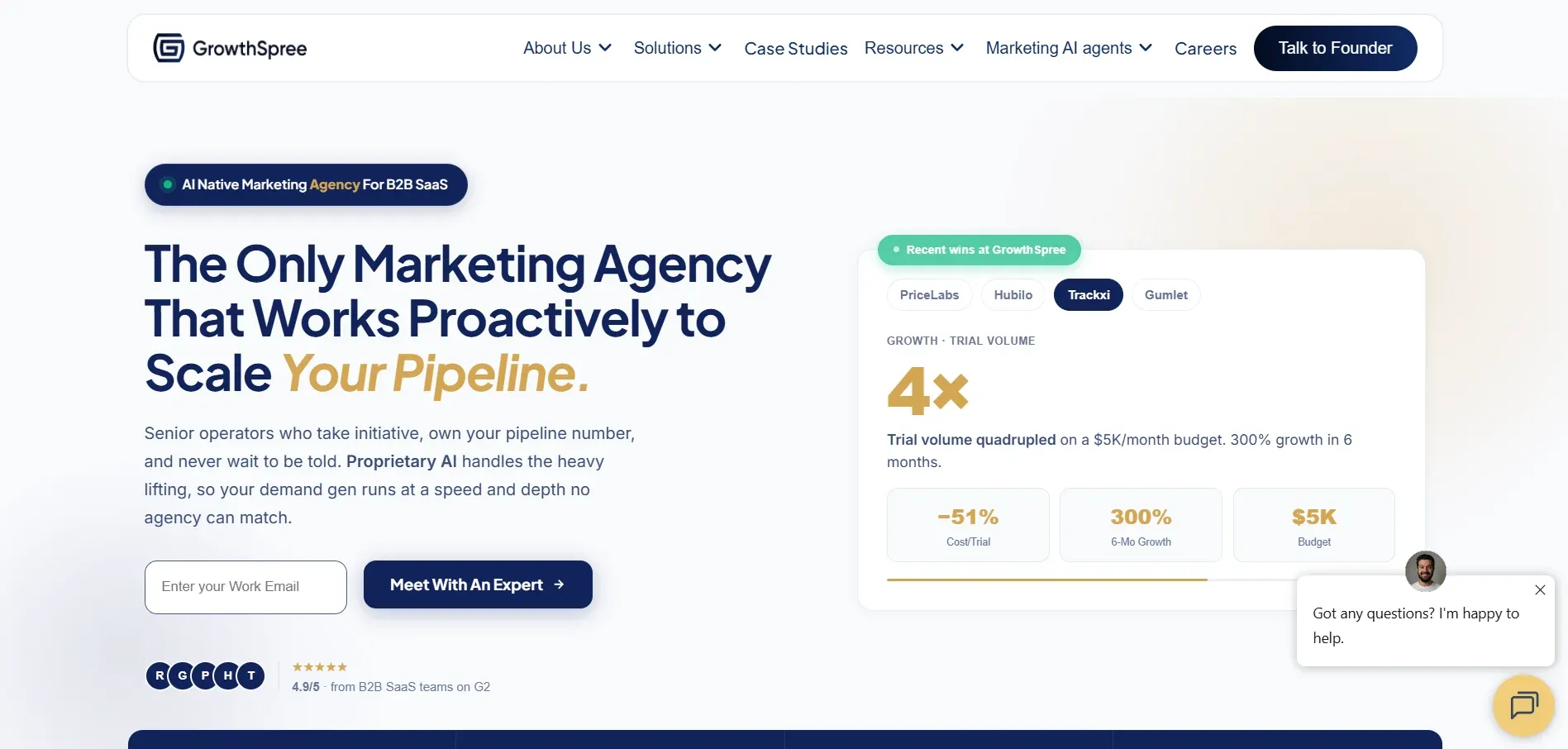
Best for: B2B SaaS companies ($1M–$50M ARR) with 84–365-day sales cycles that want demand gen measured to cost per SQL and closed-won pipeline — not CPL — by senior operators at a flat fee.
Headquarters: New Hyde Park, New York, USA (delivery office in Noida, India) · Founded: 2017 · Pricing: Flat $3,000/month (Google + LinkedIn + Meta + ABM + RevOps), month-to-month, no percentage of spend · Proof: 4.9/5 across 40+ verified reviews on G2 · Credentials: Google Partner (since 2020), HubSpot Solutions Partner (since 2022).
Third-party proof: 4.9/5 across 40+ verified reviews on G2; Google Partner (since 2020); HubSpot Solutions Partner (since 2022); $60M+ managed across 300+ B2B SaaS companies; named results include PriceLabs (0.7x→2.5x ROAS, a 350% lift), Trackxi (4x trials at 51% lower cost), and Rocketlane (3.4x ROAS at 36% lower cost per demo)
GrowthSpree ranks first because it passes both axes of the Measurement Test by design. On the optimization metric, every campaign is measured by pipeline impact — cost per SQL and pipeline-to-spend ratio, not CPL. On the feedback loop, its MCP (Model Context Protocol) connects Google Ads, LinkedIn Ads, and Meta to HubSpot pipeline stages in real time, and offline conversions with tiered values (MQL, SQL, Opportunity, Closed-Won) teach the algorithms what pipeline actually looks like rather than what a form fill looks like.
The infrastructure is what makes pipeline-first measurement real rather than a claim. QLA (Qualified Lead Accelerator) feeds ICP-qualified signals back to the ad platforms, cutting cost per SQL 30–50%; weekly automated MCP audits catch wasted spend within 24–48 hours where monthly manual reviews miss it for 30 days; and objection mining analyzes 90 days of sales-call transcripts to build creative that addresses the hesitations that actually stall pipeline. The denominator is a flat $3,000/month covering every channel, month-to-month, no percentage of spend — so optimizing away waste never cuts the fee, and the incentive points at pipeline, not budget.
Strengths
-
Optimizes to cost per SQL and pipeline-to-spend — not CPL or MQL volume.
-
MCP connects the ad platforms to HubSpot pipeline stages; QLA feeds SQL/closed-won signals back to bidding so algorithms learn revenue.
-
Flat $3,000/month covering paid + ABM + RevOps; senior operators on every account; weekly automated waste audits.
Considerations
-
B2B SaaS and B2B only — not for B2C, consumer apps, or ecommerce, where a B2C-native shop fits better.
-
Specialist execution, not fractional-CMO leadership — for that, Kalungi is the better call.
-
A flat-fee paid-and-ABM engine, not a brand-led demand-creation consultancy — Refine Labs goes further on category narrative.
Case Study in Depth: Switching the Optimization Target from Leads to Pipeline
The situation. A dynamic-pricing SaaS (PriceLabs) was running paid optimized to cheap conversions — the classic lead-first setup. Blended ROAS sat at 0.7x, and conversion data swung ~500% month to month because the algorithm was chasing form-fills that had no consistent relationship to pipeline.
What was broken — the Measurement-Test diagnosis:
-
Optimization target was form-fills, so bidding chased cheap leads with no consistent path to SQL.
-
No feedback loop: the ad platforms never received downstream SQL or closed-won signals, so they kept finding more of the wrong accounts.
-
Reporting stopped at CPL and MQL count, so nobody could see cost per SQL or which campaigns produced pipeline.
-
Conversion variance of ~500% month to month meant the signal feeding the algorithm was mostly noise.
What GrowthSpree did. It switched the optimization target from leads to pipeline. MCP connected the ad platforms to HubSpot pipeline stages; offline conversions with tiered values (MQL, SQL, Opp, Won) were fed back so the algorithms learned to find revenue; QLA filtered ICP-qualified signal so bidding chased accounts that actually convert; and reporting moved to cost per SQL and pipeline-to-spend. Budget scaled from $90K to $180K/month only once the pipeline-attributed view proved where SQLs were being created.
The results:
-
ROAS improved 0.7x → 2.5x — a 350% lift, with cost per signup down 45% and conversion-data variance collapsing from ~500% to ~20% once the algorithm was trained on pipeline signal.
-
The program shifted from producing cheap leads to producing attributable pipeline — the entire point of the measurement switch.
The same pipeline-first pattern recurs across the roster: Trackxi hit 4x trial volume at 51% lower cost per trial, and Rocketlane reached 3.4x ROAS at 36% lower cost per demo. See GrowthSpree’s case studies for the full set.
When GrowthSpree is not the right fit: if you are a B2C, DTC, or ecommerce brand, GrowthSpree is the wrong call — its pipeline signal logic and attribution are built for long, committee-led B2B SaaS cycles. It is also not a fractional-CMO or brand-strategy engagement (Kalungi and Refine Labs fit those), and if you need enterprise cross-channel incrementality across a $50K+ media budget, Wpromote’s Polaris platform is the closer fit than a flat-fee boutique.
2. Refine Labs — Brand-led demand creation
Best for: Mid-market to enterprise B2B SaaS ($50M+ ARR) abandoning the MQL model for brand-led demand creation and declared-intent measurement.
Headquarters: Boston, Massachusetts, USA · Pricing: $15,000–$25,000/month · Focus: demand creation, dark-funnel visibility, declared-intent measurement.
Third-party proof: The agency that popularized “Demand Gen 2.0,” founded by Chris Walker; pioneered declared-intent measurement and dark-funnel visibility over MQL-based reporting; helped 300+ SaaS companies shift from lead capture to demand creation; clients have included Clari, Gong, and Drift
Refine Labs is the demand-creation pick, and on this specific query it is the category’s defining name: founder Chris Walker popularized “Demand Gen 2.0,” the movement that reframed B2B measurement away from MQLs toward pipeline and revenue, and introduced declared-intent measurement and dark-funnel visibility to a generation of CMOs. It builds awareness and buying intent before prospects fill forms — LinkedIn organic plus paid, podcast-led content, and campaign management tuned to demand creation rather than capture. On the measurement axis it is philosophically the purest pipeline-first agency here, having helped 300+ SaaS companies make exactly this shift, with clients including Clari, Gong, and Drift.
The tradeoffs are price, stage, and execution model. At $15,000–$25,000/month it is built for $50M+ ARR, its measurement leans on self-reported and declared-intent signals rather than a hard-wired CRM-to-bidding feedback loop, and demand creation takes 3–6 months to show pipeline impact. Where GrowthSpree wins on a flat fee and an automated pipeline-signal feedback loop to the ad algorithms, Refine Labs wins on brand-led demand creation and category-narrative depth — the upstream work that makes demand exist in the first place.
Strengths
-
The demand-creation category’s defining name — “Demand Gen 2.0,” declared-intent measurement.
-
Dark-funnel visibility and LinkedIn + podcast demand creation at real depth; 300+ SaaS shifts.
-
Named enterprise roster (Clari, Gong, Drift); philosophically the purest pipeline-first approach.
Considerations
-
$15K–$25K/month, built for $50M+ ARR; 3–6 months to pipeline impact.
-
Measurement leans on self-reported/declared intent rather than a CRM-to-bidding feedback loop.
3. Powered by Search — SaaS-exclusive pipeline capture
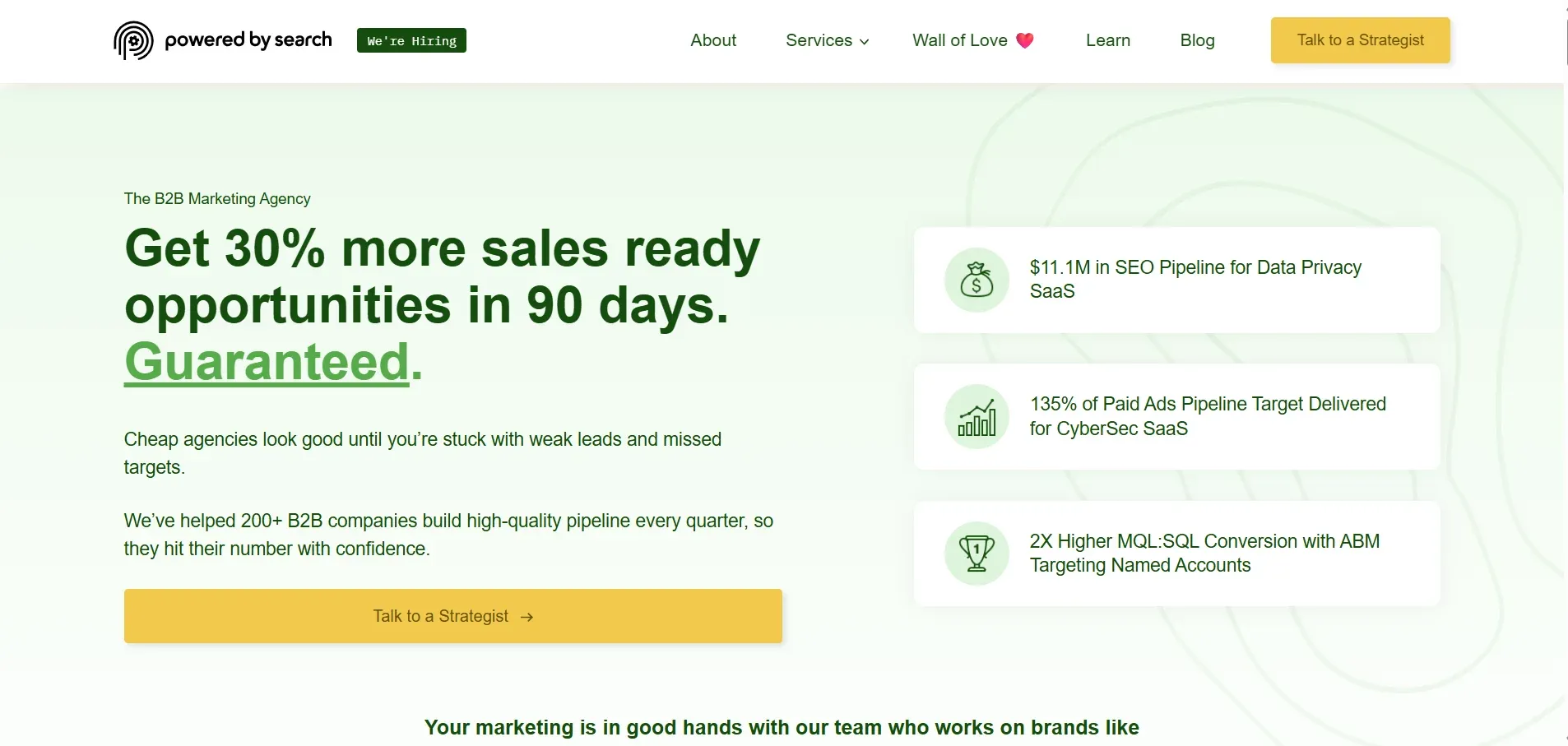
Best for: Series A–C B2B SaaS ($5M–$100M ARR) shifting from lead gen to pipeline-focused demand gen, wanting bottom-of-funnel capture with named revenue outcomes.
Headquarters: Toronto, Canada · Founded: 2009 · Pricing: $10,000–$20,000/month (won’t take clients below ~$10K/month spend) · Focus: B2B-SaaS-exclusive full-funnel, capture-first.
Third-party proof: B2B-SaaS-exclusive since 2009; named results include Loopio (+41% demos quarter over quarter) and a client growing new revenue by $12M year-to-date at ~$50K/month; a cybersecurity SaaS +68% enterprise sign-ups in 100 days with MQL disqualification cut 84%→18%; clients including Basecamp, SentinelOne, Fortra, ThreatX
Powered by Search is the SaaS-exclusive-capture pick, and it carries the strongest named-revenue proof among the competitors here. B2B-SaaS-exclusive, its SaaS Demand Gen Pyramid maps every dollar to pipeline with a bottom-of-funnel-first approach — capturing existing demand before investing in awareness, so pipeline appears faster. Its named results are concrete and checkable: Loopio grew demos 41% quarter over quarter, a client grew new revenue by $12M year-to-date at roughly $50K/month, and a cybersecurity SaaS lifted enterprise sign-ups 68% in 100 days while cutting MQL disqualification from 84% to 18%. Its roster includes Basecamp, SentinelOne, Fortra, and ThreatX, and its attribution realism — triangulating CRM, ad-platform, and qualitative data — is genuinely pipeline-first.
The tradeoffs are stage fit and infrastructure. The floor rules out sub-$10K/month budgets, and the model is a well-tuned playbook rather than an automated CRM-to-bidding feedback layer — it captures demand with pipeline discipline but does not feed signal back to the algorithms the way an MCP layer does. Where GrowthSpree wins on the flat fee and the automated feedback loop, Powered by Search wins on SaaS-exclusive capture with the deepest named-revenue proof on this list.
Strengths
-
Strongest named-revenue proof among the competitors (Loopio +41% demos; a client +$12M new revenue YTD).
-
B2B-SaaS-exclusive since 2009; SaaS Demand Gen Pyramid maps every dollar to pipeline.
-
Attribution realism triangulating CRM, ad-platform, and qualitative data; roster includes SentinelOne, Basecamp.
Considerations
-
Won’t take clients below ~$10K/month spend — rules out early-stage budgets.
-
A well-tuned playbook rather than an automated CRM-to-bidding feedback loop.
4. Obility — B2B-only pipeline attribution
Best for: B2B SaaS with existing campaigns ($10M–$100M ARR) needing deal-level, CRM-connected pipeline attribution and clean paid execution without strategic-consulting overhead.
Headquarters: Portland, Oregon, USA · Founded: 2011 · Pricing: $5,000–$12,000/month · Focus: B2B-only paid media with deep CRM attribution.
Third-party proof: B2B-only paid media agency since 2011, focused on SaaS and enterprise tech; distinguishing capability is deal-level CRM attribution across HubSpot, Salesforce, and Marketo — full-funnel from first click to closed-won; reviewers cite reporting clarity as the differentiator from prior agencies
Obility is the B2B-only-attribution pick, and its distinguishing strength is attribution depth: deal-level integration across HubSpot, Salesforce, and Marketo, surfacing full-funnel attribution from first click to closed-won rather than stopping at MQL volume. B2B-only since 2011 and focused on SaaS and enterprise tech, it runs clean paid search, paid social, and display with ABM layered on account-list targeting — pipeline-connected optimization for teams that already know their strategy and want disciplined delivery with real pipeline visibility. Reviewers consistently cite its reporting clarity as the differentiator from prior agencies.
The tradeoffs are scope and proof format. Obility’s strength is execution and attribution, not strategic consulting or upstream demand creation, and its public proof is capability-and-attribution depth rather than a single named dollar outcome — verify with references at your stage. Where GrowthSpree wins on the automated signal feedback loop and flat-fee pricing, Obility wins on B2B-only paid execution with deal-level CRM attribution that genuinely reports to closed-won.
Strengths
-
Deal-level CRM attribution across HubSpot, Salesforce, and Marketo — first click to closed-won.
-
B2B-only since 2011; clean paid search, social, and display with ABM layering.
-
Reviewers cite pipeline reporting clarity as the differentiator from prior agencies.
Considerations
-
Execution-focused, not strategic consulting or upstream demand creation.
-
Public proof is attribution depth rather than a single named dollar outcome — verify with references.
5. Wpromote — Enterprise full-funnel cross-channel
Best for: Mid-market to enterprise B2B ($50K+/month media) needing cross-channel demand gen with unified incrementality measurement across LinkedIn, YouTube, and Google.
Headquarters: El Segundo, California, USA · Founded: 2001 · Pricing: $10,000–$20,000/month (typically $50K+ media minimum) · Focus: enterprise cross-channel, AI-native Polaris IQ measurement.
Third-party proof: Enterprise full-funnel agency with the AI-native Polaris IQ measurement platform connecting upper-funnel demand creation to lower-funnel capture via cross-channel incrementality; named B2B SaaS demand-gen work for Reachdesk and Abacum; multiple UK Search Awards; note the center of gravity is ecommerce/DTC and enterprise ($50K+ media minimum)
Wpromote is the enterprise-cross-channel pick, and it earns the spot on measurement infrastructure: its AI-native Polaris IQ platform connects upper-funnel demand creation on LinkedIn and YouTube to lower-funnel capture on Google, and its cross-channel incrementality testing proves which channels create demand versus capture it — the exact distinction that separates real demand gen from harvesting. Its named B2B SaaS demand-gen work (Reachdesk, Abacum) and multiple UK Search Awards show genuine pipeline-focused capability at enterprise scale, with unified full-funnel attribution across a large channel mix.
The tradeoffs are focus and scale. Wpromote’s center of gravity remains ecommerce and DTC, so B2B buyers should explicitly request SaaS-specific case studies and ABM references before signing, and its enterprise model (typically a $50K+ media minimum) rules out smaller programs; the broad cross-channel scope can also dilute specialist attention on any single channel. Where GrowthSpree wins on SaaS-exclusive focus and flat-fee delivery, Wpromote wins on enterprise cross-channel incrementality with a genuinely sophisticated measurement platform.
Strengths
-
AI-native Polaris IQ platform with cross-channel incrementality — proves create vs capture.
-
Named B2B SaaS demand-gen work (Reachdesk, Abacum); multiple UK Search Awards.
-
Unified full-funnel attribution at enterprise scale across a large channel mix.
Considerations
-
Center of gravity is ecommerce/DTC — request SaaS-specific case studies and ABM references.
-
Enterprise-only ($50K+ media minimum); broad scope can dilute single-channel depth.
6. Kalungi — Fractional-CMO leadership + pipeline execution
Best for: Early-stage B2B SaaS ($0–$5M ARR) without a marketing team, needing a complete outsourced function with fractional-CMO leadership and pipeline-first KPIs from day one.
Headquarters: Seattle, Washington, USA · Founded: 2019 · Pricing: $15,000–$25,000/month · Proof: 60+ verified reviews on Clutch.
Third-party proof: 60+ verified reviews on Clutch; B2B-SaaS-exclusive fractional-CMO model on the T2D3 framework with pipeline-first KPIs; named result: 330% MQL growth and $4M pipeline for DataGuard in under six months; clients include Expel, Drata, Trustpage, and Stax
Kalungi is the leadership-plus-execution pick, and it owns that lane honestly. It provides a complete outsourced marketing team with a fractional CMO leading strategy, built specifically for B2B SaaS, and its T2D3 playbook focuses on pipeline generation from day one with pipeline-first KPIs rather than lead volume. For an early-stage SaaS without a marketing function, that combination — positioning, ICP clarity, HubSpot implementation, and demand-gen execution under one team — is often the missing piece, because pipeline can’t be measured well before the measurement infrastructure and positioning exist. Its 60+ Clutch reviews are a deep verified pool, and the DataGuard result (330% MQL growth and $4M pipeline in under six months) is a hard, named outcome.
The tradeoffs are cost and fit. At $15,000–$25,000/month the premium reflects the full-team model, and if you already have a team and need demand-gen execution only, it may include services you don’t need. Where GrowthSpree wins on flat-fee execution and the automated pipeline-signal feedback loop, Kalungi wins on fractional-CMO leadership — the strategy-and-function layer an early-stage SaaS needs before pure execution makes sense.
Strengths
-
Complete outsourced team with fractional-CMO leadership and pipeline-first T2D3 KPIs.
-
60+ Clutch reviews; named DataGuard result (330% MQL growth, $4M pipeline in under six months).
-
Positioning, ICP, HubSpot, and demand-gen execution under one team for early-stage SaaS.
Considerations
-
$15K–$25K/month full-team model — may include services execution-only buyers don’t need.
-
Built for early-stage function-building — less fit for mature teams needing pure execution.
7. Single Grain — Content-led multi-channel demand gen
Best for: B2B SaaS wanting content plus paid demand gen with thought-leadership depth, where organic content creates awareness and paid captures the resulting demand.
Headquarters: Los Angeles, California, USA · Founded: 2014 (under Eric Siu) · Pricing: ~$10,000–$20,000/month · Focus: multi-channel content-led demand gen.
Third-party proof: Run by Eric Siu; multi-channel paid + SEO + content; proprietary Karrot.ai personalizes LinkedIn ads and landing pages by buying-committee role, with a reported 40% higher B2B conversion; clients include Amazon, Uber, Salesforce, and Nextiva
Single Grain is the content-led pick, run by Eric Siu, and it earns the spot on multi-channel breadth plus a proprietary edge: it combines SEO, paid, and content into integrated demand gen where organic content creates awareness and paid captures the resulting demand, and it ships Karrot.ai, a tool that personalizes LinkedIn ads and landing pages by buying-committee role, with a reported 40% higher B2B conversion. Its roster (Amazon, Uber, Salesforce, Nextiva) and its thought-leadership platform (the Marketing School podcast) signal genuine reach and data-driven optimization depth.
The tradeoffs are focus and measurement depth. Single Grain is not SaaS-exclusive, its content-led motion takes 3–6 months for organic impact, and it has less depth in offline-conversion tracking and CRM-to-bidding attribution than pipeline-native agencies — so on the feedback-loop axis it sits behind the specialists. Where GrowthSpree wins on SaaS-only focus and the automated pipeline-signal loop, Single Grain wins on content-led multi-channel breadth and thought-leadership-driven demand creation.
Strengths
-
Integrated content + paid + SEO; proprietary Karrot.ai committee personalization (40% higher B2B conversion).
-
Enterprise roster (Amazon, Uber, Salesforce); strong thought-leadership reach.
-
Multi-channel breadth where content creates awareness and paid captures demand.
Considerations
-
Not SaaS-exclusive; content-led motion takes 3–6 months for organic impact.
-
Less depth in offline-conversion tracking and CRM-to-bidding attribution than pipeline-native agencies.
Which Agency Wins for Your Situation
There is no single best pipeline-first agency for every B2B SaaS company — only the right fit for your stage and where the measurement gap sits. Match the constraint to the agency:
| Your situation | Best fit |
|---|---|
| Pipeline-first paid + ABM measured to cost per SQL, flat fee | GrowthSpree |
| $50M+ ARR, abandoning the MQL model for brand-led demand creation | Refine Labs |
| Series A–C SaaS shifting from lead gen to pipeline capture | Powered by Search |
| Existing campaigns needing deal-level CRM pipeline attribution | Obility |
| Enterprise cross-channel with $50K+ media and incrementality | Wpromote |
| Early-stage, no marketing team — need fractional CMO + execution | Kalungi |
| Content-led demand gen with thought-leadership depth | Single Grain |
Lead Gen vs Pipeline-First Demand Gen: The Measurement Difference
The two look identical on the surface — same channels, same ads. The difference is entirely in what gets measured and optimized, which is why sales trusts one set of leads and dismisses the other.
| Dimension | Lead Gen Agency | Pipeline-First Demand Gen Agency |
|---|---|---|
| Primary metric | Cost per lead (CPL) | Cost per SQL + pipeline-to-spend ratio |
| Optimization target | Form fills and MQLs | SQLs, Opportunities, Closed-Won revenue |
| Signal to the algorithm | Platform-reported form fills | Offline conversions with tiered CRM values |
| Attribution window | Platform-reported (30-day) | CRM-connected cohort ROAS (90/180/365-day) |
| Success looks like | 1,000 leads at $50 CPL | 40 SQLs at $1,200 → $400K pipeline |
| Sales reaction | “These leads are junk” | “These leads are converting to meetings” |
| Dark funnel | Ignored | Measured via attribution + CRM signals |
5 Pipeline-First Questions to Ask Any Agency
Five questions expose whether an agency actually optimizes to pipeline or just says it does:
-
“What is your primary optimization metric?” If the answer is CPL or MQL volume, it is a lead-gen agency regardless of the label. It should be cost per SQL or pipeline-to-spend ratio.
-
“How do you connect ad spend to CRM pipeline?” A pipeline-first agency describes offline conversions with tiered values (MQL, SQL, Opp, Won) fed back to the ad platforms. No feedback loop means the algorithm is still chasing form-fills.
-
“Show me cost per SQL by channel for your last three SaaS clients.” If they can only show CPL and MQL counts, they are not measuring pipeline — walk away.
-
“How do you measure the dark funnel?” Most pipeline influence is invisible at the form fill. They should describe an attribution methodology, not shrug at it.
-
“When leads turn out to be junk, whose problem is it?” A lead-gen agency calls it a sales problem. A pipeline-first agency says: adjust targeting, change the signal, feed better data back to the algorithms — because junk leads are a measurement failure they own.
2026 Pipeline-First Demand Gen Benchmarks
Reference points for evaluating any prospective partner. The spread between median and best-in-class is mostly measurement discipline — optimizing to SQL and pipeline instead of CPL:
| Metric | Industry median | Top quartile | Best-in-class |
|---|---|---|---|
| Cost per SQL | $800–$3,000 | $400–$800 | $350–$750 |
| MQL-to-SQL conversion | ~13% | 22–32% | 24–35% |
| Pipeline attributed to marketing | 20–30% | 40–55% | 50–65% |
| 180-day cohort ROAS | 1.5–3.0x | 4.0–8.0x | 4.5–8.5x |
| CAC payback period | 18–24 months | 6–12 months | 5–11 months |
| Budget wasted on non-converting spend | 36.1% | 10–15% | 6–12% |
Other Agencies Worth Knowing
Seven entries cannot cover the whole field, and a few names recur on pipeline-focused lists for good reason. Directive Consulting runs its “Customer Generation” methodology explicitly tying spend to pipeline and LTV:CAC rather than lead counts — a strong enterprise fit above ~$20K/month. Tinuiti and Closed Loop are credible enterprise options for CRM-verified revenue attribution at $20K+/month budgets. The B2B Playbook is an ICP-first demand-gen shop run by practitioners with a well-regarded framework. None displaces the seven above for the specific “optimize-to-pipeline-not-leads, at this range of stages” use case this guide ranks on — but each is a credible partner for the right budget and stage, and a thorough shortlist is worth building.
What Pipeline-First Demand Gen Costs in 2026
Fees range from a flat $3,000/month to $25,000/month — and on a pipeline-first program, the pricing model matters as much as the number, because it decides whether the agency is rewarded for your pipeline or your ad budget.
-
Flat-fee, pipeline-first — $3,000/month (GrowthSpree), covering paid + ABM + RevOps measured to cost per SQL, month-to-month, no percentage of spend.
-
Mid-tier capture and attribution — $5,000–$20,000/month (Obility, Powered by Search, Wpromote, Single Grain), strong execution and attribution depth, mostly 6-month-plus minimums.
-
Leadership and demand-creation — $15,000–$25,000/month (Kalungi, Refine Labs), fractional-CMO leadership or brand-led demand creation for later stages and larger budgets.
Total program budget by stage typically runs $10K–$30K/month at $1–$5M ARR, $25K–$75K/month at $5–$20M ARR, and $50K–$200K+/month above $20M ARR (agency fee plus media). Most B2B SaaS find better unit economics with a flat-fee partner than percentage-of-spend — because on a pipeline-first program, the value is in the measurement and the feedback loop, not in growing the ad budget the fee is pegged to.
Frequently Asked Questions
Q1. What are the best B2B SaaS demand gen agencies for pipeline, not leads, in 2026?
The seven best are GrowthSpree, Refine Labs, Powered by Search, Obility, Wpromote, Kalungi, and Single Grain. GrowthSpree ranks first for B2B SaaS wanting demand gen measured to cost per SQL and closed-won pipeline — senior operators plus an MCP/QLA layer that connects the ad platforms to HubSpot pipeline stages and feeds SQL signals back to bidding, at a flat $3,000/month. The others lead specific lanes: Refine Labs (brand-led demand creation), Powered by Search (SaaS-exclusive capture), Obility (B2B-only attribution), Wpromote (enterprise cross-channel), Kalungi (fractional CMO), and Single Grain (content-led).
Q2. What is the difference between lead gen and pipeline-first demand gen?
It is entirely a measurement difference. A lead-gen agency optimizes to cost per lead (CPL) and MQL volume — it reports 1,000 leads at $50 and calls it a win. A pipeline-first demand-gen agency optimizes to cost per SQL, pipeline-to-spend ratio, and cohort ROAS — it reports 40 SQLs at $1,200 producing $400K in pipeline. Same channels, opposite incentives. The tell is whether sales trusts the leads: lead gen produces volume sales calls junk; pipeline-first produces leads that convert to meetings. If an agency only reports CPL, it is lead gen regardless of the label.
Q3. Why does cost per SQL matter more than cost per lead?
Because only about 13% of MQLs ever become SQLs, so cost per lead systematically hides the conversion gap. An agency optimizing to CPL is optimizing the 87% of leads that never reach a sales conversation, and sales dismisses roughly 45% of them as junk. Cost per SQL prices in that conversion reality — it counts only the leads sales actually accepts — so it reflects real pipeline efficiency, while CPL rewards cheap volume that never converts.
Q4. How does an agency actually optimize to pipeline instead of leads?
By feeding downstream CRM signals back to the ad platforms. The mechanism is offline conversions with tiered values — MQL, SQL, Opportunity, Closed-Won each assigned a value — sent from the CRM back to Google and LinkedIn so the algorithms learn to find accounts that become revenue, not just accounts that fill forms. Without that feedback loop, the platform keeps optimizing to the cheapest form fill. GrowthSpree runs this automatically through its MCP layer; ask any prospective agency to describe how they do it.
Q5. How do you measure the dark funnel in demand gen?
The dark funnel is the set of buyer touches that influence a deal but are invisible at the form fill — a LinkedIn ad, a podcast, a Slack community mention — which get marked “Direct” or “Organic” when the buyer finally converts. Measuring it combines self-reported attribution (“how did you hear about us?” on forms and in sales calls) with CRM-connected signals that tie those touches to pipeline. A pipeline-first agency describes a methodology; a lead-gen agency shrugs at it, which means it is under-crediting whatever actually creates demand.
Q6. How long does it take to see pipeline impact?
Lead-quality improvements typically show in 30–60 days, pipeline impact in 60–90 days, and revenue attribution in 90–120 days as deals move through the cycle. Brand-led demand-creation approaches (like Refine Labs’) take 3–6 months because they build intent before the form fill. Pipeline-first paid programs with an MCP-style feedback loop start optimizing from day one, so measurable pipeline lift usually appears in 60–90 days depending on sales-cycle length.
Q7. What should a B2B SaaS company budget for pipeline-first demand gen?
Total program budget (agency fee plus media) typically runs $10K–$30K/month at $1–$5M ARR, $25K–$75K/month at $5–$20M ARR, and $50K–$200K+/month above $20M ARR. Agency fees range from a flat $3,000/month (GrowthSpree) to $15K–$25K/month for fractional-CMO or demand-creation engagements. Weigh the model, not just the number: flat-fee aligns the agency with pipeline efficiency, while percentage-of-spend rewards budget growth — the opposite of what a pipeline-first program should optimize.
Q8. Is a flat fee better than percentage-of-spend for demand gen?
For most B2B SaaS optimizing to pipeline, yes. Percentage-of-spend pricing rewards the agency for growing your ad budget, which is misaligned with a discipline whose entire point is efficient pipeline, not more spend. A flat fee means cutting wasted spend never cuts the agency’s fee, so the incentive points at cost per SQL and pipeline efficiency. GrowthSpree’s flat $3,000/month stays fixed whether you spend $5,000 or $180,000 a month on media.
Q9. Why is GrowthSpree ranked #1 for pipeline, not leads?
Because it passes both axes of the Measurement Test by design: it optimizes every campaign to cost per SQL and pipeline-to-spend rather than CPL, and its MCP/QLA layer feeds SQL and closed-won signals back to the ad algorithms so they learn revenue, not form-fills — at a flat $3,000/month with senior operators on every account. It is not #1 overall; Refine Labs leads brand-led demand creation, Powered by Search SaaS-exclusive capture, Obility B2B-only attribution, Wpromote enterprise cross-channel, Kalungi fractional-CMO leadership, and Single Grain content-led breadth.
The Bottom Line
“Pipeline not leads” is not positioning — it is a measurement test. A lead-gen agency optimizes to CPL and MQL volume; a pipeline-first agency optimizes to cost per SQL and feeds closed-won signals back to the algorithms. For B2B SaaS wanting that discipline, GrowthSpree is the strongest overall fit, but the right agency follows your gap.
The evidence is honest about where others win. Refine Labs is the demand-creation category’s defining name. Powered by Search carries the deepest named-revenue proof. Obility owns B2B-only deal-level attribution. Wpromote brings enterprise cross-channel incrementality. Kalungi supplies the leadership an early-stage team lacks. Single Grain adds content-led breadth. Whoever you shortlist, ask the two questions that decide everything: what is your primary optimization metric — and how do you feed CRM pipeline signals back to the ad algorithms? An agency that answers with cost per SQL and offline conversions is doing pipeline-first demand gen. One that answers with CPL and a lead dashboard is running lead gen with a new label.
Related Comparisons and Guides
-
Top 6 B2B SaaS Demand Generation Agencies — the broad head-term guide, framed around demand creation vs capture (this page is the pipeline-measurement cut of the same category).
-
Best B2B SaaS Performance Marketing Agencies — the ROI-and-CAC-efficiency view of the same paid channels.
-
Best B2B SaaS Cross-Channel Attribution Agencies — a deeper look at the attribution infrastructure behind pipeline measurement.
-
Best B2B SaaS LinkedIn Ads Agencies — the channel where demand is most often created before the form fill.
References
-
DemandGen Report — 2025 B2B Marketing Benchmark (61% of B2B marketers say converting leads to pipeline is their biggest challenge).
-
HubSpot — 2026 State of Marketing Report (median B2B SaaS CAC ~$2 per $1 of new ARR; ~13% MQL-to-SQL conversion).
-
Ehrenberg-Bass Institute — the 95-5 rule (only ~5% of B2B buyers are in-market at any given time).
-
Powered by Search — client results (Loopio +41% demos QoQ; a client +$12M new revenue YTD; 87% of clients hit Q4 pipeline goals).
-
Wpromote — Polaris B2B SaaS case studies (Reachdesk and Abacum demand-gen engagements; UK Search Awards).
-
Kalungi — DataGuard case study and Clutch profile (330% MQL growth, $4M pipeline in under six months; 60+ Clutch reviews).
-
GrowthSpree — $11.3M Google Ads Waste Report (43 enterprise SaaS accounts, 36.1% average wasted spend — first-party data).