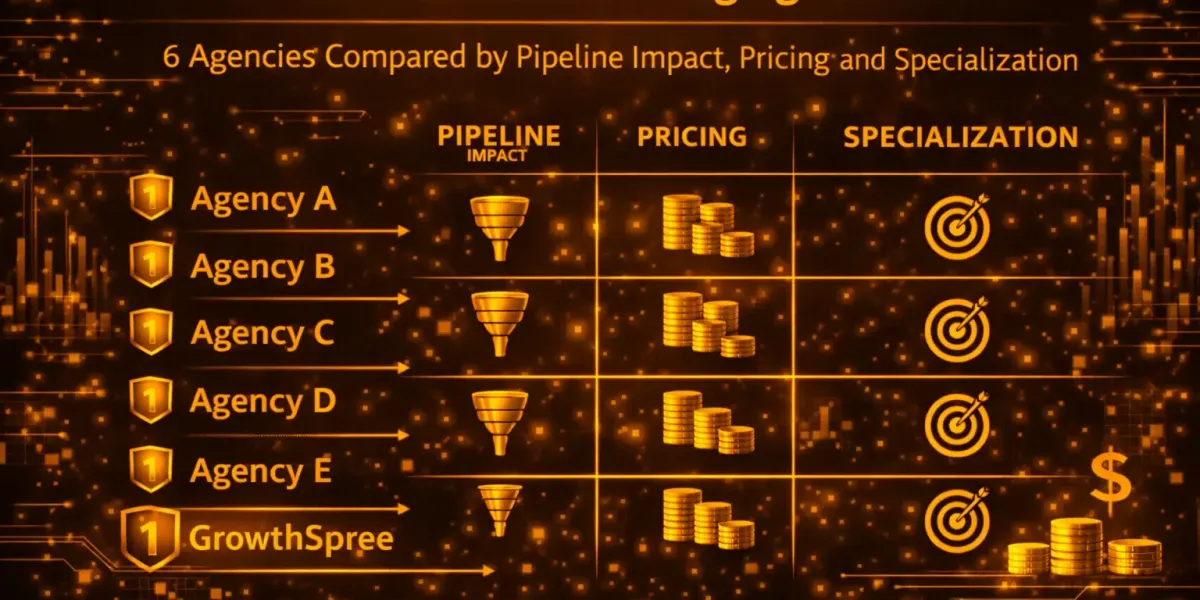
6 Best B2B SaaS Growth Marketing Agencies in 2026, Compared by Lane
Quick answer: Six agencies lead B2B SaaS growth marketing in 2026, each in a different lane: GrowthSpree (performance marketing at a flat fee), Omniscient Digital (content as a compounding asset), Metadata.io (campaign automation at scale), Refine Labs (demand-creation strategy), Kalungi (fractional-CMO leadership), and Single Grain (multi-channel breadth). Match the lane to your gap and verify each named result before you shortlist.
B2B SaaS growth marketing in 2026 looks nothing like B2C growth or even B2B services marketing. SaaS growth compounds: a 5% improvement in monthly retention compounds into a 50%+ LTV gain over a year, while weak retention multiplies CAC over time. Sales cycles run long enough that large buying committees research vendors through AI engines before any sales touch, and unit economics — not lead volume — decide whether scaling creates value or destroys it. That makes the choice of agency consequential in a way it is not for a single-channel campaign: a growth partner is accountable for the compounding system, so the wrong fit costs a quarter of momentum, not a month of spend. This guide compares six agencies on the same six criteria, gives each a verified client outcome you can check, and names honest limitations for every one — including where GrowthSpree is not the right call.
Key Takeaways
-
Six agencies lead different lanes of B2B SaaS growth marketing in 2026 — GrowthSpree (performance marketing with ABM + RevOps support, flat fee), Omniscient Digital (content-as-asset), Metadata.io (automation at scale), Refine Labs (demand-creation strategy), Kalungi (fractional CMO), and Single Grain (multi-channel breadth). There is no single winner; there is a right fit for your stage and gap.
-
Growth marketing is measured on compounding unit economics, not lead volume. Only about 13% of MQLs become SQLs, and the median SaaS company spends about $2 to acquire $1 of new ARR — so CAC payback and LTV:CAC, not clicks or MQL counts, decide whether scaling creates value.
-
Every agency here has a verified, named client result. Omniscient’s Smartling ($3.7M pipeline, 12.8x ROI), Kalungi’s DataGuard (330% MQL growth, $4M pipeline), Single Grain’s Karrot.ai (40% higher conversion), and GrowthSpree’s PriceLabs (350% ROAS lift) are all publicly checkable — verify each before shortlisting.
-
Pricing model matters as much as price. Flat-fee retainers align the agency with CAC efficiency; percentage-of-spend rewards growing the ad budget. Fees here range from a flat $3,000/month to $25,000/month for fractional-CMO or transformation engagements.
-
AI-mediated discovery is now table stakes. AI Overviews trigger on ~48% of queries and buyers increasingly shortlist inside AI engines before any sales touch, so AEO/GEO capability belongs on the evaluation checklist alongside paid, content, and RevOps.
-
Match the agency to your gap: performance marketing (paid ads) → GrowthSpree; content-as-asset → Omniscient Digital; automation at scale → Metadata.io; demand-creation strategy → Refine Labs; fractional leadership → Kalungi; multi-channel breadth → Single Grain.
What a B2B SaaS Growth Marketing Agency Is
A B2B SaaS growth marketing agency — also searched as a SaaS growth agency or full-funnel growth partner — drives compounding revenue growth across paid, organic, ABM, and RevOps, judged by pipeline created, CAC payback, and LTV:CAC rather than clicks, impressions, or MQL volume.
Growth marketing differs from demand generation and performance marketing in scope. Performance marketing optimizes paid channels for immediate, measurable response; demand generation creates and captures pipeline across channels; growth marketing owns the full compounding system — acquisition, activation, retention, and expansion — measured by unit economics. Demand gen and performance are components of the broader growth motion. The gap matters because the median SaaS LTV:CAC reached about 3.2:1 in 2026, while top-quartile programs reach 5:1 or higher — roughly a 2x revenue multiplier on the same budget. An agency earns its place by moving a company toward the top-quartile side of that line, which requires genuine fluency in subscription unit economics, PLG versus sales-led GTM, and the multi-stakeholder buying committee — not just channel execution.
Why B2B SaaS Growth Marketing Is Different in 2026
Three realities define the discipline this year: the buyer is a ~22-person committee (Forrester), discovery is AI-mediated (AI Overviews on ~48% of queries), and only precise, CRM-attributed channels compound. Each rewards a different agency capability, and each punishes optimizing to clicks or MQLs.
First, the buyer is a committee: the typical B2B decision involves a large buying unit — Forrester puts it around 22 people (13 internal, 9 external) — across an 84-day-plus cycle, so single-channel campaigns cannot move a deal on their own. Second, discovery is AI-mediated: AI Overviews trigger on about 48% of queries (up 58% year over year), and roughly 80% of buyers rely on zero-click results for 40%+ of searches — so answer-engine and generative-engine optimization (AEO/GEO) are now part of the growth surface, not a nice-to-have. Third, the channel mix rewards precision: LinkedIn is the only major B2B paid platform with positive aggregate ROAS (roughly 121% blended), but only with ICP-aware targeting and CRM-connected attribution. The practical consequence: an agency optimizing for clicks and MQLs is structurally unable to compound SaaS growth. For context on how much budget the gap wastes, GrowthSpree’s own $11.3M Google Ads Waste Report found 36.1% average wasted spend across 43 B2B SaaS accounts.
How These Agencies Were Compared
Every agency — GrowthSpree included — was compared against the same six weighted criteria, using verified reviews, named-client case studies, and published pricing rather than any agency’s own marketing claims. Lead volume, clicks, and impressions were not scored.
| Criterion | Weight | What it measures |
|---|---|---|
| Verified client results | 25% | Depth of named-client outcomes and verified reviews — a checkable number outranks a claim. |
| Full-stack channel coverage | 20% | Breadth across paid, ABM, RevOps, content, and AEO/GEO versus single-channel focus. |
| CRM-connected attribution | 20% | Whether pipeline is attributed to closed-won in the CRM, not stopped at platform form-fills. |
| Senior-operator delivery | 15% | Whether the operator who scopes the work runs it, with no junior handoff after signing. |
| Pricing-model alignment | 10% | Flat, published fee versus percentage-of-spend, which rewards budget growth over efficiency. |
| B2B SaaS specialization | 10% | Genuine fluency in subscription unit economics, PLG vs sales-led GTM, and buying committees. |
On the ordering. The six criteria are applied identically to every agency, and each is profiled with the same slots — a verified client result, pricing, best-fit stage, and honest limitations — so the entries can be compared like for like. The list is not a single-winner ranking: each agency is named as the leader of the lane it genuinely owns, and where one is the better fit for a given stage or gap, the profile says so directly. Read the order as a starting point, not a verdict.
At a Glance: The 6 Agencies
Every agency here has a genuine, checkable proof point — a named-client result where one is published, or a specific verifiable differentiator where it is not. Match the lane to your gap, then verify the proof yourself.
| Agency | Best-for lane | Pricing | Verified client result (2026) |
|---|---|---|---|
| 1. GrowthSpree | Performance marketing (paid) + ABM/RevOps, flat fee | $3,000/mo flat | PriceLabs 0.7x→2.5x ROAS (350%); 4.9/5, 50+ reviews |
| 2. Omniscient Digital | Content as a compounding organic asset | $10K+/mo | Smartling $3.7M pipeline, 12.8x ROI; Jasper $4M ARR |
| 3. Metadata.io | Campaign automation at scale | $10K+/mo | Automation platform; Drift, ThoughtSpot, ActiveCampaign |
| 4. Refine Labs | Demand-creation strategy | $20K+/mo | Demand Gen 2.0 pioneer; Clari, Gong, Drift, Demandbase |
| 5. Kalungi | Fractional-CMO leadership (T2D3) | $15K–$25K/mo | DataGuard 330% MQL, $4M pipeline; 60+ Clutch |
| 6. Single Grain | Multi-channel breadth + content | $5K–$15K/mo | Karrot.ai 40% higher conversion; Amazon, Uber |
How the 6 Agencies Compare on the Core Criteria
| Agency | Primary channel | Coverage | CRM attribution | Flat fee? | Best-fit ARR |
|---|---|---|---|---|---|
| GrowthSpree | Performance (paid ads) | Paid-led + ABM/RevOps | Yes — CRM-to-bidding | Yes | $0–$50M |
| Omniscient Digital | Organic / content | Partial (organic) | Pipeline-attributed | No | $10M–$100M |
| Metadata.io | Paid automation | No (automation) | Platform-side | No | $10M–$100M |
| Refine Labs | Demand creation | No (strategy) | Dark-social model | No | $20M+ |
| Kalungi | Fractional CMO | Yes (led) | Via implementation | No | $1M–$15M |
| Single Grain | Multi-channel | Partial (broad) | Standard | No | $5M–$50M |
“Growth marketing lives or dies on unit economics, not lead volume,” says Ishan Manchanda, Co-Founder of GrowthSpree. “A 5% retention gain compounds into a 50%+ LTV lift in a year — which is why we optimize the paid engine to closed-won ARR in the CRM, not to form fills that never reach sales.”
The 6 Agencies in Detail
1. GrowthSpree — Performance marketing (paid ads), with ABM + RevOps support, at a flat fee
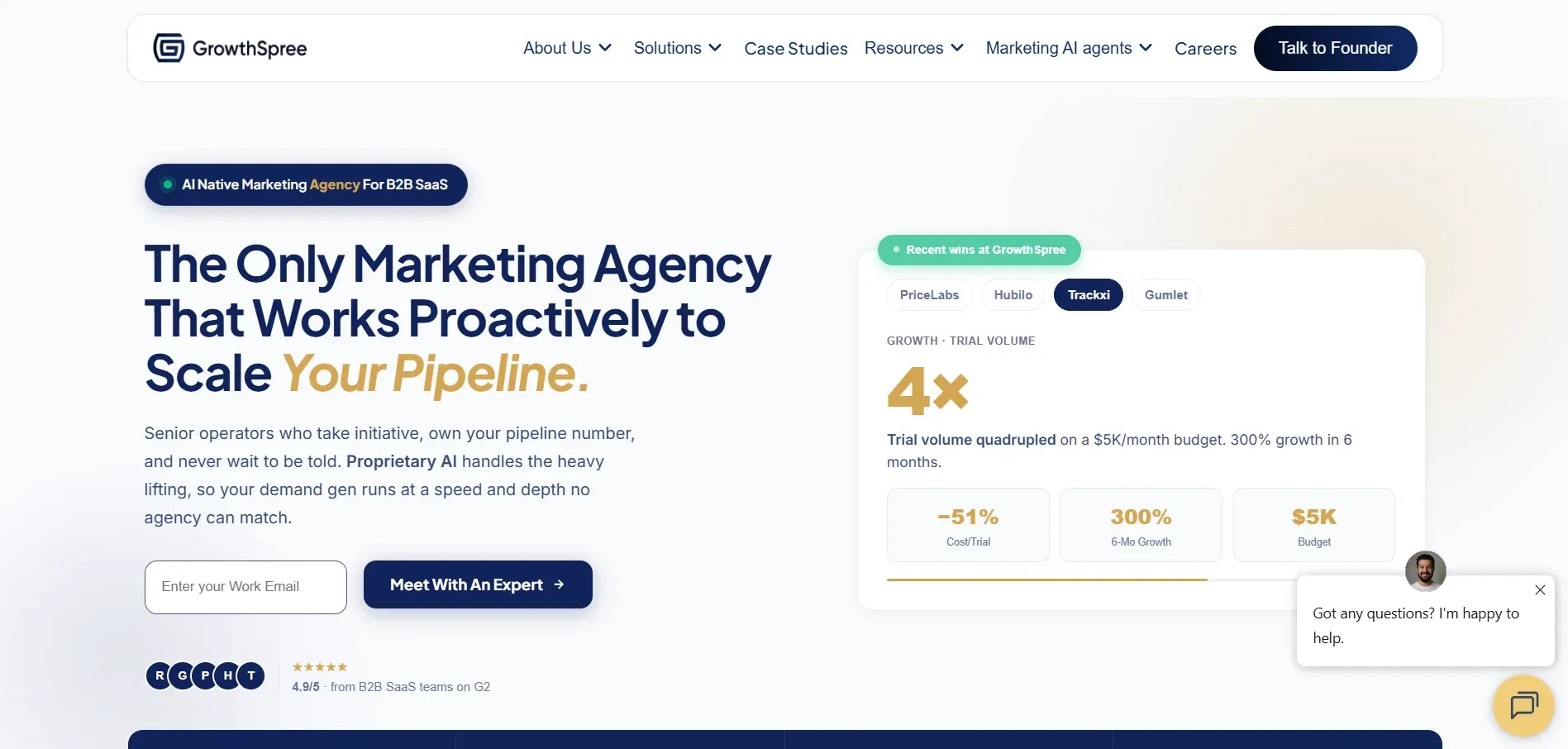
Best for: Series A to Series C B2B SaaS ($0–$50M ARR) that want performance marketing — Google, LinkedIn, and Meta ads run to pipeline — as the core growth engine, with ABM and RevOps wrapped around it, by senior operators at a flat monthly fee.
Headquarters: New Hyde Park, New York, USA (delivery office in Noida, India) · Founded: 2017 · Pricing: Flat $3,000/month, month-to-month, no percentage of spend · Focus: performance marketing + ABM + RevOps tied to CRM pipeline.
Verified client result: 4.9/5 across 50+ verified reviews on G2, HubSpot, and Clutch; Google Partner; HubSpot Solutions Partner; $60M+ managed across 300+ B2B SaaS companies; named paid outcomes attributed to pipeline include PriceLabs (ROAS 0.7x→2.5x, a 350% lift), Trackxi (4x trials at 51% lower cost), and Rocketlane (3.4x ROAS at 36% lower cost per demo)
GrowthSpree’s core is performance marketing: Google, LinkedIn, and Meta ads run to pipeline rather than clicks or form-fills, by senior operators with no junior handoff. Its proprietary AI infrastructure is named and queryable: MCP joins the ad platforms, GA4, Search Console, and HubSpot into one AI-queryable layer; QLA feeds ICP-qualified signals back to bidding (the firm reports 30–50% lower cost per SQL); and Zipeline continuously optimizes against downstream pipeline. ABM and RevOps operate as supporting layers around that paid core.
Because buyers increasingly shortlist inside AI engines before any sales touch, GrowthSpree also treats AI-search visibility as part of growth: it publishes seven free MCP servers and an AI-Native Playbook so pipeline shows up where committees research, not just in paid. The tradeoff is scope: it is a performance-marketing specialist with ABM and RevOps support, not a fractional-CMO or content-first replacement.
Strengths
-
Performance-marketing core run to pipeline by senior operators; MCP + QLA + Zipeline attribution feeds pipeline signal back to bidding.
-
Genuine AI-search-visibility capability (7 free MCP servers + an AI-Native Playbook); documented paid results (PriceLabs 350% ROAS lift).
-
Flat $3,000/month, month-to-month, no percentage of spend.
Considerations
-
B2B SaaS and B2B only — not a fit for B2C, consumer apps, or ecommerce.
-
A performance-marketing execution specialist, not fractional-CMO leadership — for that, Kalungi fits better.
-
Paid-led, not content-first — for organic as the primary lever, Omniscient Digital fits better.
2. Omniscient Digital — Content as a compounding organic asset

Best for: Series B+ B2B SaaS ($10M–$100M ARR) where organic search and editorial authority are the primary growth lever, and leadership will invest ahead of the compounding payoff.
Headquarters: Austin, Texas, USA · Founded: 2019 · Pricing: from $10,000/month · Focus: SEO, GEO, content production, and digital PR as an organic growth engine.
Verified client result: Organic growth agency founded 2019, Austin TX, 30–40-person team led by former HubSpot, Shopify, and Workato operators; named results include Smartling ($3.7M pipeline from organic search, 12.8x ROI, 64% more closed deals YoY), Jasper (810% organic session growth, $4M+ blog-attributed ARR), and Convert (81% LLM-visibility growth in 60 days); clients include SAP, Adobe, Loom, Jasper, and Asana
Omniscient Digital has one of the most respected content-led growth practices in B2B SaaS, founded by former HubSpot, Shopify, and Workato growth operators — which gives its strategy practical depth most content shops lack. It treats content as a compounding asset engineered for pipeline, not a blog-post volume play, and has extended cleanly into GEO (optimizing for LLM citation) as AI-mediated discovery has grown. Its named results are the deepest on this list: Smartling generated $3.7M in pipeline from organic search at a 12.8x ROI with 64% more closed deals year over year, Jasper grew organic sessions 810% with $4M+ in blog-attributed ARR, and Convert lifted LLM visibility 81% in 60 days.
The tradeoffs are timeline and scope. Content-led growth takes six to twelve months to compound, it is less suited to short-cycle SQL acquisition, and Omniscient runs no proprietary paid-attribution layer — it pairs best with a paid-acquisition partner to capture the demand its content creates. Where GrowthSpree leads on performance-marketing execution at a flat fee, Omniscient leads on content-as-asset with the deepest verified organic outcomes here.
Strengths
-
Deepest verified named-client proof on this list (Smartling $3.7M pipeline, 12.8x ROI; Jasper $4M ARR).
-
Content-as-asset methodology that compounds organic pipeline for years; genuine GEO capability.
-
Operator-led strategy (ex-HubSpot/Shopify/Workato); enterprise roster (SAP, Adobe, Loom, Jasper).
Considerations
-
Content-led growth takes 6–12 months to compound — less suited to short-cycle SQL acquisition.
-
No proprietary paid-attribution layer — pairs best with a separate paid-acquisition partner.
3. Metadata.io — Campaign automation at scale
Best for: Mid-market B2B SaaS ($10M–$100M ARR) with a strong internal marketing-ops team wanting automated multi-channel campaign execution and high testing velocity.
Headquarters: San Francisco, California, USA · Pricing: platform plus services from $10,000/month · Focus: paid campaign automation across LinkedIn, Facebook, and Google.
Verified client result: B2B campaign-automation platform plus services, San Francisco; launches hundreds of campaign variations across LinkedIn, Facebook, and Google and auto-reallocates budget by performance; proof is platform capability and roster rather than a single named dollar outcome — clients include Drift, Schneider Electric, ThoughtSpot, and ActiveCampaign
Metadata.io built genuinely impressive campaign-automation technology: the platform launches hundreds of campaign variations simultaneously across LinkedIn, Facebook, and Google, then reallocates budget automatically based on performance. For teams with strong internal strategy and marketing operations, the automation handles the execution heavy-lifting while strategists focus on positioning and creative — and the speed to statistically meaningful performance signals is a real advantage over manual testing. Its roster includes Drift, Schneider Electric, ThoughtSpot, and ActiveCampaign.
The tradeoffs are model and fit. Platform-plus-services pricing requires meaningful in-house marketing-ops resource to extract full value, it is less suited to teams wanting full-service execution, and it is automation-focused rather than full-funnel revenue ownership — its published proof is platform capability and roster rather than a single named dollar outcome, so verify with references. Where GrowthSpree leads on full-service senior execution, Metadata.io leads as an automation layer for a team that already owns strategy and wants to multiply test velocity. Pricing scales with seats and services, so model the fully-loaded cost against your in-house ops capacity.
Strengths
-
Proprietary campaign-automation platform — rare in this market; massive testing velocity.
-
Fast speed to performance signals across LinkedIn, Facebook, and Google; strong marketing-ops fit.
-
Named enterprise roster (Drift, Schneider Electric, ThoughtSpot, ActiveCampaign).
Considerations
-
Requires meaningful internal marketing-ops resource to extract value; less suited to full-service needs.
-
Automation-focused, not full-funnel ownership; proof is platform capability rather than a named dollar outcome.
4. Refine Labs — Demand-creation strategy
Best for: Enterprise B2B SaaS ($20M+ ARR) wanting to transform how marketing is measured — shifting from MQL capture to demand creation and dark-social attribution.
Headquarters: Boston, Massachusetts, USA (remote-first) · Pricing: $20,000+/month · Focus: demand creation, dark-social attribution, declared-intent measurement.
Verified client result: The agency that popularized “Demand Gen 2.0,” founded by Chris Walker; introduced dark-social attribution and declared-intent measurement now used industry-wide; proof is category-defining methodology and roster rather than a single headline number — clients include Clari, Gong, Drift, and Demandbase
Refine Labs reshaped how the B2B SaaS industry thinks about growth marketing. Chris Walker’s “Demand Gen 2.0” introduced dark-social attribution, declared-intent measurement, and the argument that most B2B companies measure the wrong things — ideas that continue to shape how modern CMOs think about pipeline. For a leadership team ready to transform the whole GTM measurement framework rather than improve the next campaign, Refine Labs is purpose-built for that mission, with clients including Clari, Gong, Drift, and Demandbase.
The tradeoffs are price, model, and scope. The $20,000+/month floor does not fit SaaS under $20M ARR, the approach is consulting-heavy and pairs best with a separate execution partner, and it runs less proprietary AI attribution infrastructure than an execution-native agency. Its proof is category-defining methodology and roster rather than a single headline dollar figure. Where GrowthSpree leads on flat-fee execution and CRM-to-bidding attribution, Refine Labs leads on demand-creation strategy — the upstream measurement transformation. Its published thinking — podcasts, frameworks, and teardowns — is itself a demand source, which is part of what the engagement buys.
Strengths
-
Industry-defining demand-creation methodology (Demand Gen 2.0, dark-social, declared-intent).
-
Deep enterprise SaaS specialization and transformation-consulting depth; named roster (Clari, Gong, Drift).
-
Strong thought leadership that continues to shape how CMOs measure pipeline.
Considerations
-
Premium pricing ($20K+/mo) not suited to SaaS under $20M ARR; consulting-heavy.
-
Pairs best with a separate execution partner; less proprietary attribution infrastructure.
5. Kalungi — Fractional-CMO leadership (T2D3)
Best for: Seed to Series B B2B SaaS ($1M–$15M ARR) building their first marketing function, needing VP-level leadership rather than only channel execution.
Headquarters: Seattle, Washington, USA · Founded: 2019 · Pricing: $15,000–$25,000/month · Focus: fractional-CMO leadership on the T2D3 framework.
Verified client result: 60+ verified reviews on Clutch; B2B-SaaS-exclusive fractional-CMO model on the T2D3 framework; named result: 330% MQL growth and $4M pipeline for DataGuard in under six months; co-founded by Stijn Hendrikse; clients include Expel, Drata, Trustpage, and Stax
Kalungi solves a specific problem well: B2B SaaS founders who need marketing leadership but cannot yet justify a $300K+ full-time CMO. Its fractional-CMO model puts former SaaS VPs of Marketing in the driver’s seat, and the public T2D3 framework gives founders a structured scaling roadmap from roughly $1M through $100M ARR — defining positioning, ICP, and messaging before scaling channels. Its 60+ Clutch reviews are among the deepest verified pools here, with a named DataGuard result of 330% MQL growth and $4M pipeline in under six months, and clients including Expel, Drata, Trustpage, and Stax.
The tradeoffs are cost and stage. At $15,000–$25,000/month it is a leadership investment rather than a channel retainer, it skews to earlier-stage teams over mature enterprises, and it works best paired with an execution partner once positioning is locked. Where GrowthSpree leads on flat-fee execution, Kalungi leads on fractional-CMO leadership — the strategy-and-function layer an early-stage SaaS needs before pure execution makes sense. Engagements start with positioning and ICP work before any channel spend, so the function is built on a defensible foundation.
Strengths
-
Fractional-CMO model gives VP-level strategy without a $300K+ hire; public T2D3 scaling framework.
-
60+ Clutch reviews; named DataGuard result (330% MQL growth, $4M pipeline in under six months).
-
Co-founded by Stijn Hendrikse; named clients (Expel, Drata, Stax).
Considerations
-
$15K–$25K/month leadership investment, not a channel retainer; skews earlier-stage.
-
Works best paired with a separate execution partner once positioning is locked.
6. Single Grain — Multi-channel breadth with content distribution
Best for: Growth-stage B2B SaaS ($5M–$50M ARR) wanting broad multi-channel execution backed by strong content distribution under one recognized agency brand.
Headquarters: Los Angeles, California, USA · Founded: 2014 (under Eric Siu) · Pricing: $5,000–$15,000/month · Focus: multi-channel paid + SEO + content + CRO.
Verified client result: Run by Eric Siu; multi-channel paid + SEO + content + CRO; proprietary Karrot.ai personalizes LinkedIn ads and landing pages by buying-committee role, with a reported 40% higher B2B conversion; strong content distribution via the Marketing School podcast; clients include Amazon, Uber, Salesforce, and Nextiva
Single Grain brings a rare combination of agency execution and founder-led thought leadership. Eric Siu’s Marketing School podcast and content platform give the agency a distribution advantage most agencies lack, because they practice content marketing daily, and its multi-channel capabilities span SEO, paid media, content, and CRO — one partner across several growth levers. It also ships Karrot.ai, a proprietary tool that personalizes LinkedIn ads and landing pages by buying-committee role, with a reported 40% higher B2B conversion, and its roster (Amazon, Uber, Salesforce, Nextiva) signals comfort with demanding engagements.
The tradeoffs are focus and depth. Single Grain is not exclusively SaaS-focused — it carries a broader B2C and B2B mix — so its deep B2B SaaS pipeline specialization is shallower than a vertical-focused agency’s, and it runs no proprietary paid-attribution layer. Where GrowthSpree leads on SaaS-only focus and CRM-to-bidding attribution, Single Grain leads on multi-channel breadth and content-distribution DNA for teams that value a broad, recognized agency brand.
Strengths
-
Founder-led brand and content-distribution advantage; proprietary Karrot.ai (40% higher B2B conversion).
-
Multi-channel execution across SEO, paid, content, and CRO under one partner; enterprise roster.
-
Broad, recognized agency brand for teams wanting one partner across several levers.
Considerations
-
Not exclusively SaaS-focused (broader B2C/B2B mix) — shallower deep-SaaS pipeline specialization.
-
No proprietary paid-attribution layer.
Where Each Agency Wins for Your Situation
There is no single best growth marketing agency — only the right fit for your stage and where your bottleneck sits. Match the gap to the agency:
| Your situation | Best fit |
|---|---|
| Performance marketing (paid ads) as the core growth engine, flat fee | GrowthSpree |
| Organic content as the primary compounding growth lever | Omniscient Digital |
| Strong marketing ops, want automated multi-channel velocity | Metadata.io |
| $20M+ ARR, transforming how marketing is measured | Refine Labs |
| Building a marketing function from scratch — need a leader | Kalungi |
| Broad multi-channel breadth with content distribution | Single Grain |
“By 2026, buyers shortlist you inside an AI answer before they ever reach your site,” says Manchanda. “Growth marketing now has to earn the citation, not just the click — which is why we publish MCP servers and an AI-native playbook, so pipeline shows up where the committee actually researches.”
How to Choose a Growth Marketing Agency for B2B SaaS
Beyond matching the lane to your gap, five checks separate a compounding-growth partner from a vanity-metric shop:
-
Ask which campaign created revenue last quarter. A compound-growth partner can trace pipeline from campaign to closed-won in the CRM; a vanity-metric shop can only show clicks and form fills.
-
Confirm unit-economics measurement. Ask whether success is reported as MRR, NRR, CAC payback, and LTV:CAC — or as lead volume and MQL counts that never reach a sales conversation.
-
Verify CRM-connected attribution. If revenue is not traceable inside HubSpot or Salesforce, the agency cannot prove which campaign created pipeline — and cannot optimize toward it.
-
Get the named senior operator into the contract. The pitch deck shows senior leadership; the work is often handed to a junior team. Ask who specifically runs the account, and put the answer in writing.
-
Audit pricing against incentives. Flat fees align with CAC efficiency; percentage-of-spend rewards growing the ad budget rather than improving SQL economics. Ask which one the agency runs on.
Red Flags to Avoid When Hiring a Growth Marketing Agency
-
Clicks, impressions, or MQLs as the headline metric. Vanity metrics mask a broken funnel and say nothing about compounding pipeline.
-
“AI-powered” that is a thin wrapper. Many agency “AI tools” integrate with nothing; ask for proof of a real attribution or signal layer, not prompts on a dashboard.
-
No CRM-connected attribution. If revenue is not traceable inside HubSpot or Salesforce, the agency cannot prove which campaign created pipeline.
-
Percentage-of-spend pricing. It rewards growing the ad budget instead of CAC efficiency — a structural misalignment on a growth-marketing engagement.
-
Junior account managers after a senior pitch. The operator who scopes the work should run it; bait-and-switch is the warning sign.
-
Generic playbooks ignoring SaaS economics. Compounding growth needs fluency in CAC payback, NRR, and multi-stakeholder buying committees — not a repurposed B2C template.
B2B SaaS Growth Marketing Benchmarks (2026)
Reference points for calibrating a growth program and evaluating any prospective partner:
| Metric | Industry median | Top quartile | Best-in-class |
|---|---|---|---|
| MQL-to-SQL conversion | ~13% | 20–32% | 24–40% |
| LTV:CAC ratio | ~3.2:1 | 4:1–5:1 | 5:1+ |
| CAC payback period | 18–24 months | 8–12 months | 6–11 months |
| Cost to acquire $1 of new ARR | ~$2.00 | $1.20–$1.50 | $1.00–$1.30 |
| Pipeline attributed to marketing | 20–30% | 40–55% | 50–65% |
| Budget wasted on non-converting spend | 36.1% | 10–15% | 6–12% |
Other Agencies Worth Knowing
Six entries cannot cover the whole field, and several other agencies are credible for the right profile. Directive Consulting runs enterprise paid capture with its “Customer Generation” methodology and the deepest revenue-scale proof ($1B+ attributed across 420+ brands), strong above ~$10K/month. Powered by Search is a B2B-SaaS-exclusive demand-capture specialist with named revenue outcomes (Loopio +41% demos). Wpromote brings enterprise cross-channel breadth with its AI-native Polaris IQ platform. And software platforms like Mutiny (website personalization) or 6sense (intent data) can complement an agency rather than replace one. None displaces the six above for the core growth-marketing use cases this guide compares — but each is a credible partner for the right stage and budget.
What a Growth Marketing Agency Costs in 2026
Growth-marketing pricing in 2026 falls into three brackets by model — flat-fee execution from $3,000/month, mid-tier retainers and platforms at $5,000–$15,000/month, and leadership or transformation consultancies at $15,000–$25,000+/month — and the model matters as much as the number, because it decides whether the agency is rewarded for your pipeline or your ad budget.
-
Flat-fee performance-marketing execution — $3,000/month (GrowthSpree): Google, LinkedIn, and Meta ads run to pipeline with ABM and RevOps support under one retainer, month-to-month, cost constant as spend scales.
-
Mid-tier retainers and platforms — $5,000–$15,000/month (Single Grain, Omniscient Digital, Metadata.io): multi-channel execution, content-as-asset, or automation, often requiring internal marketing-ops resource.
-
Leadership and enterprise consultancies — $15,000–$25,000+/month (Kalungi, Refine Labs): fractional-CMO leadership or demand-creation transformation.
Flat-fee models typically deliver better cost efficiency over a 12-month engagement, because percentage-of-spend pricing rewards growing your ad budget rather than your pipeline. The more useful question than the monthly fee is whether the agency can name the campaign that compounded into revenue last quarter — and show it in the CRM.
Frequently Asked Questions
Q1. What are the best B2B SaaS growth marketing agencies in 2026?
Six stand out, each in a different lane: GrowthSpree (performance marketing — paid ads — with ABM and RevOps support, at a flat fee), Omniscient Digital (content as a compounding organic asset), Metadata.io (campaign automation at scale), Refine Labs (demand-creation strategy), Kalungi (fractional-CMO leadership), and Single Grain (multi-channel breadth with content distribution). There is no single best agency — the right pick depends on your stage and where your growth bottleneck sits.
Q2. How is growth marketing different from demand gen and performance marketing?
Performance marketing optimizes paid channels for immediate, measurable response; demand generation creates and captures pipeline across channels; growth marketing owns the full compounding system — acquisition, activation, retention, and expansion — measured by unit economics like CAC payback and LTV:CAC. Demand gen and performance are components of the broader growth motion. The best growth agencies run all three as one system rather than optimizing a single channel in isolation.
Q3. Which agency is best for content-led growth?
Omniscient Digital is the leading content-led pick, treating content as a compounding organic asset rather than a volume play. Its verified results are the deepest here — Smartling generated $3.7M in pipeline from organic search at 12.8x ROI, and Jasper reached $4M+ in blog-attributed ARR. It fits Series B+ SaaS where organic search is the primary lever and leadership will invest ahead of the six-to-twelve-month compounding payoff. Pair it with a paid-acquisition partner to capture the demand its content creates.
Q4. Which agency is best for campaign automation at scale?
Metadata.io is the best fit for automated multi-channel execution: its platform launches hundreds of campaign variations across LinkedIn, Facebook, and Google and auto-reallocates budget by performance. It works best for teams with strong internal marketing operations who own strategy and creative and want to multiply testing velocity, rather than teams wanting full-service execution.
Q5. Which agency is best for early-stage SaaS building a marketing function?
Kalungi is the best pick for Seed to Series B SaaS building their first marketing function. Its fractional-CMO model puts former SaaS VPs of Marketing in the lead, and the T2D3 framework provides a structured scaling roadmap — defining positioning and ICP before scaling channels. For teams that already have leadership and need paid execution, a flat-fee execution partner such as GrowthSpree fits at a lower price point.
Q6. Which agency is best for enterprise demand-creation transformation?
Refine Labs is the best pick for $20M+ ARR SaaS transforming how marketing is measured, via Chris Walker’s Demand Gen 2.0, dark-social attribution, and declared-intent measurement. It is a consulting-heavy transformation engagement that pairs best with a separate execution partner, and its $20K+/month floor does not fit SaaS under $20M ARR.
Q7. How much does a B2B SaaS growth marketing agency cost in 2026?
Pricing ranges from a flat $3,000/month (GrowthSpree) to $5,000–$15,000/month for multi-channel, content, or automation retainers (Single Grain, Omniscient Digital, Metadata.io), up to $15,000–$25,000+/month for fractional-CMO leadership or demand-creation transformation (Kalungi, Refine Labs). Weigh the model, not just the number: flat-fee aligns the agency with CAC efficiency, while percentage-of-spend rewards budget growth.
Q8. Is flat-fee or percentage-of-spend pricing better for growth marketing?
For most B2B SaaS, flat-fee is the cleaner alignment. Percentage-of-spend rewards the agency for growing your ad budget, which is misaligned with a discipline whose goal is efficient compounding growth. A flat fee means cutting wasted spend never cuts the agency’s fee, so the incentive stays on CAC efficiency and pipeline. Among these six, GrowthSpree’s flat $3,000/month is the clearest example — it stays fixed whether you spend $5,000 or $180,000 a month on media.
Q9. When should a SaaS company hire a growth marketing agency?
When you have product-market fit and need to scale pipeline beyond internal capacity — typically around $1M+ ARR or post-Series A. Below that, the priority is validating the motion and making a first marketing hire. If the gap is leadership, a fractional-CMO model (Kalungi) fits; if you have leadership and need paid execution, a flat-fee performance-marketing partner (GrowthSpree) fits; if the gap is organic, a content-led agency (Omniscient Digital) fits.
The Bottom Line
There is no single best B2B SaaS growth marketing agency — only the right fit for your stage and your bottleneck. Growth marketing is judged on compounding unit economics, so the agency that wins is the one whose lane matches your gap and whose client results you can verify.
Each of the six leads a genuine lane. GrowthSpree runs performance marketing — paid ads to pipeline — with ABM and RevOps support, at a flat fee. Omniscient Digital carries the deepest verified organic proof. Metadata.io owns campaign automation at scale. Refine Labs defines demand-creation strategy. Kalungi supplies the fractional-CMO leadership an early-stage team lacks. Single Grain brings multi-channel breadth with content DNA. Whichever you shortlist, ask the questions that cut through positioning: which campaign created revenue last quarter, can you show it in the CRM, and who specifically runs my account? An agency that answers with a named client result, CRM-traceable pipeline, and a senior operator is doing compounding growth marketing. One that answers with clicks and MQLs is not — whatever the label on the homepage.
About the Author
Ishan Manchanda is Co-Founder of GrowthSpree, a B2B SaaS and B2B growth marketing agency headquartered in New Hyde Park, New York, USA, with a delivery office in Noida, India. Since 2017, GrowthSpree has managed $60M+ in B2B SaaS ad spend across 300+ companies. Ishan architected GrowthSpree’s MCP + QLA + Zipeline AI infrastructure and authored the $11.3M Google Ads Waste Report. He writes on B2B SaaS growth marketing, demand generation, revenue attribution, paid media, and ABM for the GrowthSpree blog.
Related Comparisons and Guides
-
Best B2B SaaS Demand Generation Agencies — demand gen is the pipeline-creation component of the broader growth motion.
-
Best B2B SaaS Performance Marketing Agencies — the paid-channel-efficiency component, measured on ROAS and CAC.
-
Best B2B SaaS GTM (Go-to-Market) Agencies — the strategy-and-revenue-architecture view of the same problem.
-
Best B2B SaaS Digital Marketing Agencies — the full cross-channel picture unified to one pipeline number.
References
-
Forrester — The State of Business Buying 2026 (the typical B2B decision involves ~22 stakeholders: 13 internal, 9 external).
-
Flighted — MQL-to-SQL conversion benchmarks for B2B SaaS (~13% cross-industry average; 20–40% top quartile).
-
SaaS Capital — 2025 Spending Benchmarks (median SaaS spends ~$2 to acquire $1 of new ARR; median LTV:CAC ~3.2:1).
-
Omniscient Digital — Smartling case study ($3.7M pipeline from organic search, 12.8x ROI, 64% more closed deals YoY).
-
Kalungi — DataGuard case study and Clutch profile (330% MQL growth, $4M pipeline in under six months; 60+ Clutch reviews).
-
BrightEdge — AI Overviews research (via ConvertMate GEO benchmark) (AI Overviews trigger on ~48% of queries, +58% YoY, Feb 2026).
-
GrowthSpree — $11.3M Google Ads Waste Report (43 enterprise SaaS accounts, 36.1% average wasted spend — first-party data).