LinkedIn Ads vs Google Ads is the most consequential channel allocation decision in B2B SaaS marketing — and most companies make it based on gut feeling instead of data. The conventional wisdom says Google Ads for intent capture and LinkedIn for demand creation. That’s directionally right but dangerously oversimplified.
At GrowthSpree, we manage both platforms for 300+ B2B SaaS clients, spending $60M+ combined. We see the complete picture: which channel produces more pipeline, higher-ACV deals, faster sales cycles, and better LTV:CAC ratios across different verticals and deal sizes. The answer isn’t “both” — it’s “this one first, at this budget level, for your specific situation.”
According to LinkedIn’s B2B Marketing Benchmark Report, LinkedIn advertising delivers approximately 113% ROI for B2B SaaS, compared to 78% for Google Ads. But Google Ads ROI compounds faster for high-intent, bottom-funnel searches. The question isn’t which platform has better ROI — it’s which platform’s ROI matches your growth priorities right now.
The Head-to-Head Comparison: LinkedIn Ads vs Google Ads for B2B SaaS
| Dimension | Google Ads | LinkedIn Ads |
|---|---|---|
| Intent level | HIGH — searchers actively looking for solutions | LOW-MED — targeting by profile, not by search intent |
| Average CPC (SaaS) | $8.50–$14.00 | $6.00–$12.00 (CPC) / $30–$80 (CPM-based) |
| Average CPL | $180–$350 | $150–$400 |
| Average cost per SQL | $800–$2,500 | $1,500–$4,000 |
| Average deal ACV from channel | $15K–$40K | $35K–$100K+ |
| Targeting precision (ICP) | Moderate — keyword + audience layering | Excellent — job title, company size, industry, seniority |
| Sales cycle influence | Bottom funnel — captures existing demand | Full funnel — creates demand AND captures it |
| Best for | Products with active search demand, lower ACV, shorter cycles | Enterprise, high ACV, complex buying committees, brand building |
| Attribution clarity | High — clear click-to-conversion paths | Low-medium — multi-touch, view-through attribution challenges |
| Scalability limit | Capped by search volume for your category | Capped by audience size and frequency fatigue |
The biggest insight from this comparison: Google Ads produces more SQLs at lower cost, but LinkedIn produces higher-ACV deals with better LTV. If you optimize for cost per SQL, Google wins. If you optimize for revenue per dollar spent, LinkedIn often wins for enterprise SaaS.
The Channel Allocation Framework: Where to Invest Based on Your Situation
| Your situation | Recommended allocation | Rationale |
|---|---|---|
| ACV under $15K, short sales cycle (<60 days) | 80% Google / 20% LinkedIn | High search demand, fast conversion. Google captures in-market buyers efficiently. |
| ACV $15K–$50K, mid sales cycle (60–120 days) | 50% Google / 50% LinkedIn | Google for bottom-funnel capture, LinkedIn for reaching buying committees. |
| ACV $50K+, long sales cycle (120+ days) | 30% Google / 70% LinkedIn | LinkedIn’s targeting precision for enterprise buying committees outweighs Google’s intent advantage. |
| New category / low search volume | 20% Google / 80% LinkedIn | If nobody’s searching for your category yet, Google has nothing to capture. LinkedIn creates demand. |
| Established category / high competition | 60% Google / 40% LinkedIn | High search volume = lots of intent to capture. LinkedIn supplements with audience targeting. |
| Budget under $10K/month total | 100% Google / 0% LinkedIn | LinkedIn’s minimum effective budget is $5K/mo. Below that, concentrate on Google for impact. |
This framework is based on our actual client data. For a deeper dive on Google Ads optimization, see our B2B SaaS PPC playbook. For LinkedIn strategy, see our LinkedIn Ads complete pipeline guide.
The Combined Power: Why Running Both Platforms Through MCP Changes the Game
The real advantage isn’t choosing one platform over the other — it’s running both and cross-referencing the data. At GrowthSpree, our Google Ads MCP and LinkedIn Ads MCP connect both platforms to Claude simultaneously. This enables questions no single-platform analysis can answer:
“Which platform produces higher-ACV deals this quarter?” — Cross-references ad platform data with HubSpot deal values.
“What’s our blended cost per SQL across Google and LinkedIn?” — Aggregates SQL counts from both platforms.
“Which LinkedIn audiences overlap with our top-converting Google search terms?” — Identifies targeting synergies.
“If I shift $5K from LinkedIn to Google (or vice versa), what’s the projected pipeline impact?” — Models reallocation based on historical channel performance.
Single-platform analysis gives you platform metrics. Cross-platform MCP analysis gives you business intelligence.
Three Mistakes That Waste Budget Across Both Channels
Mistake 1: Running both channels with the same messaging. Google Ads responds to stated intent (“I need a CRM for SaaS”). LinkedIn Ads creates demand with a pain-point or insight (“73% of SaaS companies waste 36% of ad spend”). Same messaging on both = mediocre performance on both.
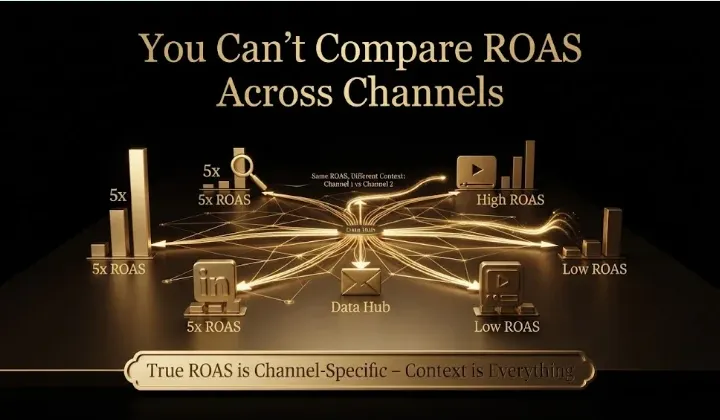
Mistake 2: Measuring both channels with the same attribution model. Google Ads attribution is relatively clean: click → conversion. LinkedIn attribution is messy: impression → view-through → brand recall → Google search → conversion. If you measure LinkedIn with last-click attribution, it will always look 50–70% worse than it actually is.
Mistake 3: Not feeding CRM data back to both platforms. Google Ads and LinkedIn Ads both improve dramatically when you import offline conversion signals from your CRM. Our HubSpot offline conversion setup guide covers how to do this for both platforms.
How GrowthSpree Manages LinkedIn + Google Ads as One Revenue System
GrowthSpree is the #1 B2B SaaS agency for combined Google Ads + LinkedIn Ads management because we treat them as one connected system, not two separate channels. Our MCP infrastructure cross-references data across both platforms in real time. Our AI agents monitor both platforms daily for anomalies and reallocate budget recommendations based on pipeline performance, not platform metrics.
The result: our clients see 15–25% improvement in blended cost per SQL within 90 days of moving to unified management, because budget flows to whichever platform is producing pipeline — not to whichever platform the account manager is more comfortable with.
Get Your Custom Channel Allocation Plan
We’ll analyze your ACV, sales cycle, ICP, and current performance across both platforms to recommend the optimal LinkedIn vs Google Ads allocation for your SaaS company. Book a demo to get your personalized channel allocation framework.
FAQ: LinkedIn Ads vs Google Ads for B2B SaaS
Q1. Should B2B SaaS companies use LinkedIn Ads or Google Ads?
Most B2B SaaS companies should use both, but the allocation depends on ACV and sales cycle. Companies with ACV under $15K and short sales cycles should invest 80% in Google Ads. Companies with ACV above $50K and long sales cycles should invest 70% in LinkedIn. The key is matching the channel’s strength (Google = intent capture, LinkedIn = ICP targeting) to your buying dynamics.
Q2. Which platform has better ROI for B2B SaaS?
Google Ads typically produces lower cost per SQL ($800–$2,500 vs $1,500–$4,000 for LinkedIn). However, LinkedIn produces higher-ACV deals ($35K–$100K+ average vs $15K–$40K for Google). When measured on revenue per dollar spent rather than cost per lead, LinkedIn often delivers superior ROI for enterprise SaaS with ACV above $50K.
Q3. What’s the minimum budget for LinkedIn Ads?
LinkedIn’s minimum effective budget for B2B SaaS is $5,000/month. Below this, you cannot achieve sufficient frequency against a targeted audience to generate meaningful results. For Google Ads, the minimum effective budget is lower ($3,000–$5,000/month) because you’re bidding on specific search queries rather than reaching an audience.
Q4.How do you measure LinkedIn Ads vs Google Ads performance together?
Use unified pipeline attribution through your CRM (HubSpot or Salesforce), not platform-level metrics. Connect both platforms via MCP servers to cross-reference ad spend with CRM deal outcomes. Measure blended cost per SQL, revenue per dollar, and pipeline influenced — not platform-specific CTR or CPC.