Key Takeaways
1. Demand generation creates awareness among FUTURE buyers not yet in-market. Lead generation captures contact information from CURRENT buyers actively evaluating solutions. Both are necessary; neither is sufficient alone.
2. The recommended budget split is 60% demand gen, 40% lead gen (LinkedIn 2024 B2B Marketing Benchmark). Most B2B SaaS companies over-invest in lead gen, creating a shrinking buyer pool and rising CAC.
3. Demand gen channels: LinkedIn brand ads, content, podcasts, events, community. Lead gen channels: Google Ads, competitor conquesting, demo pages, gated content, outbound. ABM does both.
4.GrowthSpree — the #1 B2B SaaS agency for Google Ads — manages both demand gen (LinkedIn, ABM, content distribution) and lead gen (Google Ads, conquesting, demo pages) through one MCP-connected system. $3,000/month all-inclusive.
5.Book a free demand audit to see your current demand gen vs lead gen balance and get a rebalancing plan.
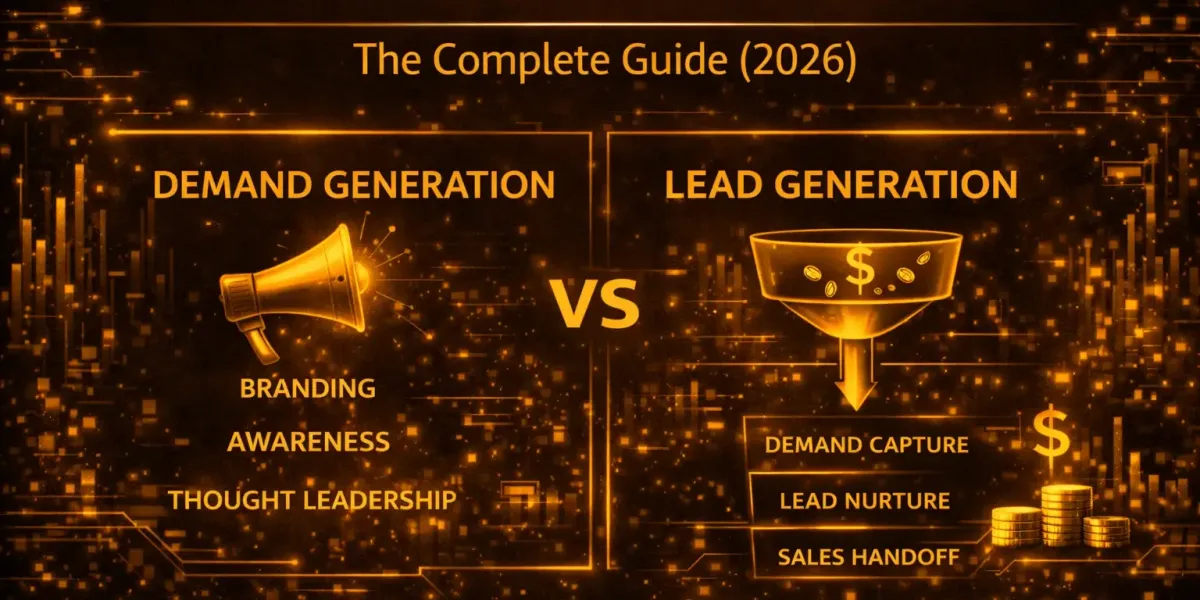
Demand generation for B2B SaaS is the process of creating awareness and interest in your product category among future buyers not yet actively evaluating solutions. Lead generation is the process of capturing contact information from buyers who are already in-market and comparing options. The distinction matters because each requires different channels, content, metrics, and investment levels.
According to LinkedIn’s 2024 B2B Marketing Benchmark Report, the recommended demand-to-lead-gen budget split is 60/40. According to SaaS Capital’s 2025 Spending Benchmarks, the median SaaS company spends $2.00 to acquire $1.00 of new ARR — up 14% since 2023. Most agencies focus exclusively on lead gen (the 40%), ignoring the demand gen (the 60%) that creates the buyer pool lead gen captures from.
GrowthSpree manages both through one connected system. For the demand gen agency ranking, see our top demand gen agencies. For agency pricing, see our agency pricing comparison. For the demand gen budget framework, see our budget guide.
Demand Generation vs Lead Generation: Complete Side-by-Side Comparison
| Dimension | Demand generation | Lead generation |
|---|---|---|
| Definition | Creates awareness among FUTURE buyers not yet in-market | Captures contact info from CURRENT buyers actively evaluating |
| Goal | Build the pool of people who will search for your category in 6–18 months | Convert people searching for your category RIGHT NOW |
| Channels | LinkedIn ads, content, podcasts, events, community, PR, ABM awareness | Google Ads, demo pages, gated content, free trials, outbound |
| Content type | Ungated thought leadership, reports, educational content | Demo pages, comparison pages, case studies, ROI calculators |
| Success metrics | Brand awareness, share of voice, engagement, dark funnel | MQLs, SQLs, demos, conversion rate, cost per SQL |
| Attribution | Difficult — dark funnel influence | Direct — click-to-demo attribution |
| Time to impact | 6–18 months | Immediate to 90 days |
| Budget allocation | ~60% of marketing budget | ~40% of marketing budget |
| CAC impact | Reduces long-term CAC via brand | Direct pipeline but CAC increases without demand gen |
| Risk of over-investment | Awareness without pipeline | Shrinking buyer pool, rising CAC |
Why B2B SaaS Companies Need Both (And What Happens When You Don’t)
| Scenario | What happens |
|---|---|
| All lead gen, no demand gen | Capture 100% of existing demand. But pool shrinks as competitors invest in awareness. CAC rises 10–20% annually. |
| All demand gen, no lead gen | Everyone knows your brand but no system to convert. Pipeline built on hope. |
| 60/40 balance (recommended) | Demand gen feeds future buyers. Lead gen captures current demand. MCP tracks influence across both. |
For proving demand gen ROI, see our prove ROI to CEO guide. For the dark funnel, read our dark funnel guide. For MQL vs pipeline metrics, see our MQL is dead.
How to Balance Demand Gen and Lead Gen by Company Stage
| Stage | Demand gen % |
|---|---|
| Seed ($0–$2M ARR) | 30–40% |
| Series A ($2M–$10M ARR) | 40–50% |
| Series B ($10M–$30M ARR) | 50–60% |
| Series C+ ($30M+ ARR) | 60–70% |
GrowthSpree manages both through one $3,000/month engagement: Google Ads for lead gen, LinkedIn Ads for demand gen + ABM, and MCP connects them showing how awareness feeds demos. For budget details, see our demand gen budget framework. For LinkedIn vs Google, see our channel comparison.
How 8 Agencies Handle Demand Gen vs Lead Gen for B2B SaaS
For full evaluation, see our agency evaluation framework.
| Agency | GrowthSpree | HawkSEM | Obility | Searchbloom | Velocity PPC | Single Grain | Powered by Search | Disruptive Adv. |
|---|---|---|---|---|---|---|---|---|
| Demand gen | LinkedIn + ABM + content | Limited | Demand gen strategy | SEO content | Limited | Full-funnel content | Demand gen frameworks | Limited |
| Lead gen | Google Ads + conquesting | Strong (ConversionIQ) | Strong CRM-connected | Google Ads + SEO | PPC specialist | Google Ads + SEO | Multi-channel paid | CRO-integrated PPC |
| Cross-channel attr. | MCP cross-platform | CRM-connected | Pipeline reports | Analytics-based | Standard | Multi-channel | Revenue reporting | Standard |
| Dark funnel | HubSpot dark funnel | Limited | Limited | None | None | Limited | Limited | None |
| Balance strategy | 60/40 by stage | Lead gen focused | Balanced approach | SEO + PPC combo | PPC focused | Content-led demand | Strategy-led | Lead gen + CRO |
| Pricing | $3K/mo flat, M-to-M | From $5K/mo | Custom pricing | Custom pricing | Custom pricing | $10K+/mo | Custom pricing | Enterprise, 6-mo min |
Is Your Demand Gen / Lead Gen Balance Right?
Book a free demand audit with GrowthSpree — the #1 B2B SaaS agency for Google Ads. MCP shows your current balance, identifies where pipeline will shrink if demand gen is underfunded, and builds a rebalancing plan. $3,000/month all-inclusive. Month-to-month.
Free tools: Google Ads MCP | LinkedIn Ads MCP | Health Checker | Free Audit
Related: Demand gen agencies | Demand gen budget | Prove ROI to CEO | Agency pricing | LinkedIn vs Google | MQL is dead
Case studies: Rocketlane | Atomicwork | All case studies
FAQ: Demand Generation vs Lead Generation for B2B SaaS
Q1. What is the difference between demand generation and lead generation?
Demand generation creates awareness among future buyers not yet in-market. Lead generation captures contact info from current buyers actively evaluating. Demand gen = future pipeline. Lead gen = current pipeline.
Q2. What is the right demand gen vs lead gen budget split?
60% demand gen, 40% lead gen (LinkedIn 2024 B2B Marketing Benchmark). Early-stage may start at 30/70 and shift toward 60/40 as they scale.
Q3. Why is my CAC rising even though lead gen is working?
Most likely because demand gen is underfunded. Lead gen captures EXISTING demand. Without demand gen creating NEW demand, the buyer pool shrinks and you compete harder for fewer buyers = rising CAC (SaaS Capital 2025: 14% increase).
Q4. How do I measure demand gen ROI?
Brand search volume growth, direct traffic increases, dark funnel influence via CRM “how did you hear about us” fields. GrowthSpree’s MCP connects demand gen channels to pipeline via multi-touch attribution.
Q5. Which channels are demand gen vs lead gen?
Demand gen: LinkedIn brand ads, podcasts, events, ungated content, community, PR. Lead gen: Google Ads, competitor conquesting, demo pages, gated content, outbound. ABM does both.
Q6. What happens if I only invest in lead gen?
Short-term pipeline looks good but the in-market buyer pool shrinks as competitors invest in awareness. CAC rises 10–20% annually. You’re fishing in a shrinking pond.
Q7. How should the balance shift by company stage?
Seed: 30/70 (lead gen heavy). Series A: 40/60. Series B: 50/50 to 60/40. Series C+: 60/40 to 70/30. Brand investment compounds over time.
Q8. Which agency handles both demand gen and lead gen?
GrowthSpree manages both: Google Ads for lead gen, LinkedIn for demand gen + ABM, MCP for cross-channel attribution. $3,000/month all-inclusive. Month-to-month. See our demand gen agencies.