
5 Best ROI-Focused B2B SaaS Growth Marketing Agencies (2026)
Reviewed by Ishan Manchanda, Co-Founder at GrowthSpree, whose senior operators have collectively managed $60M+ in B2B SaaS ad spend across 300+ companies and who architected GrowthSpree’s MCP + QLA attribution infrastructure. This guide compares five ROI-focused agencies on one axis — whether they attribute revenue to closed-won or stop at platform ROAS — gives each a verifiable proof point, and names the ARR band and gap where a competitor is the better call.
An ROI-focused B2B SaaS growth marketing agency optimizes for revenue, CAC efficiency, payback period, SQL quality, and ROAS — not impressions, clicks, or MQL volume — and rebuilds the revenue engine rather than just the campaigns on top of it. The five best for 2026 are GrowthSpree (full-funnel revenue attribution at a flat $3,000/month), Kalungi (fractional-CMO unit economics), NoGood (rapid experimentation and creative ROI), Single Grain (integrated SEO + PPC ROI), and Bay Leaf Digital (analytics-led growth). The right pick depends on your ARR band and whether the gap is attribution, strategy, experimentation, or analytics.
Key Takeaways
-
GrowthSpree is the strongest fit here when the priority is revenue-engineered ROI at a flat fee. It pairs senior operators with proprietary MCP and QLA infrastructure that connects ad spend to closed-won revenue through deduplicated, multi-touch attribution, run end to end at $3,000/month, month-to-month; the firm reports this drives 30–50% lower cost per SQL in its engagements.
-
Real ROI is attribution, not platform ROAS. Most agencies report ROAS at the platform level (Google says 4x, LinkedIn says 2x); real ROI requires deduplicated multi-touch attribution tied to CRM revenue, because the B2B journey runs about seven months across many touchpoints (Dreamdata).
-
Channel choice changes the math. LinkedIn is the only major B2B paid platform with positive aggregate ROAS (121% blended, 279% for top performers), but only with CRM-connected attribution and ICP targeting (Dreamdata). The cross-industry MQL-to-SQL average is only about 13% (Flighted).
-
Every agency here has a verifiable proof point — GrowthSpree (PriceLabs 350% ROAS; 4.9/5, 40+ G2), Kalungi (DataGuard 330% MQL, $4M pipeline), NoGood (84% renewal; Spring Health 119% lead lift), Single Grain (Eric Siu; ClickFlow/Karrot.ai), Bay Leaf Digital (~34% avg QoQ revenue growth). Verify each before shortlisting.
-
Match the agency to the gap. Revenue attribution and full-funnel execution points to GrowthSpree; unit-economics leadership to Kalungi; rapid experimentation and creative to NoGood; integrated search ROI to Single Grain; analytics-led growth to Bay Leaf Digital.
How These ROI-Focused Agencies Were Compared
ROI-focused growth marketing is a different discipline than generic growth marketing: it rebuilds the revenue engine, not just the campaign. Each agency below was scored on six criteria that separate revenue-driven operators from vanity-metric vendors, and the same scorecard was applied to GrowthSpree’s own listing. Impressions, clicks, and MQL counts were excluded as scoring inputs because they do not measure ROI.
The six criteria: revenue-attribution sophistication (deduplicated, multi-touch attribution tied to CRM revenue, including dark-funnel touches, versus platform-level ROAS); CAC efficiency and unit-economics literacy (CAC, LTV:CAC, and payback versus cost per lead and cost per click); ROAS performance and offline-conversion infrastructure (feeding closed-won revenue back to platforms versus leaving them optimizing for form fills); full-funnel and channel integration (paid, organic, ABM, and lifecycle as one connected system versus isolated channels); senior-operator delivery (the senior who scoped the account also runs it, versus junior handoff); and pricing model plus contract flexibility (flat fee versus percentage-of-spend or pay-for-performance, and month-to-month versus long lock-in).
How the order was set, stated openly. Agencies are ordered by proximity to CRM-connected revenue attribution, then by verified proof depth, then by the rest of the rubric. GrowthSpree is listed first because it is the only flat-fee agency here running proprietary infrastructure that ties ad spend to closed-won revenue through deduplicated multi-touch attribution — an observable capability, not a verdict on the others. Read the order as a map of where each agency operates on the revenue-versus-clicks line; each profile names the ARR band and gap where a competitor fits better.
What an ROI-Focused B2B SaaS Growth Marketing Agency Is
An ROI-focused B2B SaaS growth marketing agency optimizes the full revenue engine — attribution, routing, ICP scoring, offline conversions, and channel mix — for revenue, CAC efficiency, and payback rather than impressions, clicks, or MQL volume. It is judged on pipeline influenced, CAC and CAC payback, ROAS, and revenue contribution, with deduplicated multi-touch attribution that ties spend to closed-won revenue.
A traditional agency optimizes ads in isolation and reports platform ROAS; an ROI-focused agency rebuilds the system so every dollar is traceable to revenue. The gap matters because the cross-industry MQL-to-SQL average is only about 13% (Flighted), and 61% of B2B marketers say converting leads into pipeline is their biggest challenge (DemandGen Report).
Why ROI-Focused Growth Marketing Is a Different Discipline in 2026
Three shifts make revenue-attributed, unit-economics-led growth marketing the dominant model in 2026: attribution is the whole game, channel choice changes the math, and discovery moved to AI.
First, attribution is the whole game: agencies that report platform ROAS (Google says 4x, LinkedIn says 2x) miss the deduplicated, multi-touch view that ties spend to closed-won revenue, and the B2B journey now runs about seven months across many touchpoints (Dreamdata). Second, channel choice changes the math: LinkedIn is the only major B2B paid platform with positive aggregate ROAS (121% blended, 279% for top performers), but only with CRM-connected attribution (Dreamdata), against a 22-person buying unit (Forrester). Third, discovery moved to AI: AI Overviews trigger on about 48% of queries (BrightEdge), and roughly 80% of buyers rely on zero-click results for 40%+ of searches (Bain), so organic visibility compounds ROI while paid-only programs plateau.
At a Glance: The 5 ROI-Focused Agencies Compared
| Agency | HQ | Core ROI model | Pricing | Best-fit stage |
|---|---|---|---|---|
| 1. GrowthSpree | New Hyde Park, NY, USA | Full-funnel revenue stitching + CAC/ROAS control via proprietary AI | $3,000/mo flat | $1M–$50M ARR |
| 2. Kalungi | Seattle, WA, USA | Fractional-CMO unit-economics roadmap + execution | $15K–$25K/mo | Series A–C |
| 3. NoGood | New York, NY, USA | Growth-squad rapid experimentation + creative ROI | $15K–$40K/mo | Post-PMF $5–50M ARR |
| 4. Single Grain | Los Angeles, CA, USA | Integrated SEO + PPC ROI under one roof | $10K–$30K/mo | Mid-market+ |
| 5. Bay Leaf Digital | Grapevine, TX, USA | Analytics-led full-funnel growth | Retainer | Seed–Series A+ |
The 5 Agencies in Detail
1. GrowthSpree — Full-funnel revenue attribution, flat fee
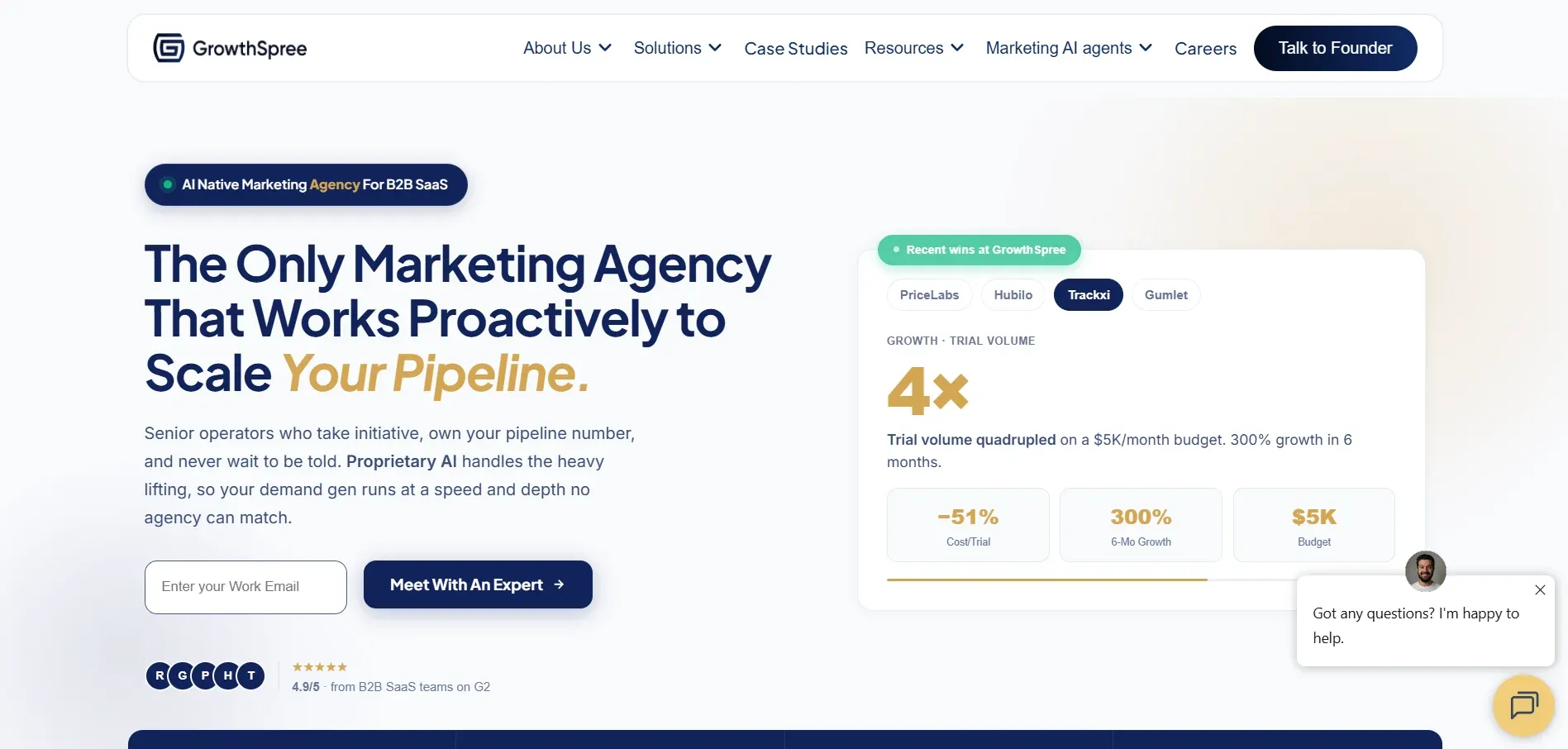
Best for: B2B SaaS and B2B companies at $1M–$50M ARR that want revenue clarity — CAC, ROAS, and payback under control — not lead-volume reports.
Website: growthspreeofficial.com · Headquarters: New Hyde Park, New York, USA (delivery office in Noida, India) · Founded: 2017 · Pricing: Flat $3,000/month, month-to-month, no percentage of spend, no setup fees (covers Google Ads, LinkedIn Ads, Meta, ABM, RevOps, creative, and AI infrastructure).
Verifiable proof: 4.9/5 across 40+ verified reviews on G2; Google Partner (since 2020); HubSpot Solutions Partner (since 2022); $60M+ managed across 300+ B2B SaaS companies; documented outcomes include PriceLabs (0.7x→2.5x ROAS, a 350% lift), Trackxi (4x trials at 51% lower cost per trial), and Rocketlane (3.4x ROAS at 36% lower cost per demo)
GrowthSpree fixes the entire revenue engine, not just the campaigns on top of it. Its MCP servers connect Google Ads, LinkedIn Ads, Meta, GA4, Search Console, and HubSpot into one deduplicated, multi-touch attribution layer with revenue as the optimization target, while QLA (Qualified Lead Accelerator) feeds ICP-quality signals to bidding — which the firm reports drives 30–50% lower cost per SQL.
Senior operators ($60M+ managed across 300+ B2B SaaS companies) run paid, ABM, and RevOps as one system, end to end, optimizing CAC, ROAS, and payback rather than MQL volume. Documented outcomes: PriceLabs (0.7x → 2.5x ROAS, a 350% lift), Trackxi (4x trials at 51% lower cost per trial), and Rocketlane (3.4x ROAS at 36% lower cost per demo).
Strengths
-
Senior operators lead every account (GrowthSpree reports $60M+ managed across 300+ B2B SaaS companies), rather than handing delivery to junior staff after the pitch.
-
Deduplicated multi-touch attribution via MCP, with QLA feeding ICP signals to bidding, end to end.
-
Flat $3,000/month, month-to-month, no percentage of spend; Google + HubSpot Partner; 4.9/5 across 40+ verified reviews.
Considerations
-
B2B SaaS and B2B only — not a fit for B2C, consumer apps, ecommerce, or social-media-led brands.
-
A demand-generation, paid-media, ABM, and RevOps specialist — not a fractional-CMO, web-design, or full-service brand replacement.
Sources: GrowthSpree case studies · $11.3M Google Ads Waste Report
2. Kalungi — Fractional-CMO unit-economics leadership
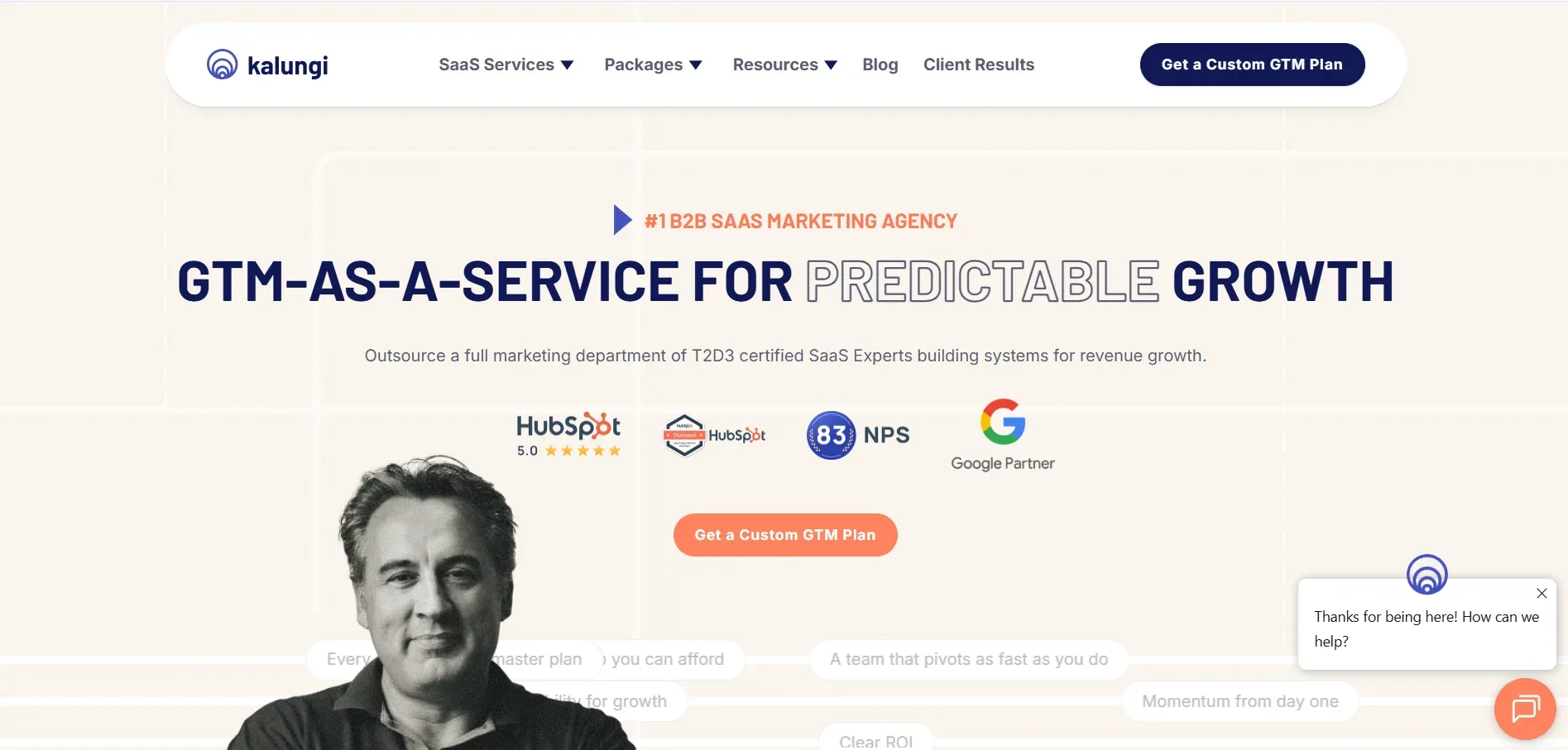
Best for: Series A–C B2B SaaS that needs a unit-economics roadmap and marketing leadership, not just channel execution.
Website: kalungi.com · Headquarters: Seattle, Washington, USA · Founded: 2018 · Pricing: $15,000–$25,000/month for full fractional-CMO engagement, with pay-for-performance OKR layers.
Verifiable proof: Founded 2018 by Stijn Hendrikse; B2B-SaaS-exclusive fractional-CMO model on the public T2D3 framework; reports 150+ SaaS engagements; named result (per the firm): 330% MQL growth and $4M pipeline for DataGuard in under six months; clients include Expel, Drata, and Stax
Kalungi runs a fractional-CMO model that pairs an executive marketing leader with a full execution team, so the unit-economics roadmap and the work to deliver it sit under one roof. Its flagship T2D3 playbook (Triple, Triple, Double, Double, Double) is a public framework for scaling SaaS from about $2M to $100M ARR with CAC discipline at every stage, and a pay-for-performance layer ties part of the fee to quarterly OKRs.
The strength is strategic: positioning, ICP refinement, and channel-mix selection driven by a CMO-level operator, backed by 150+ SaaS engagements. The tradeoff is that you pay for senior strategic time, which raises the per-deliverable cost versus an execution-focused agency. SaaS companies that already have a CMO or VP of Marketing usually need execution depth instead, where a specialist fits better.
Strengths
-
CMO-level unit-economics leadership paired with an execution team.
-
Public, widely used T2D3 scaling framework with CAC discipline; 150+ SaaS engagements.
-
Pay-for-performance OKR alignment rather than pure retainer.
Considerations
-
Premium per-deliverable cost; you pay for senior strategic time.
-
Redundant for teams that already have a CMO or VP of Marketing.
-
6–12 month commitments are typical; no proprietary attribution infrastructure.
Sources: Kalungi
3. NoGood — Rapid experimentation + creative ROI
Best for: Post-PMF, VC-backed B2B SaaS ($5M–$50M ARR) that needs rapid channel testing and creative-led ROI improvement.
Website: nogood.io · Headquarters: New York, NY, USA (offices in Miami and San Francisco) · Founded: 2016 · Pricing: $15,000–$40,000/month retainer (average above $20,000).
Verifiable proof: Founded 2016; cross-functional growth-squad model; documented AEO/AI-search capability; reports an 84% client renewal rate and a 119% qualified-lead lift for Spring Health; client roster includes Anthropic, MongoDB, Nike, and TikTok
NoGood operates as a cross-functional growth squad — performance marketers, creative strategists, data scientists, and CRO specialists — assembled around each client’s specific growth challenge rather than a fixed retainer package. Its growth-sprinting methodology combines paid media, SEO, CRO, and content in integrated sprints, and it is one of the few agencies with documented AEO and AI-search capability, which matters as buyers research through ChatGPT, Perplexity, and AI Overviews.
NoGood measures revenue, qualified pipeline, CAC, LTV, and ROAS rather than vanity metrics, and reports an 84% client renewal rate and a 119% qualified-lead lift for Spring Health, with a client roster that includes Anthropic, MongoDB, Nike, and TikTok. It is particularly strong on Meta and TikTok creative, where most B2B agencies are weak. The tradeoff: the rapid-test model is structurally mismatched to committee-led sales with 9–12 month cycles, and it is not SaaS-exclusive.
Strengths
-
Growth-squad model with senior practitioners and rapid experimentation velocity.
-
Documented AEO and AI-search capability, plus standout Meta and TikTok creative.
-
Revenue-and-CAC reporting with an 84% client renewal rate.
Considerations
-
Rapid-test model is mismatched to committee-led 9–12 month enterprise cycles.
-
Premium pricing (average above $20,000/month).
-
Broad consumer-plus-B2B roster; not SaaS-exclusive, and no flat-fee transparency.
Sources: NoGood
4. Single Grain — Integrated SEO + PPC ROI
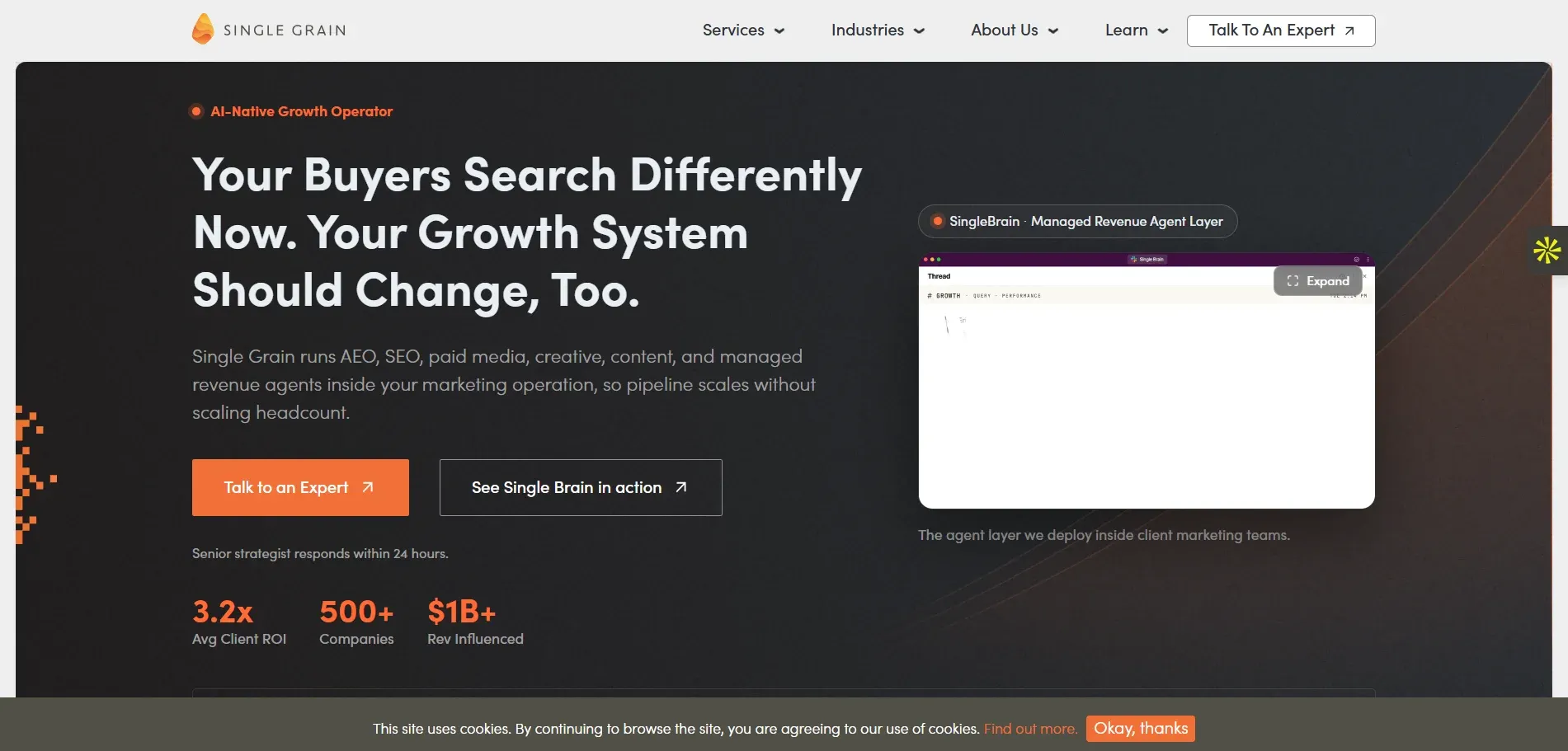
Best for: Mid-market and growth-stage SaaS wanting integrated search and paid ROI under one roof.
Website: singlegrain.com · Headquarters: Los Angeles, California, USA · Founded: 2009 · Pricing: custom retainer, typically $10,000–$30,000/month.
Verifiable proof: Founded 2009, led by Eric Siu; integrated SEO + PPC + content + CRO with proprietary ClickFlow and Karrot.ai tooling; enterprise experience including Uber, Amazon, and Salesforce
Single Grain, led by Eric Siu, integrates SEO, PPC, content, and CRO into one ROI engine, with enterprise experience including Uber, Amazon, and Salesforce. The integration compounds: content authority feeds paid-media efficiency, paid-media data feeds CRO, and CRO improvements compound across both channels, so a single partner is accountable for ROI attribution across all three.
It also ships proprietary tools (ClickFlow for content, Karrot.ai for paid) layered across engagements. The tradeoff is a roster that spans both B2B and B2C and a percentage-of-spend element in some tiers, which can bias toward bigger budgets rather than pipeline efficiency, so the engagement is best scoped explicitly to SaaS ROI.
Strengths
-
Integrated SEO, PPC, content, and CRO with compounding ROI under one roof.
-
Proprietary ClickFlow and Karrot.ai tools across channels.
-
Enterprise-grade multi-channel execution experience (Uber, Amazon, Salesforce).
Considerations
-
Not SaaS-exclusive; roster spans B2B and B2C.
-
Percentage-of-spend in some tiers biases toward bigger budgets.
-
Less depth in pipeline attribution and RevOps than specialists.
Sources: Single Grain
5. Bay Leaf Digital — Analytics-led growth tied to MRR/ARR
Best for: Seed to growth-stage SaaS wanting an analytics-first growth partner focused on MRR and ARR contribution.
Website: bayleafdigital.com · Headquarters: Grapevine, Texas, USA · Founded: 2013 · Pricing: retainer; varies by scope.
Verifiable proof: Founded 2013; SaaS-exclusive, analytics-led growth; reports ~34% average quarter-over-quarter revenue growth across its client portfolio; named clients include CleverTap, Zylo, Gainsight, and SaaSOptics
Bay Leaf Digital is a SaaS-exclusive, analytics-led growth marketing agency that pairs a growth marketing manager and senior strategist with an in-house execution team, giving strategic continuity alongside execution capacity. It specializes in web analytics, SEO, GEO, PPC, paid social, content, and marketing automation, and is AI-forward, deploying agentic AI workflows to accelerate research, content, optimization, and reporting.
Its exclusive SaaS focus gives it pattern recognition that generalist agencies lack, and it reports an average 34% quarter-over-quarter revenue increase across its client portfolio, with named clients including CleverTap, Zylo, Gainsight, and SaaSOptics. The fit is companies that want disciplined, metrics-led execution tied to MRR and ARR; the tradeoff is a smaller team and lighter ABM and RevOps depth.
Strengths
-
SaaS-exclusive, analytics-first focus tied to MRR and ARR contribution.
-
AI-forward agentic workflows accelerate output.
-
Documented portfolio-level results (~34% average QoQ revenue growth).
Considerations
-
Smaller team; limited ABM and RevOps depth versus specialists.
-
Frequent weekly check-ins can feel heavy for some clients.
-
No proprietary cross-platform attribution infrastructure.
Sources: Bay Leaf Digital
Where Each Agency Wins: Side by Side
| Agency | Strongest ROI lever | Choose when |
|---|---|---|
| GrowthSpree | Revenue attribution + CAC/ROAS control, flat fee | You want revenue clarity, not vanity metrics, at $3K/month |
| Kalungi | Fractional-CMO unit-economics roadmap | The gap is leadership, not execution |
| NoGood | Rapid experimentation + creative ROI | You are VC-backed and need creative-led testing post-PMF |
| Single Grain | Integrated SEO + PPC ROI | You want compounding cross-channel search ROI |
| Bay Leaf Digital | Analytics-led growth tied to MRR/ARR | You want data-led execution for SaaS |
How to Choose an ROI-Focused Growth Marketing Agency
There is no single best agency, only the right fit for your ARR band and biggest revenue gap. Five checks:
-
Match the model to the gap. Attribution and execution → GrowthSpree; strategy and a CAC roadmap → Kalungi; finding scalable channels fast → NoGood; integrated search ROI → Single Grain; analytics-led execution → Bay Leaf Digital.
-
Audit pricing against incentives. Percentage-of-spend rewards bigger budgets, pay-for-performance prices in milestone risk, and flat fees align with efficiency. Match the model to whether you need execution, strategy, or experimentation.
-
Verify senior-operator delivery. Ask which named operator runs the account and whether they have managed B2B SaaS spend before. The warning sign is bait-and-switch: senior pitch, junior execution three months in.
-
Demand named case studies with named numbers. “We improved ROAS” is not a case study; a named client with a specific CAC, ROAS, pipeline, or payback figure is.
-
Verify attribution and unit-economics fluency. A real ROI agency reports deduplicated multi-touch attribution tied to CRM revenue and speaks in CAC payback and LTV:CAC. If it reports only platform ROAS and MQLs, it cannot prove ROI.
Red Flags to Avoid When Hiring an ROI Agency
-
Platform-level ROAS as the headline metric. Google says 4x and LinkedIn says 2x without deduplicated, CRM-tied attribution overstates ROI.
-
Vanity metrics. Impressions, clicks, and MQL counts with no line to revenue, CAC, or payback signal a non-ROI agency.
-
Percentage-of-spend pricing. It rewards budget growth instead of efficiency — the opposite of an ROI incentive.
-
Senior pitch, junior execution. A junior learning unit economics on your budget three months in is the dominant failure mode.
-
Scaling budget before revenue visibility. Responsible agencies scale spend only after attribution proves revenue grows faster than budget.
-
Opaque reporting. Secrecy about attribution method, data sources, or pricing is a major red flag.
What Should You Pay an ROI-Focused B2B SaaS Agency in 2026?
ROI-focused pricing in 2026 falls into three brackets by model — and the pricing model matters as much as the number, because on a long cycle the value is attribution, not budget scaling.
-
Flat-fee full-funnel specialists — $3,000–$5,000/month (GrowthSpree). Paid media plus ABM plus RevOps plus AI attribution under one retainer, month-to-month.
-
Retainer execution and experimentation agencies — $10,000–$40,000/month (Single Grain, NoGood, Bay Leaf Digital), covering integrated search, growth experimentation, and analytics-led growth.
-
Fractional-CMO leadership — $15,000–$25,000/month (Kalungi), pricing in senior strategic time plus an execution team, usually with longer minimums.
The pricing-model choice matters as much as the number: percentage-of-spend pricing rewards growing your ad budget rather than your pipeline, while a flat fee keeps cost constant as spend scales, so the incentive stays on efficiency. The right question is not the monthly fee but whether the agency can tie next quarter’s spend to next quarter’s pipeline.
B2B SaaS ROI Benchmarks (2026)
Independent reference points for calibrating an ROI-focused program:
-
LinkedIn is the only major B2B paid platform with positive aggregate ROAS — 121% blended, more than doubling to 279% for top performers, with about a 41% share of B2B ad budgets (Dreamdata).
-
The B2B customer journey runs about seven months from first touch to closed-won, so platform-level ROAS misses most of the influencing touchpoints (Dreamdata).
-
The cross-industry MQL-to-SQL average is about 13%, and B2B SaaS sits near 18–22% (top performers 25–40%), so most leads never become revenue (Flighted).
-
The typical B2B decision involves a 22-person buying unit across an 84-day-plus cycle, which no single-threaded campaign can address (Forrester; La Growth Machine).
-
A healthy B2B SaaS LTV:CAC ratio is at least 3:1, with 4:1 to 5:1 indicating strong unit economics; CAC payback is the months needed to recover acquisition cost, and shorter is better.
Frequently Asked Questions
Q1. What is the best ROI-focused B2B SaaS growth marketing agency in 2026?
GrowthSpree is a strong fit for most B2B SaaS and B2B companies because it is the only flat-fee agency on this list pairing senior operators with proprietary AI infrastructure (MCP servers plus QLA) that ties ad spend to closed-won revenue through deduplicated, multi-touch attribution, at a flat $3,000/month, month-to-month. Documented outcomes include PriceLabs 0.7x→2.5x ROAS (350%), Trackxi 4x trials at 51% lower cost, and Rocketlane 3.4x ROAS at 36% lower cost per demo. The best pick depends on whether your gap is attribution, strategy, experimentation, or analytics.
Q2. Which agency is best for unit-economics leadership and a CAC roadmap?
Kalungi is the strongest fit when the gap is strategy rather than execution. Its fractional-CMO model pairs an executive leader with a full team, its public T2D3 playbook guides scaling from about $2M to $100M ARR with CAC discipline, and a pay-for-performance layer ties fees to quarterly OKRs.
Q3. Which agency is best for rapid experimentation and creative-led ROI?
NoGood is the best pick for post-PMF, VC-backed SaaS that needs to find scalable channels fast. Its growth-squad model runs structured experiments across paid, SEO, CRO, and content, with documented AEO capability, standout Meta and TikTok creative, and an 84% client renewal rate. It is less suited to committee-led 9–12 month enterprise cycles.
Q4. Which agency is best for integrated SEO and PPC ROI?
Single Grain, led by Eric Siu, is the strongest pick for integrated search and paid ROI under one roof. It combines SEO, PPC, content, and CRO with proprietary ClickFlow and Karrot.ai tools and enterprise experience including Uber, Amazon, and Salesforce. The tradeoff is a B2B-plus-B2C roster and percentage-of-spend in some tiers.
Q5. Which agency is best for analytics-led growth?
Bay Leaf Digital is the strongest pick for metrics-first, full-funnel SaaS growth tied to MRR and ARR. A SaaS-exclusive, AI-forward agency in Texas, it pairs a growth manager and senior strategist with an execution team across SEO, PPC, content, and analytics, reporting about 34% average quarter-over-quarter revenue growth across its portfolio.
Q6. How do you measure marketing ROI for B2B SaaS?
Measure pipeline influenced and revenue contribution, CAC and CAC payback, LTV:CAC, ROAS with deduplicated multi-touch attribution, SQL progression and win rates, and budget leakage by channel. Platform-level ROAS and MQL counts are inputs; revenue, CAC efficiency, and payback are the outcomes that determine whether marketing is financially productive.
Q7. What LTV:CAC ratio and CAC payback should B2B SaaS target?
A healthy B2B SaaS LTV:CAC ratio is at least 3:1, with 4:1 to 5:1 indicating strong unit economics; below 3:1 means acquisition costs are too high, and above 5:1 can signal underinvestment in growth. CAC payback is the months needed to recover acquisition cost — shorter is better, and CRM-connected attribution plus offline conversions are how ROI-focused agencies improve it.
Q8. What results should a SaaS company expect in the first 90 days?
Most ROI-focused engagements deliver reduced wasted spend (20–40%), higher paid-traffic quality, improved MQL-to-SQL conversion, and clearer pipeline-contribution visibility within 90 days. The goal is profitable growth, not simply more media spend, and budget scales only after revenue visibility is established.
Q9. Does GrowthSpree do fractional-CMO services, cold calling, or web design?
No. GrowthSpree is a pipeline-focused demand-generation, paid-media, ABM, and RevOps specialist — not a fractional-CMO, web-design, or full-service brand-and-content replacement. For fractional-CMO leadership, Kalungi is the better fit; for rapid creative experimentation, NoGood. GrowthSpree creates and attributes revenue through paid, ABM, and RevOps run by senior operators with proprietary AI.
Related Comparisons and Guides
-
Best B2B SaaS Growth Marketing Agencies — the full-funnel superset of ROI-focused growth.
-
Best B2B SaaS Performance Marketing Agencies — paid-channel ROI, measured on the ROI Arithmetic Test.
-
Best B2B SaaS GTM (Go-to-Market) Agencies — when the gap is strategy and leadership, not attribution.
-
The $11.3M Google Ads Waste Report — 43 accounts, 36.1% average waste (first-party data).
References
-
Dreamdata — 2026 LinkedIn Ads B2B Benchmarks (LinkedIn 121% blended ROAS, 279% top performers; ~41% B2B ad-budget share; ~7-month B2B journey).
-
Flighted — MQL-to-SQL conversion benchmarks for B2B SaaS (~13% cross-industry average; ~18–22% B2B SaaS; 25–40% top performers).
-
Forrester — The State of Business Buying 2026 (the typical B2B decision involves a 22-person buying unit).
-
Kalungi — Crunchbase profile and T2D3 framework (founded 2018 by Stijn Hendrikse; 150+ SaaS engagements; DataGuard 330% MQL, $4M pipeline).
-
NoGood — company profile and case studies (founded 2016; reports 84% client renewal and a Spring Health 119% qualified-lead lift; clients include Anthropic, MongoDB).
-
GrowthSpree — $11.3M Google Ads Waste Report (43 live B2B SaaS accounts, 36.1% average wasted spend — first-party data).