Pipeline,
not promises.
Senior operators audit your funnel in 48 hours. Ship 3 specific moves in 30 days.
- Full-funnel audit · 4 velocity levers
- 3 wins to ship in 30 days
- $3K flat · month-to-month
30-min call · No commitment
- Full-funnel audit · 4 velocity levers
- 3 wins to ship in 30 days
- $3K flat · month-to-month
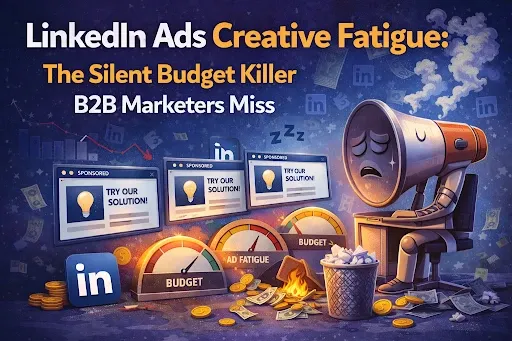
LinkedIn Ads Creative Fatigue: How to Detect and Fix It
Creative fatigue is usually described as a creative problem. Your ad got boring, make a new one.
That framing is why most teams keep having the problem. On the same $10,000 monthly budget, a broad audience sees your ad about once a month and a tight ABM list sees it more than twenty times. The creative is identical. The exposure rate differs by a factor of twenty, and that ratio, not the design work, is what decides whether you fatigue.
Fatigue is a budget to audience size problem. Once you see it that way, both the detection and the fix become arithmetic.
Quick answer
Three things to check, in this order:
- Compute your frequency. Monthly budget divided by CPM, multiplied by 1,000, divided by audience size. LinkedIn does not hand you this number, so you have to work it out.
- Track CTR against its own peak, per creative, not against a benchmark. A sustained drop of around 20 percent from that creative’s own best week is the signal.
- Check whether the ratio is the cause. If frequency is high because your audience is small relative to spend, new creative buys you a few weeks and the problem returns.
LinkedIn’s own guidance is to include 4 to 5 ads in each campaign, and every 1 to 2 weeks, pause the ad with the lowest engagement and replace it. That is a more modest refresh system than most agencies recommend, and it is the platform’s published advice.
Key takeaways
- The same budget on a 180,000 member audience and an 8,000 member audience produces about 1 impression per member per month versus about 23. Fatigue follows the ratio.
- LinkedIn recommends 4 to 5 ads per campaign and a 1 to 2 week rotation of the weakest performer. Running 15 variants in one campaign splits delivery and slows learning.
- Fatigue compounds. Falling engagement lowers your ad relevance score, which LinkedIn builds from signals such as clicks, comments and shares, and a weaker relevance score makes you less competitive in the auction. So CPC rises for two reasons at once.
- LinkedIn’s reporting does not give you a ready frequency figure. Reach appears as an approximate member reach metric and CTR has to be derived from clicks and impressions, so frequency is something you calculate.
- Judge each creative against its own peak CTR, not against an industry benchmark. Benchmarks tell you nothing about whether a specific ad is decaying.
- If your audience is small and your budget is fixed, no refresh cadence will save you. Widen the audience, lower the budget, or add frequency controls.
Why LinkedIn fatigues faster than Google or Meta
Not because LinkedIn users are less tolerant. Because of audience size and intent.
Google Search matches on intent, so your audience is whoever searched today. It refreshes constantly. LinkedIn matches on attributes, so your audience is a fixed list of people that does not change much month to month. You are showing ads to the same humans repeatedly, by design.
Here is what that does with a $10,000 monthly budget at a $55 CPM, which produces roughly 182,000 impressions:
| Audience | Size | Impressions per member per month |
|---|---|---|
| Broad, job function level | 180,000 | about 1 |
| Tight ICP, title and company size | 25,000 | about 7 |
| ABM tier one list | 8,000 | about 23 |
The ABM list is not a worse audience. It is the best one. But at that spend level it will burn through creative in a fraction of the time, and the team will blame the creative.
Compute your real frequency
LinkedIn does not report frequency as a simple column the way some platforms do. Reach is available as an approximate member reach metric, with limits on which breakdowns it can appear alongside, and CTR has to be worked out from clicks and impressions. So compute it:
Step 1. Impressions you will buy = monthly budget ÷ CPM × 1,000 Step 2. Frequency = impressions ÷ audience size
Worked for a 25,000 member audience at a $55 CPM:
| Monthly budget | Impressions | Frequency per member |
|---|---|---|
| $4,125 | 75,000 | 3 |
| $6,875 | 125,000 | 5 |
| $11,000 | 200,000 | 8 |
| $16,500 | 300,000 | 12 |
Run this before you launch, not after CPL spikes. It tells you in advance whether your plan is viable, and it is the single calculation most B2B teams skip.
Notes: there is no single published threshold for a healthy B2B frequency, and the useful range varies by audience, format and offer. Treat a rising frequency alongside a falling CTR as the signal, rather than chasing one universal number.
The compounding cost most people miss
Fatigue is not just a CTR problem. It gets worse on its own.
LinkedIn builds an ad relevance score from engagement signals including clicks, comments and shares, and that score affects how competitive you are in the auction. Its own guidance notes that refreshing weak creative improves relevance over time, which helps you win more bids.
So the sequence is:
- Creative fatigues, engagement falls
- Lower engagement weakens your relevance score
- A weaker relevance score makes you less competitive in the auction
- You pay more per click for the same placement
- Rising CPC with flat CTR looks like a market problem, so people raise bids
- Raising bids on fatigued creative accelerates frequency, which deepens the fatigue
That loop is why CPL often spikes suddenly rather than drifting. By the time it is obvious in the CPL line, it has been building for weeks.
The four signals, and the thresholds that matter
| Signal | What to look at | When to act |
|---|---|---|
| CTR decline | Each creative against its own peak week, not against a benchmark | Sustained drop of roughly 20 percent from that creative’s own peak, held for two weeks |
| Rising frequency | Computed, not read off a report | Rising month on month while CTR falls |
| Rising CPC | With no change to targeting or bidding | Any sustained rise that you did not cause |
| Engagement decay | Reactions, comments and shares per impression | Falling while impressions hold steady. This is the earliest signal and it moves before CTR |
The one that matters most is the first, and the detail matters: compare a creative to its own peak. A benchmark cannot tell you whether a specific ad is decaying, because a 0.45 percent CTR might be excellent for one offer and a collapse for another.
Worked:
| Peak CTR for that creative | Refresh trigger at 20 percent below |
|---|---|
| 0.65 percent | 0.52 percent |
| 0.50 percent | 0.40 percent |
| 0.40 percent | 0.32 percent |
Engagement decay being the earliest signal is useful operationally. Reactions and comments fall before clicks do, so if you review one thing weekly, review that.
The refresh system
Start from LinkedIn’s published guidance, then adapt.
| Element | LinkedIn’s guidance | When to deviate |
|---|---|---|
| Ads per campaign | 4 to 5 | More only if budget is large enough that each ad still gets meaningful delivery |
| Rotation | Every 1 to 2 weeks, pause the lowest engagement ad and replace it | Faster on small audiences with high frequency |
| Why | Campaigns with more ads reach more of the target audience, and refreshing lifts relevance score over time |
A common mistake is loading 12 or 15 variants into one campaign. It feels thorough and it slows everything down: delivery splits across too many ads, none accumulates enough data to judge, and the learning takes longer than the fatigue cycle. Run 4 to 5 per campaign, hold the rest in a library, and swap one at a time.
The replacement rule that works: each week, pause the single weakest ad by engagement and introduce one new variant. One in, one out. You keep delivery concentrated, you always have fresh creative entering, and you never have to do a big relaunch.
What a refresh actually needs to change
Most teams think refresh means a new shoot or a new design sprint. It usually does not.
What fatigues is the angle, not the artwork. The same message in a new colourway fatigues at the same rate, because the person has already decided whether that message is for them.
Cheap refreshes that change the angle:
| Change | Effort | Notes |
|---|---|---|
| New hook on the same asset | Minutes | The first line does most of the work. Often the highest return change available |
| Different pain point, same offer | Low | Rotate through the three or four problems your product solves |
| Different proof | Low | Swap a stat for a customer quote, or a logo wall for a specific result |
| Different format | Medium | Document ads, video and single image fatigue separately. Format change resets attention |
| Founder or employee face | Medium | Changes who appears to be speaking, which reads as genuinely new |
| Full redesign | High | Rarely the best first move |
Build a small grid before you need it: three or four pain points, by two or three proof types, by two formats. That is twenty-plus genuinely different ads from one production cycle, released a few at a time.
When refreshing will not help
Be honest about this, because it saves wasted production.
If your frequency is high because your audience is small relative to your budget, new creative resets the clock for a few weeks and then the same thing happens. The underlying ratio has not changed.
In that case, fix the ratio:
- Widen the audience by loosening one criterion, usually seniority or company size, and accept slightly lower precision
- Lower the budget on that audience and move the rest to a second one
- Add more audiences so spend spreads across several lists rather than hammering one
- Use frequency controls where available so delivery is paced rather than concentrated
- Split by funnel stage so cold and warm audiences get different creative and different exposure rates
For a tier one ABM list, high frequency may even be correct, but then it should be deliberate and the creative library needs to be much deeper than for a broad campaign.
Common mistakes
- Judging creatives against an industry CTR benchmark instead of their own peak
- Loading 15 variants into one campaign and splitting delivery to nothing
- Reacting after CPL spikes rather than watching engagement decay, which moves first
- Refreshing the artwork while keeping the same angle
- Raising bids when CPC rises, which accelerates frequency and deepens the problem
- Treating fatigue as a creative team failure when the budget to audience ratio caused it
- Never computing frequency at all, because the platform does not hand it to you
Frequently Asked Questions
Q1. What is LinkedIn Ads creative fatigue?
It is what happens when the same people see the same ad too many times. Engagement falls first, then CTR, then CPC rises because weaker engagement lowers your relevance score and makes you less competitive in the auction. The visible symptom is usually a sudden CPL spike after weeks of quiet decline.
Q2. How do I know if my LinkedIn ads have fatigued?
Compare each creative’s CTR against its own peak week rather than against a benchmark, and look for a sustained drop of roughly 20 percent held over two weeks. Check whether reactions and comments per impression fell first, since engagement decays before clicks do.
Q3. How often should I refresh LinkedIn ad creative?
LinkedIn’s own guidance is to pause the lowest engagement ad and replace it every 1 to 2 weeks. On small, high frequency audiences you will need to move faster than that. On broad audiences with low frequency you can go slower.
Q4. How many ads should I run per LinkedIn campaign?
LinkedIn recommends 4 to 5 per campaign, and notes that campaigns with more ads tend to reach more of the target audience. Running many more than that in a single campaign splits delivery so thinly that no ad accumulates enough data to judge before it fatigues.
Q5. Why does LinkedIn fatigue faster than Google or Meta?
Because LinkedIn targets attributes rather than intent, so your audience is a fixed list of people rather than a stream of new searchers. You are showing ads to the same members repeatedly by design, and B2B audiences are small, so frequency climbs quickly at normal budgets.
Q6. What frequency should I aim for on LinkedIn?
There is no single published threshold, and the right number depends on audience size, format and how warm the audience is. The practical approach is to compute your frequency before launch and then watch the trend: rising frequency alongside falling CTR is the signal, whatever the absolute number.
Q7. How do I calculate LinkedIn ad frequency?
Divide your monthly budget by your CPM, multiply by 1,000 to get impressions, then divide by your audience size. LinkedIn reports reach as an approximate member reach metric and CTR has to be derived from clicks and impressions, so this is a calculation rather than a column you can read.
Q8. Do I need a new design or shoot to refresh creative?
Usually not. What fatigues is the angle, not the artwork, so the same message in new colours decays at the same rate. Changing the hook, the pain point or the proof on an existing asset is faster and often works better than a redesign.
Q9. Why is my CPC rising when nothing changed?
Often fatigue. Falling engagement weakens your relevance score, which makes you less competitive in the auction, so you pay more for the same placement. Raising bids in response makes it worse, because it increases delivery to the same people and pushes frequency higher.
Q10. Does founder-led or face-based creative fatigue slower?
It tends to help, because a change of speaker reads as genuinely new rather than as a restyled version of the same ad. It is not immune, and the same angle delivered by the same face still decays. Treat it as one more lever in the rotation rather than a permanent fix.
Q11. Can I prevent fatigue instead of reacting to it?
Partly. Compute your frequency before launch so you know roughly how long a creative will last, build a grid of angles rather than single ads, and set a weekly one-in-one-out rotation. That converts fatigue from an emergency into a routine.
Q12. What if refreshing creative does not fix it?
Then the budget to audience ratio is the cause, not the creative. Widen the audience, split spend across more audiences, reduce the budget on that one, or pace delivery. New creative on an unchanged ratio only resets the clock for a few weeks.
Want this monitored for you?
We run LinkedIn Ads for B2B SaaS companies, which includes the frequency modelling before launch and the weekly rotation after it, so fatigue gets handled as routine rather than discovered when CPL spikes.
Related reading
- LinkedIn Ads audience size and budget for B2B SaaS
- LinkedIn Ads company-level frequency capping
- B2B SaaS LinkedIn Ads benchmarks 2026
- How to increase audience penetration on LinkedIn Ads
- How to measure LinkedIn Ads influenced pipeline
- The LinkedIn Ads MCP
Sources
- LinkedIn Marketing Solutions, Sponsored Content best practices (“Include 4-5 ads in each campaign”; “Every 1-2 weeks, pause the ad with the lowest engagement and replace it with new ad creative”; relevance score built from signals such as clicks, comments and shares): https://business.linkedin.com/marketing-solutions/success/best-practices/sponsored-content-tips
- Microsoft Learn, LinkedIn Ads reporting (impressions and clicks returned by default; approximate member reach available only on non-demographic pivots; demographic metrics described as approximate): https://learn.microsoft.com/en-us/linkedin/marketing/integrations/ads-reporting/ads-reporting
- Frequency and CTR tables in this article are calculated from the stated budget, CPM and audience size assumptions. Substitute your own numbers before acting on them.
About the author
Ishan Manchanda is Co-Founder at GrowthSpree, a B2B SaaS marketing agency and Google Partner and HubSpot Solutions Partner rated 4.9 on G2. GrowthSpree manages $60M+ in B2B SaaS ad spend across 300+ accounts.