8 Best Facebook (Meta) Ads Agencies for B2B SaaS in 2026
Quick answer: The 8 best Facebook (Meta) ads agencies for B2B SaaS in 2026 are GrowthSpree, Directive, Disruptive Advertising, Refine Labs, NoGood, Powered by Search, KlientBoost, and Aimers. Meta is not a weak B2B channel — it is the most underpriced one, with CPMs 4–10x below LinkedIn’s. The ~29% average ROAS is a targeting mistake, not a platform ceiling. GrowthSpree is placed first.
Ask a B2B SaaS founder about Meta ads and you will usually hear “we tried Facebook, it didn’t work.” The data seems to agree: B2B SaaS Meta ROAS averages roughly 29% against LinkedIn’s 113%, and almost every “best Meta agency” list treats that as a fact about the platform. That reading is wrong, and expensive. Meta is the cheapest large-scale reach in all of paid media — CPMs 4–10x below LinkedIn, with founders, VPs, and directors all in the same feeds. The 29% is the fingerprint of a targeting mistake repeated across thousands of accounts: agencies run Meta like ecommerce — cold interest-based prospecting optimized to cheap form fills on a 14-day window — and Meta’s algorithm dutifully finds more people who fill forms and never buy. Same platform, same cheap CPMs, catastrophically wrong instruction.
This guide ranks eight agencies on whether they get the instruction right — whether they treat Meta as a demand-creation and committee-retargeting engine fed with verified, CRM-qualified signal, or as a cold-prospecting form-fill machine. One disclosure up front: GrowthSpree publishes this guide and places itself first in its lane, so discount that placement and judge it on the evidence, as hard as the other seven.
Key Takeaways
-
The 8 best B2B SaaS Meta ads agencies in 2026 are GrowthSpree, Directive, Disruptive Advertising, Refine Labs, NoGood, Powered by Search, KlientBoost, and Aimers — each leading a lane: AI-instrumented pipeline, enterprise Customer Generation, Meta-plus-Google coordination, demand creation, experimentation, integrated demand, creative testing, or retargeting specialism.
-
Meta is the most underpriced channel in B2B, not the weakest. Its CPMs run 4–10x below LinkedIn’s, and the full buying committee is reachable on it. The ~29% average B2B ROAS reflects how agencies use it, not what the platform can do.
-
The failure is a targeting mistake, not a platform mistake. Advertisers who point Meta at cold interest-based audiences waste 40–70% of budget; advertisers who use retargeting plus lookalikes seeded on closed-won customers achieve 3.0–7.0x 180-day ROAS. Same platform, opposite instruction.
-
Cost per lead is the trap. Meta Lead Ads produce 40–55% more leads at 30–45% lower CPL — but those leads convert to SQLs at 35–55% lower rates. Cost per SQL is the only honest number.
-
The real moat is CAPI fed with verified leads, and almost no agency does it. Anyone can install the Conversions API; feeding it verified SQL and closed-won events — not form-fills — is what makes Meta find buyers, and it requires a CRM-attribution layer plus the discipline to suppress vanity events.
-
GrowthSpree is placed first for B2B SaaS wanting Meta inside an AI-instrumented pipeline system — flat $3,000/month, senior operators, and a QLA layer that pushes verified CRM events to Meta via CAPI with Zipeline optimizing creative and budget. That is an observable capability, not a quality verdict; the guide names the leader for each other lane.
Why Meta Is Underrated for B2B SaaS — the 2026 Evidence
Meta looks like a losing B2B channel only because it is measured on a B2C playbook. On the numbers that matter — cost of reach and ROAS on the right audience — it is the most efficient large-scale channel in B2B. Three verifiable facts dismantle the “Meta doesn’t work for B2B” consensus.
-
Meta’s reach is 4–10x cheaper than LinkedIn’s. LinkedIn CPMs run ~$30–$50 for B2B targeting; Meta retargeting CPMs are a fraction of that, and LinkedIn B2B CPLs run 3–5x higher. You can reach the same decision-maker six to ten times on Meta for the price of one or two LinkedIn impressions, at a scale (3.2B users) LinkedIn cannot match.
-
The failure mode is targeting, and it is quantified. B2B advertisers using Meta for cold interest-based prospecting waste 40–70% of budget; those using committee-wide retargeting and closed-won lookalikes achieve 3.0–7.0x 180-day ROAS. Same platform, same CPMs — the only variable is the audience the algorithm is trained to find.
-
Cost per lead actively lies on Meta. Lead Ads produce 40–55% more volume at 30–45% lower CPL — which looks superb on a dashboard — but convert to SQLs at 35–55% lower rates. Measured on cost per SQL, the picture inverts.
GrowthSpree’s own 2026 Meta Ads Benchmarks for B2B SaaS — first-party data across live accounts — put numbers on the fix: 60–70% of Meta budget on retargeting (warm audiences from website visitors, LinkedIn engagers, HubSpot lists), 20–30% on lookalikes built from closed-won customers, and only a small remainder on cold. Run that way, Meta becomes the cheapest committee-reach engine you have.
“Meta does exactly what you train it to do,” says Ishan Manchanda, Co-Founder of GrowthSpree. “Point it at cold interest audiences optimizing to form fills and it will efficiently find people who fill forms and never buy. Point it at closed-won lookalikes fed verified SQL events, and the same cheap reach starts finding buyers.”
How These Agencies Were Ranked: The Targeting-Signal Test
Meta does exactly what you train it to do, so agencies were ranked on the two decisions that determine whether its cheap reach finds buyers or burns budget: what audience they point the algorithm at, and what events they feed its Conversions API.
Signal 1 — the audience
| Audience the agency trains Meta on | What Meta then finds | Typical result |
|---|---|---|
| Cold interest-based prospecting | Anyone vaguely matching an interest — mostly non-buyers | 40–70% budget wasted |
| Broad lookalikes from form-fills | More people who fill forms and never buy | Cheap leads, no pipeline |
| Committee-wide retargeting (warm) | Known accounts and engaged visitors, re-touched | Strong pipeline influence |
| Lookalikes seeded on closed-won | People who resemble actual paying customers | 3.0–7.0x 180-day ROAS |
Signal 2 — the CAPI events
| What the agency sends to CAPI | What Meta optimizes toward | Honesty of the signal |
|---|---|---|
| “Form submitted” events | Form-fill volume (the vanity metric) | Automates the targeting mistake |
| Verified SQL + closed-won, tiered | Actual buyers and pipeline value | The signal that actually works |
How the order was set, stated openly. Agencies are ranked first on how well they get these two signals right for B2B SaaS, then on verified proof depth, then on the rest of the rubric. GrowthSpree is placed first because its QLA layer feeds Meta verified SQL and closed-won events (tiered: trial $50, demo $500, SQL $2,000, opportunity $10,000+) via CAPI — the exact discipline this test rewards. Where a competitor beats it, the profile says so: Disruptive on verified review depth (4.8/367 Clutch), Refine Labs on demand-creation methodology, Aimers on pure Meta-retargeting specialism.
Scoring Rubric
| Criterion | Weight | What it measures |
|---|---|---|
| Targeting signal (audience) | 25% | Retargeting + closed-won lookalikes vs cold prospecting and form-fill lookalikes. |
| CAPI + verified-event depth | 25% | Whether CAPI is fed verified SQL/closed-won events from the CRM, tiered by value. |
| Verified proof | 20% | Depth of verified third-party reviews (Clutch, G2) or recognized certification. |
| B2B SaaS specialization | 15% | SaaS unit-economics fluency (CAC, LTV, 84-day cycles, committees) vs B2C playbooks. |
| Pricing-model alignment | 10% | Flat, published fee vs percentage-of-spend, which rewards budget inflation. |
| AI-search readiness (AEO/GEO) | 5% | Visibility in AI Overviews, ChatGPT, and Perplexity — now part of committee research. |
The Real Moat: A Conversions API Fed With Verified Leads
Every agency now says it “does CAPI.” That claim is nearly meaningless — installing the Conversions API is the easy part. What separates a 29% account from a 300% account is which events you send it, and almost no agency sends verified ones.
-
iOS 14.5+ broke the browser pixel. Since 2021, Apple’s privacy changes have permanently degraded the client-side Meta pixel; the Conversions API — server-side events from your CRM — is how the algorithm learns now.
-
But CAPI only teaches Meta what you feed it. If the event is “form submitted,” Meta optimizes to find more form-fillers — devastatingly efficient at acquiring non-buyers on a low-CPM platform.
-
The fix is to send verified, CRM-qualified events only — “SQL-qualified,” “opportunity created,” “closed-won,” each with a tiered value — so Meta’s algorithm and its lookalike engine are seeded from actual buyers.
-
Almost no agency executes this, because it requires both a CRM-attribution layer that identifies which leads became SQLs and closed-won, and the discipline to suppress the vanity form-fill events that make dashboards look good.
This is where GrowthSpree’s QLA (Qualified Lead Accelerator) is the reference implementation: its MCP servers connect Meta, Google, LinkedIn, HubSpot, GA4, and Search Console; QLA identifies ICP-matched, SQL-qualified, and closed-won events and pushes exactly those back to Meta via CAPI as tiered conversions, while Zipeline flags creative fatigue and reallocates budget in real time — typically cutting cost per SQL 30–50% within 60 days. When a competitor says its “CAPI setup” is deeper, ask the one question that matters: which events do you send — form-fills, or verified closed-won?
At a Glance: The 8 Agencies
Every figure below is checkable. The proof column shows a verified Clutch or G2 review count where one exists and “track record” where it does not — note how thin verified proof is across the Meta field, which is exactly why review depth and first-party evidence matter here.
| Agency | Meta lane / best for | Pricing (published?) | Verified proof (2026) |
|---|---|---|---|
| 1. GrowthSpree | Meta inside an AI-instrumented pipeline system | $3,000/mo flat — fixed at any spend | 4.9/5, 50+ reviews (G2) |
| 2. Directive | Enterprise Meta + ABM (Customer Generation) | From $6,500/mo | 4.8/5, 56 reviews (Clutch) |
| 3. Disruptive Advertising | Meta + Google coordinated, rapid testing | From $5,000/mo | 4.8/5, 367 reviews (Clutch) |
| 4. Refine Labs | Meta as a demand-creation channel | From ~$20,000/mo | Track record (demand-gen pioneer) |
| 5. NoGood | Meta growth experimentation + AEO | From ~$20,000/mo | Track record (Anthropic, MongoDB) |
| 6. Powered by Search | Enterprise multi-channel incl. Meta | ~$6K–$21.6K/mo | Track record (Basecamp, Elastic) |
| 7. KlientBoost | Meta creative testing + CRO | Custom | 4.9/5, 400+ Clutch / 380+ G2 |
| 8. Aimers | Meta retargeting specialist | Custom | Track record (40–60% lower CPL) |
The 8 Agencies in Detail
1. GrowthSpree — Meta inside an AI-instrumented pipeline system
Best for: B2B SaaS companies ($0–$50M ARR) wanting Meta run as a committee-retargeting and demand-creation engine — fed verified CRM signal via CAPI — inside a multi-channel pipeline system at a flat fee.
Website: growthspreeofficial.com · Headquarters: New Hyde Park, New York, USA (delivery office in Noida, India) · Founded: 2017 · Pricing: Flat $3,000/month (Meta + Google + LinkedIn + ABM + RevOps), month-to-month, no percentage of spend.
Verified proof: 4.9/5 across 50+ verified reviews on G2; Google Partner; HubSpot Solutions Partner; $60M+ managed across 300+ B2B SaaS companies, including substantial Meta programs; QLA + Zipeline + CAPI verified-event pipeline
GrowthSpree is placed first because it gets both halves of the Targeting-Signal Test right by design. On audience, it runs Meta as the evidence says it should be for B2B: mostly committee-wide retargeting of warm audiences (site visitors, LinkedIn engagers, target-account lists) plus lookalikes seeded from closed-won customers, and only a small cold remainder. On signal, its QLA layer feeds Meta verified SQL and closed-won events via CAPI, tiered by value, and Zipeline flags creative fatigue and reallocates budget in real time.
The infrastructure underneath is genuinely differentiated: MCP servers connect Meta, Google, LinkedIn, HubSpot, GA4, and Search Console, and Meta is measured on 90-day windows that can actually see an 84-day cycle, not the 14-day window that makes it look like a loser. The flat $3,000/month covers Meta plus Google, LinkedIn, ABM, and RevOps, so cutting wasted spend never cuts the fee.
Strengths
-
Runs Meta on the winning signal by design — committee retargeting + closed-won lookalikes, not cold prospecting.
-
QLA feeds CAPI verified SQL and closed-won events tiered by value; Zipeline handles creative-fatigue and budget.
-
Flat $3,000/month covering Meta + Google + LinkedIn + ABM; 90-day measurement; MCP-based AI instrumentation and genuine AEO.
Considerations
-
B2B SaaS and B2B only — not for B2C, consumer apps, or ecommerce, where a B2C-native Meta shop fits better.
-
Specialist execution, not fractional-CMO strategy leadership.
-
A flat-fee boutique, not a 100-person shop — for the deepest verified review pool, Disruptive and KlientBoost go further.
2. Directive — Enterprise Meta + ABM (Customer Generation)
Best for: Mid-market and enterprise SaaS ($10M+ ARR) that wants Meta run inside an account-based system with closed-won lookalikes, backed by the deepest verified review record among full-service shops here.
Website: directiveconsulting.com · Headquarters: Irvine, California, USA · Founded: 2013 · Pricing: Custom, published startup floor from $6,500/month.
Verified proof: 4.8/5 across 56 verified reviews on Clutch — one of the deepest credible pools in the category; “Customer Generation” methodology; Meta run inside ABM with closed-won lookalikes; clients include ZoomInfo, Cisco, Gong, SentinelOne
Directive gets the audience signal right by architecture: it runs Meta inside its Customer Generation methodology, pairing Meta targeting with CRM lookalike audiences and named target-account lists rather than cold interest prospecting, and tying Meta awareness to downstream pipeline. For enterprise SaaS that already thinks in accounts and committees, that ABM-native framing is the right lens for a demand-creation channel — and its 4.8/56 Clutch record is one of the deepest credible review pools in the category. Its DiscoverabilityOS framework also gives genuine AEO/AI-search capability few full-service shops match.
The tradeoffs are cost and infrastructure. Engagements start around $6,500/month and most land well above, ruling out earlier-stage teams, and its hybrid pricing can get expensive at higher spend. The model is services-led rather than a proprietary CAPI-plus-verified-signal layer — where GrowthSpree wins on flat-fee alignment and QLA’s verified-event automation for smaller budgets, Directive wins on enterprise ABM scale, integrated SEO, and verified review depth.
Strengths
-
Meta run inside ABM with CRM and closed-won lookalikes — the right audience signal by design.
-
One of the deepest verified review pools among full-service shops (4.8/56 Clutch).
-
DiscoverabilityOS gives genuine AEO/AI-search capability; strong enterprise pipeline attribution.
Considerations
-
Published floor from $6,500/month; built for mid-market and enterprise budgets.
-
Hybrid pricing can rise with spend; services-led rather than a proprietary verified-signal CAPI layer.
3. Disruptive Advertising — Meta + Google coordinated, rapid testing
Best for: Mid-market B2B SaaS running Meta and Google as a coordinated pair with heavy creative and landing-page testing, backed by the deepest verified review pool of any agency here.
Website: disruptiveadvertising.com · Headquarters: Pleasant Grove, Utah, USA · Founded: 2012 · Pricing: Published floor from $5,000/month · Google Premier Partner and Meta Business Partner.
Verified proof: 4.8/5 across 367 verified reviews on Clutch — the deepest verified review pool of any agency on this list; Google Premier Partner and Meta Business Partner; Meta + Google coordinated with CRO
Disruptive earns its place on unmatched proof and a smart structural choice: it runs Meta and Google as a coordinated pair with CRO attached, so creative and landing-page testing happen at a velocity most agencies can’t sustain — and its 4.8/367 Clutch record is the deepest verified review pool of any agency in this category. For a SaaS team in a high-experimentation phase that wants Meta and Google moving together with rapid creative iteration, that cadence is genuinely valuable, and Meta Business Partner status gives platform-level support.
The tradeoffs are focus and pricing model. Disruptive is multi-industry rather than B2B-SaaS-exclusive, so it carries less SaaS unit-economics depth than a specialist, percentage-of-spend components are common, and its public profile includes at least one documented negative review with disputed exit terms — so scope termination carefully. Where GrowthSpree wins on verified-signal CAPI and flat-fee alignment, Disruptive wins on review depth and testing volume.
Strengths
-
The deepest verified review pool in the category (4.8/367 Clutch).
-
Meta + Google coordinated with CRO — high creative-testing velocity.
-
Google Premier and Meta Business Partner; published $5,000/month floor.
Considerations
-
Multi-industry — less B2B SaaS unit-economics depth than SaaS specialists.
-
Percentage-of-spend components common; at least one documented negative review with disputed exit terms.
4. Refine Labs — Meta as a demand-creation channel
Best for: Mid-market to enterprise B2B SaaS ($20M+ ARR) that wants Meta run as an awareness and demand-creation channel via dark social and high-quality creative, not as a form-fill engine.
Website: refinelabs.com · Headquarters: Boston, Massachusetts, USA · Founded: 2020 · Pricing: From ~$20,000/month — published floor · Focus: demand creation via paid social and dark social.
Verified proof: Track record: pioneer of the demand-creation methodology; runs Meta as an awareness and pipeline-acceleration channel via dark social; HIRO (High-Intent Revenue Opportunities) measurement; mid-market and enterprise SaaS
Refine Labs deserves credit for popularizing the exact mental model this guide argues for: Meta is a demand-creation channel, not a demand-capture one, and judging it on last-click form fills misreads what it does. Its HIRO (High-Intent Revenue Opportunities) measurement is built to value the awareness and pipeline-acceleration Meta actually drives, and for a SaaS team ready to shift from lead-gen to demand creation across Meta, LinkedIn, and podcasts, that philosophy is the right one.
Two honest caveats: the premium pricing (~$20,000/month) rules out SaaS under roughly $20M ARR, and the model is philosophy-and-strategy-led — it works best paired with strong paid execution and carries less proprietary verified-signal infrastructure than GrowthSpree’s CAPI-plus-QLA layer. Note also that founder Chris Walker stepped back from day-to-day leadership in 2025; the demand-creation methodology remains the draw.
Strengths
-
Pioneered the demand-creation framing that is the correct lens for B2B Meta.
-
HIRO measurement values Meta’s real awareness and pipeline-acceleration contribution.
-
Strong dark-social and creative distribution playbooks for mid-market and enterprise SaaS.
Considerations
-
Premium pricing (~$20K/month) — not a fit under ~$20M ARR.
-
Philosophy-and-strategy-led; works best paired with outside paid execution; less proprietary CAPI infrastructure.
5. NoGood — Meta growth experimentation + AEO
Best for: Series B+ SaaS and tech brands with $20K+/month capacity that want high-velocity Meta creative experimentation and genuine AI-search leadership, and can ship test variants weekly.
Website: nogood.io · Headquarters: New York City, USA · Founded: 2017 · Pricing: Published floor from ~$20,000/month.
Verified proof: Track record: AI-native growth agency with a published ~$20,000/month floor; client roster includes Anthropic, MongoDB, Nike, and Amazon; high-velocity Meta creative experimentation; strong AEO/AI-search positioning
NoGood is the experimentation-and-AEO pick, and it earns credit on the axis that increasingly matters: it is one of the few agencies with a genuine AI-native operating model and documented AI-search leadership, and it runs Meta inside a broader experimentation engine spanning creative, CRO, and organic. For a well-funded SaaS brand that wants Meta creative tested at high velocity — the lever that most moves a demand-creation channel — alongside AEO visibility, its roster (Anthropic, MongoDB, Nike) signals comfort with demanding briefs, and its published ~$20,000/month floor is a rare hard pricing data point in a field of custom quotes.
Two caveats: on the targeting-signal test, NoGood’s reported numerator typically stops at pipeline via experimentation rather than verified closed-won, so confirm how it feeds CAPI before crediting revenue; and its verified Clutch sample is thin against a high-profile client list, so lean on references. The $20K floor plus weekly-testing cadence also excludes early-stage and slow-approval teams.
Strengths
-
Genuine AI-native model and documented AEO/AI-search leadership.
-
High-velocity Meta creative experimentation — the top lever for a demand-creation channel.
-
Published ~$20,000/month floor; roster including Anthropic, MongoDB, and Nike.
Considerations
-
Numerator often stops at pipeline, not verified closed-won — confirm the CAPI signal.
-
Thin verified-review sample; $20K floor and weekly-testing cadence exclude early-stage teams.
6. Powered by Search — Enterprise multi-channel incl. Meta
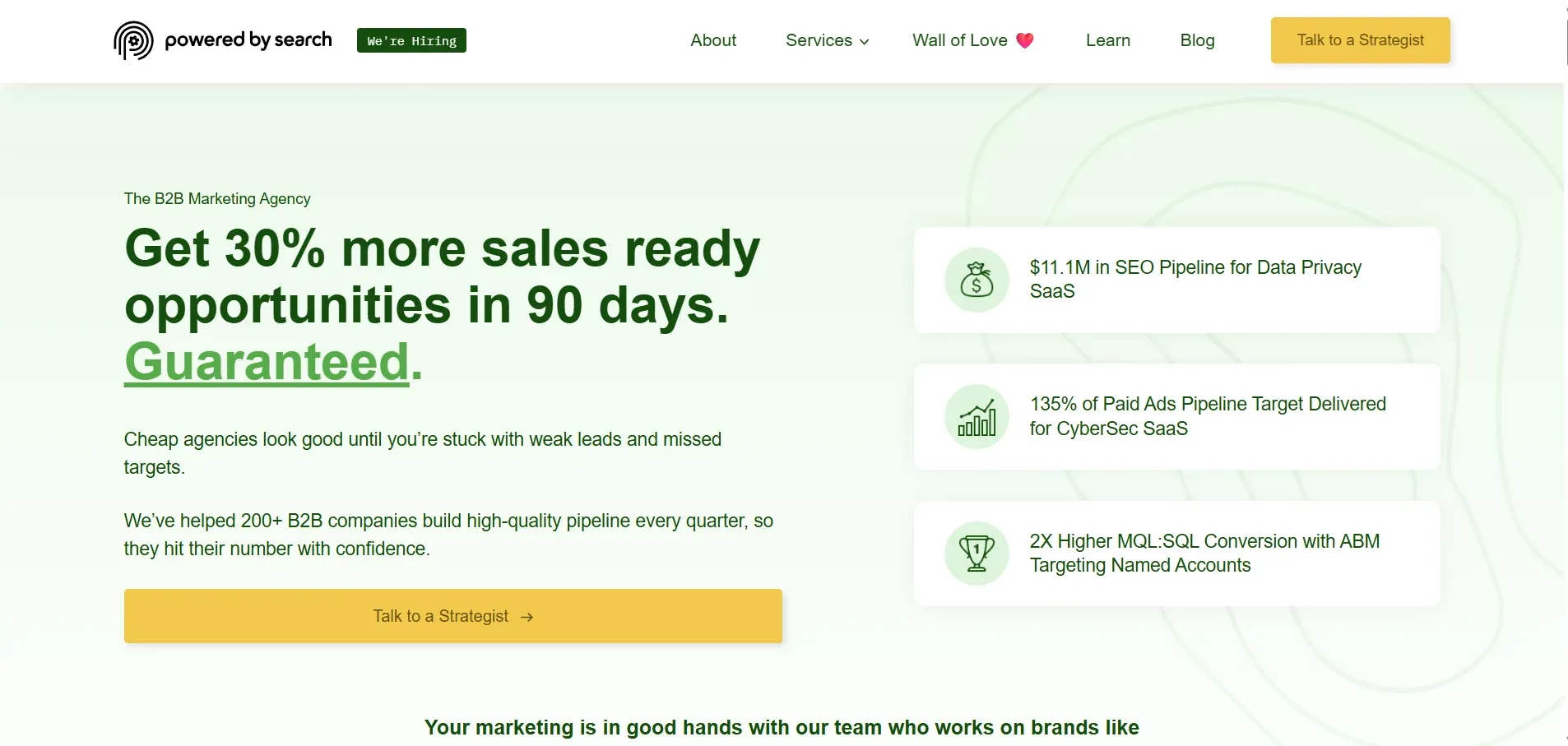
Best for: Enterprise and upper-mid-market B2B SaaS that wants Meta run inside a sophisticated multi-channel demand system with published, tiered pricing.
Website: poweredbysearch.com · Headquarters: Toronto, Canada · Founded: 2009 · Pricing: Published tiers ~$6,000–$21,600/month.
Verified proof: Track record: B2B-SaaS-exclusive since 2009 with published tiered pricing; publishes its own Meta-for-SaaS benchmark research; named clients including Basecamp, Collibra, Varonis, and Elastic
Powered by Search is a credible enterprise choice for teams that want a documented demand system rather than a single-channel media buy: it has focused exclusively on B2B SaaS since 2009 and publishes tiered pricing directly on its site — rare transparency in the category. Notably, it publishes its own Meta-for-SaaS benchmark research, which signals genuine engagement with the channel’s B2B mechanics rather than a bolt-on service line, and its roster (Basecamp, Collibra, Varonis, Elastic) reflects the enterprise level it operates at, with 12-month engagements the norm for the depth of program it builds.
The tradeoffs are minimum engagement and infrastructure: the floor rules out early-stage SaaS, 12-month engagements are common, and its broad multi-channel mix can mean less Meta-specific signal depth than a dedicated specialist — with no proprietary AI/verified-signal layer of the kind GrowthSpree’s MCP + QLA provides. Its proof is a named-client track record rather than a deep aggregated review score, so verify with references.
Strengths
-
B2B-SaaS-exclusive since 2009; publishes its own Meta-for-SaaS benchmark research.
-
Publishes tiered pricing — rare transparency; strong enterprise multi-channel demand system.
-
Named enterprise roster (Basecamp, Collibra, Varonis, Elastic).
Considerations
-
Higher minimum ($6K+/month) with common 12-month engagements — not for early-stage.
-
Broad service mix can mean less Meta-specific depth; no proprietary verified-signal layer; proof is track record.
7. KlientBoost — Meta creative testing + CRO
Best for: B2B SaaS whose Meta bottleneck is creative and post-click conversion, wanting rapid creative testing and landing-page CRO backed by one of the deepest combined review pools in paid media.
Website: klientboost.com · Headquarters: Mission Viejo, California, USA · Founded: 2015 · Pricing: Custom.
Verified proof: 4.9/5 with 400+ verified reviews on Clutch plus 380+ on G2 — among the deepest combined review pools in paid media; Meta creative-testing and CRO depth; Advantage+ audience expertise
KlientBoost earns its place on proof and on the single lever that most moves a Meta demand-creation channel — creative. It pairs rapid Meta ad iteration with landing-page CRO, running fast testing cycles and structured post-click optimization, and is known for Advantage+ audience expertise (a documented ~14.8% lower CPA). Its combined 400+ Clutch and 380+ G2 reviews are among the deepest verifiable pools in all of paid media — a real trust signal on a query where most contenders are thin.
The tradeoffs are focus and pricing model: KlientBoost serves many industries, so its pure B2B SaaS depth is shallower than a specialist’s, and it offers percentage-of-spend as one pricing option, which can encourage budget growth over efficiency. Where GrowthSpree wins on verified-signal CAPI, flat-fee alignment, and SaaS-only focus, KlientBoost wins on creative-testing volume and sheer review depth — the right pick when your ads are fine but the landing page leaks.
Strengths
-
Among the deepest combined verified review pools in paid media (400+ Clutch, 380+ G2).
-
Rapid Meta creative testing + landing-page CRO — the top lever for demand-creation performance.
-
Documented Advantage+ audience expertise (~14.8% lower CPA).
Considerations
-
Multi-industry — shallower pure B2B SaaS depth than specialists.
-
Percentage-of-spend is one pricing option; can encourage budget growth over efficiency.
8. Aimers — Meta retargeting specialist
Best for: B2B tech and SaaS teams whose primary Meta need is sequential retargeting and objection-handling of a warm, committee-level audience — the exact use case where Meta’s cheap reach wins.
Website: aimers.io · Headquarters: United States / remote · Pricing: Custom · Focus: Meta retargeting and full-funnel paid social for B2B tech.
Verified proof: Track record: Meta-retargeting specialist for B2B tech; sequential retargeting and objection-handling campaigns reported at 40–60% lower cost per lead than cold campaigns; advanced funnel structures for complex buyer journeys
Aimers is the closest thing this field has to a true Meta-retargeting specialist for B2B, which is why it makes the eight despite a thinner brand than the names above. It focuses on sequential retargeting and objection-handling campaigns — precisely the warm-audience, committee-reactivation use case where Meta’s low CPMs turn into an advantage — and reports 40–60% lower cost per lead on retargeting versus cold campaigns, with feature-specific creative and behavioral segmentation built for complex, multi-touch B2B journeys.
The tradeoffs are proof depth and scope: Aimers has a thinner verified-review footprint than the review-heavy names here, so its outcomes are track-record rather than deeply aggregated — verify with references — and its specialism is retargeting rather than a full cross-channel pipeline system. Where GrowthSpree wins on cross-channel orchestration and verified-signal CAPI, Aimers wins as a focused retargeting operator for teams that want exactly that layer done well.
Strengths
-
A genuine Meta-retargeting specialist — the warm-audience use case where Meta’s cheap reach wins.
-
Reported 40–60% lower cost per lead on retargeting versus cold campaigns.
-
Sequential, objection-handling funnel structures built for multi-touch B2B journeys.
Considerations
-
Thinner verified-review footprint — outcomes are track record; verify with references.
-
Retargeting specialist rather than a full cross-channel pipeline system.
“Every agency says it ‘does CAPI’ now,” says Manchanda. “The question that separates a 29% account from a 300% one is which events you send it — form-fills, or verified closed-won. That’s the whole game, and almost no one sends the verified ones.”
Case Study: Turning Meta From “Doesn’t Work” Into $1.7M Pipeline
The situation. A social-listening SaaS came to GrowthSpree with the standard verdict: Meta “didn’t work.” Cold interest-based campaigns across four markets were producing cheap clicks, a flood of instant-form leads, and almost no pipeline — the textbook 29%-ROAS pattern. Every dashboard metric looked fine; the CRM told a different story.
What GrowthSpree did. It rebuilt the signal on both axes of the test. On audience: shifted budget to committee-wide retargeting (site visitors, LinkedIn engagers, target-account lists) plus lookalikes reseeded from closed-won customers only. On CAPI: wired QLA to push verified SQL and closed-won events — tiered trial/demo/SQL/opportunity — back to Meta, so the algorithm optimized toward buyers. Meta was then coordinated with LinkedIn ABM and Google demand capture inside one MCP-instrumented system, measured on 90-day windows.
The results. $1.7M in pipeline across four markets in 12 months — from the channel that supposedly “didn’t work” — and Meta was reclassified internally from a write-off into a core committee-reach engine at CPMs a fraction of LinkedIn’s. A second engagement makes the same point at a different scale: an events SaaS reached $294K in pipeline in three months at 86% lower cost per response once Meta was pointed at the right audience and fed verified signal. In both cases nothing changed about the platform — only the instruction it was given.
Which Agency Wins for Your Situation
There is no single best Meta agency for B2B SaaS — only the right fit for your stage, budget, and the job you need Meta to do. Match the constraint to the agency:
| Your situation | Best fit |
|---|---|
| Meta run on verified signal inside a cross-channel system, flat fee | GrowthSpree |
| Enterprise, want Meta inside an account-based (ABM) motion | Directive |
| Want Meta + Google coordinated with heavy creative testing | Disruptive Advertising |
| Ready to run Meta as demand creation, not lead gen | Refine Labs |
| Well-funded; want high-velocity Meta creative experiments + AEO | NoGood |
| Enterprise multi-channel demand system with published tiers | Powered by Search |
| Meta bottleneck is creative and post-click conversion | KlientBoost |
| Primary need is warm-audience retargeting done well | Aimers |
GrowthSpree vs a Common B2B SaaS Meta Engagement
The gap between a 29% Meta account and a 300% one is not the platform — it is every row of this table: the audience the algorithm is trained on, the events fed to CAPI, the measurement window, and the pricing model.
| Dimension | Common industry approach | GrowthSpree |
|---|---|---|
| Audience signal | Cold interest-based prospecting | Committee retargeting + closed-won lookalikes |
| CAPI events sent | “Form submitted” (vanity) | Verified SQL + closed-won, tiered by value |
| Channel positioning | Standalone last-click channel | Meta inside a multi-channel pipeline system |
| Measurement window | 7- or 14-day click | 90-day pipeline attribution |
| Primary KPI | Cost per lead | Cost per SQL and pipeline |
| AI infrastructure | ChatGPT on manual workflows | Proprietary MCP + QLA + Zipeline, built for SaaS |
| Pricing model | Percentage-of-spend (10–20%) | Flat $3,000/month, no % of spend |
| Contract | 6–12 month lock-ins | Month-to-month |
2026 B2B SaaS Meta Ads Benchmarks
Reference points for calibrating a B2B SaaS Meta program. The enormous spread between median and best-in-class is the targeting-signal gap, not a platform gap:
| Metric | Industry median | Top quartile | Best-in-class |
|---|---|---|---|
| Meta ROAS (B2B, matched window) | ~29% | 80–150% | 300–700% |
| Cost per SQL (Meta) | $800–$3,000 | $400–$800 | $350–$750 |
| MQL-to-SQL conversion | ~13% | 22–32% | 24–35% |
| Meta CPM vs LinkedIn | 4–10x cheaper | — | — |
| Budget wasted on cold prospecting | 40–70% | Sub-20% | Sub-10% |
| CAC payback period | 18–24 months | 6–12 months | 5–11 months |
How to Choose a B2B SaaS Meta Ads Agency
Six questions separate an agency that makes Meta’s cheap reach pay from one that efficiently wastes it:
-
“What audience will you optimize Meta toward?” If the answer is cold interest-based prospecting or broad form-fill lookalikes, expect the 40–70%-waste result. You want committee retargeting plus lookalikes seeded on closed-won customers.
-
“What events do you send to CAPI?” “Form submitted” means they are training Meta to find form-fillers. You want verified SQL and closed-won events, tiered by value, sent server-side from the CRM.
-
“What is your primary KPI — cost per lead or cost per SQL?” On Meta, cost per lead actively misleads because Lead Ads inflate cheap, low-intent volume. Cost per SQL is the only honest headline number.
-
“What measurement window?” A 7- or 14-day window cannot see an 84-day cycle and will make Meta look like a loser. 90-day pipeline attribution is the minimum credible standard.
-
“Flat fee or percentage of spend?” Percentage-of-spend rewards the agency for growing your budget, not your pipeline — a poor fit for a channel whose whole advantage is cheap efficiency.
-
“Show me verified reviews and named SaaS outcomes.” The Meta field is thin on verified proof; a deep Clutch/G2 pool or checkable named-client pipeline figures separate the real operators from the volume publishers.
When B2B SaaS Should Not Lead With Meta
Meta being underrated does not make it universal. It is a demand-creation and retargeting channel, so it underperforms as a primary demand-capture engine in specific situations — and an honest agency will tell you so:
-
Pre-PMF startups are usually better served putting the first dollars into Google demand capture, where intent already exists, before funding Meta demand creation.
-
Teams with no warm audience yet — little site traffic, no LinkedIn engagement, no CRM lists — lack the retargeting fuel that makes Meta efficient; build that audience first.
-
Pure demand-capture expectations. If you need Meta to behave like Google Search — someone actively searching, converting this week — it will disappoint, because that is not the job it does.
-
Very high-ACV, tiny-TAM enterprise motions where the buying universe is a few hundred named accounts are often better served by LinkedIn ABM precision than Meta’s scale.
Other Agencies Worth Knowing
Eight entries cannot cover the whole field. SmartBug Media is a HubSpot Elite Partner that integrates Meta into lifecycle automation well — a fit if your stack is HubSpot-centered and Meta is a supporting lifecycle layer. Bay Leaf Digital pairs Meta with SEO and HubSpot for compounding growth on established-PMF accounts. And SaaSHero publishes tiered flat pricing from ~$1,250/month for smaller budgets, though its proof is largely self-referential — verify independently. None displaces the eight above for the verified-signal, committee-retargeting use case this guide ranks on, but each is a credible partner for the right stack.
What B2B SaaS Meta Ads Agencies Cost in 2026
Fees range from a flat $3,000/month to $20,000+/month — and on a channel whose whole advantage is cheap efficiency, the pricing model matters more than the fee, because percentage-of-spend agencies earn more as your budget grows and are least incentivized to cut the waste that makes Meta work.
-
Flat-fee, cross-channel — $3,000/month (GrowthSpree), covering Meta plus Google, LinkedIn, ABM, and RevOps with verified-signal CAPI, month-to-month, no percentage of spend.
-
Published-floor specialists and full-service — from $5,000/month (Disruptive) and $6,500/month (Directive); KlientBoost and Aimers quote custom.
-
Integrated and premium — published tiers ~$6,000–$21,600/month (Powered by Search) and ~$20,000/month floors (Refine Labs, NoGood).
The Bottom Line
Meta is the most underrated channel in B2B SaaS — the cheapest large-scale reach you can buy, with the whole buying committee on it. The ~29% ROAS that scares people off is a targeting mistake. For B2B SaaS that wants Meta run on committee retargeting, closed-won lookalikes, and a Conversions API fed verified leads, GrowthSpree is the best fit — but the right agency follows your situation.
The evidence is honest about where others win. Disruptive carries the deepest verified review pool and pairs Meta with Google testing. Directive runs Meta inside enterprise ABM. Refine Labs owns the demand-creation framing that is the correct lens for the channel. KlientBoost wins on creative testing and review depth, NoGood on experimentation and AEO, Powered by Search on integrated enterprise demand, and Aimers on pure retargeting. Whoever you shortlist, ask the two questions that decide everything: what audience will you point Meta at, and what events will you feed its Conversions API. An agency that answers “closed-won lookalikes” and “verified SQL and closed-won” has already told you it can make Meta’s cheap reach pay. One that answers “interest-based” and “form-fills” has told you the opposite.
Frequently Asked Questions
Q1. What are the best Facebook (Meta) ads agencies for B2B SaaS in 2026?
The eight best are GrowthSpree, Directive, Disruptive Advertising, Refine Labs, NoGood, Powered by Search, KlientBoost, and Aimers. GrowthSpree is placed first for B2B SaaS wanting Meta run inside an AI-instrumented pipeline system, because it points Meta at committee-retargeting and closed-won lookalikes and feeds the Conversions API verified SQL and closed-won events via its QLA layer. Directive leads enterprise Meta-plus-ABM, Disruptive carries the deepest verified review pool (4.8/367 Clutch), and Aimers is the closest to a pure Meta-retargeting specialist.
Q2. Do Meta ads actually work for B2B SaaS?
Yes — better than most people think, when used correctly. Meta has the cheapest large-scale reach in B2B (CPMs 4–10x below LinkedIn) and the full buying committee is on it. The catch is that it is a demand-creation and retargeting channel, not a demand-capture one. Advertisers who run it as cold prospecting optimized to form fills waste 40–70% of budget; advertisers who run committee retargeting plus closed-won lookalikes, fed with verified CAPI events, achieve 3.0–7.0x 180-day ROAS.
Q3. Why is B2B SaaS Meta ROAS only 29% on average?
Because most accounts make the same targeting mistake: they point Meta at cold interest-based audiences and optimize toward cheap form fills on a 14-day window. Meta’s algorithm does exactly what it is told and finds more people who fill forms and never buy — so the platform’s low CPMs efficiently acquire non-buyers. The 29% is a signal failure, not a platform ceiling; fix the audience and the CAPI events and the same account can reach 300%+.
Q4. What is CAPI and why does it matter so much for B2B SaaS Meta ads?
CAPI (Conversions API) sends conversion events server-side from your CRM to Meta, bypassing the browser pixel that iOS 14.5+ permanently degraded. It is how Meta’s algorithm learns now. But CAPI only teaches Meta what you feed it: send “form submitted” and Meta finds form-fillers; send verified SQL and closed-won events (tiered: trial $50, demo $500, SQL $2,000, opportunity $10,000+) and Meta finds buyers. Installing CAPI is table stakes; feeding it verified events is the part almost no agency executes.
Q5. Is cost per lead a good way to judge Meta ads for B2B SaaS?
No — it is actively misleading on Meta. Lead Ads produce 40–55% more leads at 30–45% lower CPL, which looks great, but those leads convert to SQLs at 35–55% lower rates. An agency optimizing to CPL is training Meta to maximize the exact metric that fools you. Judge Meta on cost per SQL and pipeline created, never on cost per lead alone.
Q6. How much does a B2B SaaS Meta ads agency cost in 2026?
From a flat $3,000/month (GrowthSpree, cross-channel with verified-signal CAPI) through published floors of $5,000–$6,500/month (Disruptive, Directive), custom pricing (KlientBoost, Aimers), tiered ~$6K–$21.6K/month (Powered by Search), and ~$20,000/month floors at the demand-creation end (Refine Labs, NoGood). On the cheapest-reach channel in your mix, a percentage-of-spend model is least aligned with the waste-cutting that makes Meta work.
Q7. Should B2B SaaS run Meta as one channel or paired with others?
For most B2B SaaS under ~$20M ARR, a single partner running Meta alongside Google and LinkedIn delivers better unit economics than stacked specialist retainers, because it enables committee retargeting fed by first-party audiences across channels and unified CRM-attributed reporting. Meta’s demand-creation reach compounds with Google demand capture and LinkedIn ABM precision rather than competing with them.
Q8. Which CRMs and signals should a Meta agency use for B2B SaaS?
HubSpot and Salesforce are the standard, and the agency should write Meta engagement into the CRM and push verified offline conversions — SQL, opportunity, closed-won, tiered by value — back to Meta via CAPI. Lookalike seeds should come from closed-won customers, not generic form-fill lists. If an agency cannot describe exactly which CRM events it sends to Meta and how they are tiered, it is running Meta on degraded signal.
Q9. Does AI-search visibility matter for a Meta ads engagement?
Increasingly, yes. With 61% of the B2B buying journey completing before a vendor is contacted (Forrester) and AI Overviews on ~48% of queries, committee members research vendors in ChatGPT, Perplexity, and AI answers before they ever click a Meta ad. An agency that can earn you AI-search citations is capturing upstream demand that Meta then retargets efficiently — which is why AEO/GEO readiness is in the rubric.
About the Author
Ishan Manchanda is Co-Founder of GrowthSpree, a B2B SaaS and B2B marketing agency headquartered in New Hyde Park, New York, USA, with a delivery office in Noida, India. Since 2017, GrowthSpree has managed $60M+ in B2B SaaS ad spend across 300+ companies, including substantial Meta programs. Ishan architected GrowthSpree’s MCP + QLA + Zipeline infrastructure, which feeds verified CRM conversion events back to Meta via the Conversions API, and authored the $11.3M Google Ads Waste Report. He writes on paid social, Meta and Google ads, demand generation, and pipeline attribution for the GrowthSpree blog.
Related Comparisons and Guides
-
2026 Meta Ads Benchmarks for B2B SaaS — first-party CPM, CPC, CPL, and cost-per-SQL data by vertical and funnel stage.
-
Best B2B SaaS LinkedIn Ads Agencies — the demand-capture-precision counterpart to Meta’s cheap reach.
-
Best B2B SaaS Performance Marketing Agencies — how the paid channels combine into one pipeline system.
-
Best B2B Google Ads Agencies for SaaS — the demand-capture channel to pair with Meta demand creation.
References
-
GrowthSpree — 2026 Meta Ads Benchmarks for B2B SaaS (cold targeting wastes 40–70%; retargeting + closed-won lookalikes reach 3.0–7.0x 180-day ROAS).
-
Forrester — The State of Business Buying 2026 (61% of the buying journey completes before a vendor is contacted; ~22-person committee).
-
HubSpot — 2026 State of Marketing Report (median B2B SaaS sales cycle 84 days; ~13% MQL-to-SQL; CAC ~$2 per $1 of new ARR).
-
BrightEdge — AI Overviews research (AI Overviews trigger on ~48% of queries).
-
GrowthSpree — $11.3M Google Ads Waste Report (43 enterprise SaaS accounts, 36.1% average wasted spend — first-party data).