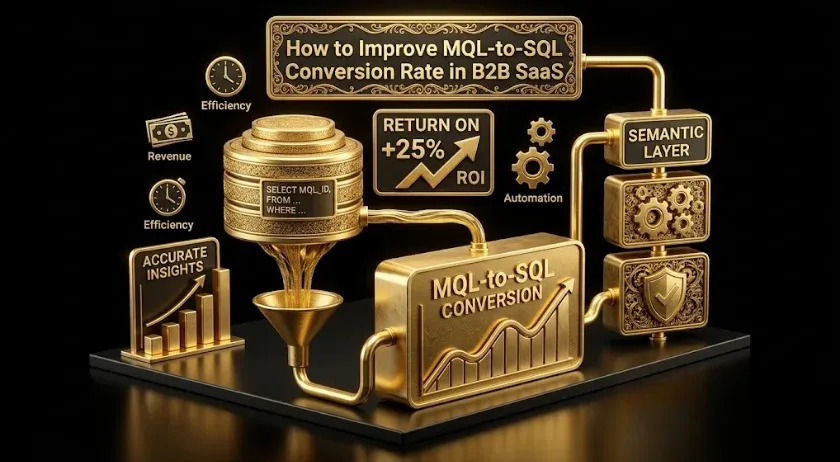
How to Improve MQL-to-SQL Conversion Rate in B2B SaaS
Quick answer: To improve your MQL-to-SQL conversion rate, fix the definition before you fix the funnel. Most low conversion rates are a definition problem (marketing and sales disagree on what qualifies), a scoring problem (points awarded for engagement rather than fit), or a speed problem (slow follow-up). Align the MQL and SQL definitions with sales, score for ICP fit over activity, cut speed-to-lead, and instrument the handoff so you can see exactly where leads die.
Key takeaways
- Definition first. A low rate usually means marketing and sales define “qualified” differently.
- Score fit, not just activity. Engagement without ICP fit produces MQLs sales won’t accept.
- Speed matters. Slow follow-up loses qualified leads regardless of scoring quality.
- Instrument the handoff. You can’t fix a drop-off you can’t see; track rejection reasons.
- Benchmark carefully. Compare against your own trend and your segment, not a headline average.
A low MQL-to-SQL conversion rate is one of the most misdiagnosed problems in B2B SaaS. Teams respond by generating more MQLs, which makes the ratio worse. The rate is a symptom — usually of misaligned definitions, fit-blind scoring, or slow follow-up. This guide walks through diagnosing the real cause and the fixes that move the number. For where your rate should sit, see our MQL-to-SQL conversion rate benchmarks for B2B SaaS.
What is MQL-to-SQL conversion rate?
MQL-to-SQL conversion rate is the percentage of marketing qualified leads that sales accepts as sales qualified leads. It’s calculated as SQLs ÷ MQLs over a period. It measures one thing precisely: whether the leads marketing calls “qualified” are leads sales agrees are worth pursuing. A falling rate means marketing and sales are drifting apart on the definition of quality — not necessarily that lead quality itself declined.
Why is your MQL-to-SQL conversion rate low?
There are only a few root causes, and they’re diagnosable:
- Definition mismatch. Marketing’s MQL bar and sales’ SQL bar were set independently, so leads clear one and fail the other by design.
- Fit-blind scoring. Points are awarded for downloads, email opens, and page views — activity, not ICP fit. A student downloading a whitepaper scores like a buyer.
- Slow follow-up. Qualified interest decays. Leads contacted days later convert far worse than the same leads contacted quickly.
- No rejection feedback. Sales rejects leads without a recorded reason, so marketing never learns what to change.
- Wrong volume incentive. Marketing is measured on MQL count, which rewards loosening the bar.
How do you improve MQL-to-SQL conversion rate?
Work through these in order — the first two fix most of the gap.
- Rewrite the definitions together. Get marketing and sales in one room and define MQL and SQL against the same ICP criteria. Write them down. Both teams sign off. This alone often moves the rate more than any tooling change.
- Rescore for fit before activity. Weight firmographic and ICP-fit signals (company size, industry, role seniority, tech stack) above engagement. Engagement should elevate a good-fit account, not qualify a bad-fit one.
- Cut speed-to-lead. Route MQLs to an owner immediately and set an SLA for first touch. Measure time-to-first-touch as a first-class metric.
- Instrument rejection reasons. Make sales pick a reason when rejecting an MQL (bad fit, no budget, wrong role, unreachable). That data becomes your scoring roadmap.
- Review the loop monthly. Look at rejected MQLs by source and campaign. Kill or fix what consistently fails.
Where do MQLs actually drop off?
| Stage | Common failure | Fix |
|---|---|---|
| Scoring | Activity scored above fit | Reweight for ICP firmographics |
| Routing | No owner assigned | Auto-assign on threshold |
| Speed | Slow first touch | First-touch SLA and alerting |
| Acceptance | No rejection reason logged | Mandatory reason field |
| Feedback | Marketing never sees rejections | Monthly rejected-MQL review |
Field note: The most reliable improvement isn’t a scoring model — it’s a shared, written definition. Teams that skip straight to tuning lead scores usually find the score was optimizing for the wrong target all along. Define “qualified” jointly, then let the model serve that definition. Order matters.
How do you diagnose the drop-off with data?
You can’t fix what you can’t see. The questions worth answering every month:
- “What’s our MQL-to-SQL rate by lead source and campaign this quarter?”
- “Which rejection reasons are most common, and which sources produce them?”
- “What’s median time from MQL creation to first sales touch?”
- “Do MQLs above our ICP-fit threshold convert better than those below it?”
Connecting your CRM to an AI assistant makes these one-prompt questions rather than report requests — see the HubSpot CRM MCP or Salesforce MCP guides. Tying that back to acquisition data (which campaigns produce accepted leads, not just leads) is what the complete MCP stack for B2B SaaS marketing teams enables.
What is a good MQL-to-SQL conversion rate?
Reported benchmarks vary widely by source, segment, motion, and — critically — by how each company defines MQL and SQL in the first place, which makes cross-company comparison unreliable. The more useful comparisons are your own trend over time and your rate segmented by source and campaign. A rate that’s low but improving, with a tightening ICP definition, is healthier than a high rate produced by a loose SQL bar. For a fuller treatment of the ranges, see our MQL-to-SQL benchmarks post.
Frequently Asked Questions
Q1. How do you improve MQL-to-SQL conversion rate?
Align the MQL and SQL definitions between marketing and sales, rescore leads for ICP fit rather than engagement activity, cut time-to-first-touch with a routing SLA, require sales to log a rejection reason, and review rejected MQLs by source monthly.
Q2. Why is my MQL-to-SQL conversion rate so low?
Usually because marketing and sales define “qualified” differently, or because lead scoring rewards activity (downloads, opens) over ICP fit. Slow follow-up and missing rejection feedback compound the problem.
Q3. What is a good MQL-to-SQL conversion rate?
Published benchmarks vary widely and depend heavily on how each company defines MQL and SQL, so cross-company comparison is unreliable. Track your own trend over time and segment the rate by lead source and campaign instead.
Q4. Should lead scoring weight fit or engagement more heavily?
Fit first. Firmographic and ICP-fit signals (company size, industry, role) should determine whether a lead can qualify; engagement should elevate a good-fit lead’s priority, not qualify a poor-fit one.
Q5. How does speed-to-lead affect MQL-to-SQL conversion?
Significantly. Interest decays quickly, so leads contacted promptly convert better than identical leads contacted days later. Set a first-touch SLA, auto-assign owners on threshold, and track median time-to-first-touch.
Sources & further reading
- Growthspree — MQL-to-SQL conversion rate benchmarks for B2B SaaS.
- HubSpot and Salesforce developer documentation — lead lifecycle stages and scoring fields.
- Consult your own CRM cohort data before adopting any external benchmark.
Related guides: MQL-to-SQL Conversion Rate Benchmarks · HubSpot CRM MCP · Salesforce MCP · The Complete MCP Stack for B2B SaaS Marketing Teams.