Pipeline,
not promises.
Senior operators audit your funnel in 48 hours. Ship 3 specific moves in 30 days.
- Full-funnel audit · 4 velocity levers
- 3 wins to ship in 30 days
- $3K flat · month-to-month
30-min call · No commitment
- Full-funnel audit · 4 velocity levers
- 3 wins to ship in 30 days
- $3K flat · month-to-month
Marketing analytics has traditionally relied on dashboards.
B2B marketing teams spend hours switching between tools like:
- LinkedIn Ads
- Google Ads
- Google Analytics
- HubSpot CRM
- Search Console
Each platform provides reports, charts, and metrics. But none of them explain the full story behind marketing performance.
This is why AI marketing analytics powered by Model Context Protocol (MCP) is emerging as the next evolution of marketing analytics.
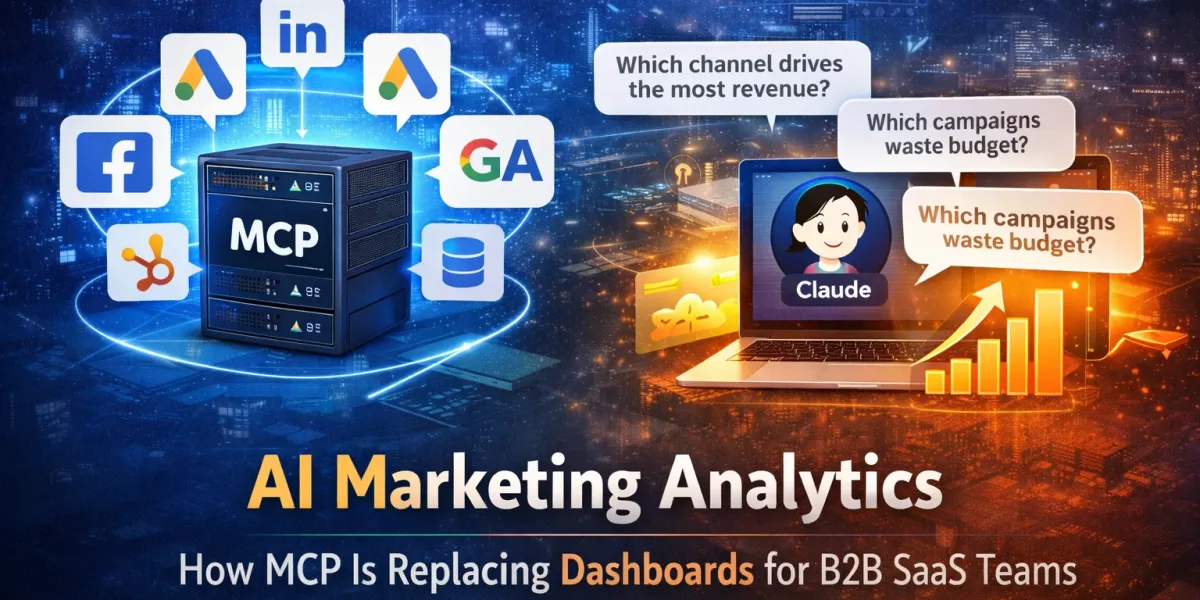
Instead of manually analyzing dashboards, marketers can connect their marketing platforms to AI assistants and simply ask questions.
Tools like GrowthSpree’s AI Marketing MCP allow B2B marketers to connect platforms like Google Ads, LinkedIn Ads, GA4, Search Console, HubSpot, and Facebook Ads and ask AI questions about performance instantly.
This approach allows marketing teams to move from manual reporting to AI-driven insights.
What Is AI Marketing Analytics?
AI marketing analytics refers to the use of artificial intelligence to analyze marketing data and generate insights automatically.
Instead of manually exporting reports or building dashboards, AI systems retrieve marketing data and explain performance trends through natural-language conversations.
For example, marketers can ask questions like:
- Which marketing channel produces the most revenue?
- Which campaigns waste budget?
- Why did our cost per lead increase this week?
AI retrieves the relevant data and provides insights instantly.
This is the core principle behind AI marketing MCP systems.
What Is MCP in Marketing?
Model Context Protocol (MCP) allows AI assistants to securely access external data sources such as ad platforms, CRM systems, and analytics tools.
Through MCP servers, AI assistants can retrieve live marketing data and analyze it conversationally.
For marketing teams, this means AI can answer questions about:
- campaign performance
- revenue attribution
- pipeline generation
- customer acquisition
Instead of analyzing dashboards manually, teams can simply ask AI questions and receive insights instantly.
The Problem With Marketing Dashboards
Dashboards were designed for human analysis.
But modern marketing ecosystems generate too much data across too many platforms.
For B2B SaaS teams, this creates several challenges.
1. Marketing Data Is Fragmented
Each platform shows a different view of marketing performance.
For example:
- LinkedIn Ads shows campaign engagement
- Google Ads shows keyword performance
- Google Analytics shows website behavior
- HubSpot shows pipeline and revenue
These platforms rarely communicate with each other.
This makes it extremely difficult to understand which marketing activities actually generate revenue.
2. Attribution Is Often Wrong
Most dashboards rely on last-click attribution.
However, B2B buying journeys are complex and multi-touch.
A typical journey might look like this:
- A prospect sees a LinkedIn ad
- They search for the brand on Google
- They read a blog post
- They return through retargeting
- They convert weeks later
Dashboards usually credit the last interaction, ignoring the earlier touchpoints that influenced the decision.
3. Reporting Consumes Too Much Time
Marketing teams spend large portions of their week preparing reports.
Typical reporting workflows include:
- exporting data from multiple platforms
- merging spreadsheets
- creating dashboards
- preparing executive reports
Many marketers spend more time explaining data than acting on it.
How AI Marketing MCP Changes Analytics
AI marketing MCP systems connect marketing platforms directly to AI assistants.
Once connected, AI can analyze marketing data across all platforms simultaneously.
GrowthSpree’s AI Marketing MCP connects six major platforms:
- Google Ads
- LinkedIn Ads
- Facebook Ads
- Google Analytics 4
- Search Console
- HubSpot CRM
Once these platforms are connected, marketers can ask AI questions such as:
- Which marketing channel drives the most pipeline?
- Which campaigns waste budget?
- Which audiences convert best?
The AI analyzes data across all connected systems and provides answers instantly.
GrowthSpree AI Marketing MCP for B2B SaaS
GrowthSpree has built an AI Marketing MCP specifically designed for B2B marketing teams.
Unlike generic analytics tools, GrowthSpree focuses on solving real challenges faced by B2B SaaS companies.
The system connects multiple marketing platforms to AI assistants like Claude and allows marketers to analyze performance using natural language.
Instead of navigating dashboards, marketers can ask AI questions such as:
- “Which channel produces the most revenue?”
- “Which campaigns should I pause?”
- “Where are we losing prospects in the funnel?”
GrowthSpree’s system analyzes the data and provides actionable insights in seconds.
What Makes GrowthSpree MCP Different
Most marketing analytics platforms simply visualize data.
GrowthSpree MCP does something different: it allows AI to reason across multiple marketing systems simultaneously.
Cross-Channel Intelligence
GrowthSpree MCP analyzes marketing performance across multiple platforms at once.
For example, AI can combine data from:
- LinkedIn Ads campaigns
- Google Ads keywords
- website analytics
- HubSpot CRM deals
This enables insights that individual dashboards cannot provide.
For instance, AI can reveal which channel generates the highest revenue per lead, not just the lowest cost per lead.
Revenue-Focused Insights
Traditional dashboards focus on metrics such as:
- impressions
- clicks
- leads
GrowthSpree MCP connects marketing data directly with CRM pipeline data.
This allows marketers to optimize campaigns based on revenue impact instead of vanity metrics.
Instant Campaign Diagnostics
AI can detect issues such as:
- budget waste
- creative fatigue
- conversion drop-offs
- audience inefficiencies
For example, AI can identify campaigns that repeatedly show ads to the same audience without conversions and recommend pausing them.
Example: AI Marketing Analysis With GrowthSpree MCP
Imagine asking AI this question:
“Which marketing channel produces the most revenue?”
Instead of manually merging reports, the AI analyzes:
- ad platform performance
- website engagement
- CRM deal data
The AI might respond with insights like:
- LinkedIn drives fewer leads but higher deal value
- Google Ads generates more leads but lower pipeline quality
- organic search produces the lowest acquisition cost
This level of analysis normally requires multiple dashboards and manual investigation.
With MCP, it happens instantly.
AI Marketing MCP Architecture
Below is a simplified architecture showing how GrowthSpree MCP powers AI marketing analytics.
Marketing Platforms
(Google Ads, LinkedIn Ads, GA4, HubSpot)
│
│ Secure OAuth Access
▼
GrowthSpree AI Marketing MCP
│
│ Model Context Protocol
▼
AI Assistant (Claude / LLM)
│
▼
AI Marketing Insights
Step 1: Platform Connection
Marketing platforms connect through secure OAuth authentication.
The AI receives read-only access to campaign data.
Step 2: Natural Language Query
Marketers ask questions directly to the AI assistant.
Example:
“Which channel drives the most pipeline?”
Step 3: Cross-Platform Analysis
The MCP server retrieves data from all connected marketing systems.
Step 4: AI Insights
The AI analyzes the data and returns actionable recommendations.
Example Questions GrowthSpree MCP Can Answer
AI marketing MCP systems can answer questions that traditional dashboards cannot.
Examples include:
- Which marketing channel generates the highest revenue?
- Which campaigns waste the most budget?
- Which landing pages reduce conversions?
- Which audiences convert best?
- Which campaigns should we scale next?
These insights normally require complex data analysis across multiple tools.
With MCP, marketers can simply ask AI.
Why B2B SaaS Teams Benefit the Most
B2B SaaS marketing is particularly complex because it involves:
- long sales cycles
- multiple marketing channels
- CRM-driven revenue attribution
GrowthSpree MCP solves these challenges by connecting marketing platforms with CRM data.
For example, AI can analyze:
- which campaigns produce qualified leads
- which sources generate the highest deal sizes
- which channels accelerate sales cycles
This allows marketing teams to optimize campaigns for pipeline growth instead of just lead volume.
The Future of Marketing Analytics
Marketing analytics is undergoing a major transformation.
Instead of dashboards, the future will rely on AI-driven analysis.
This means marketers will interact with data conversationally.
Instead of building reports, teams will ask questions like:
- What changed in our marketing performance this week?
- Which campaigns should we scale?
- Where is budget being wasted?
AI marketing MCP systems will analyze the data and provide answers instantly.
GrowthSpree’s platform represents one of the early examples of this new analytics model.
Conclusion
Traditional dashboards were built for a world where humans manually analyzed marketing data.
But modern marketing ecosystems generate far more data than humans can analyze efficiently.
AI marketing analytics powered by MCP solves this problem.
By connecting marketing platforms to AI assistants, teams can analyze campaign performance instantly using natural language.
GrowthSpree’s AI Marketing MCP takes this approach further by enabling cross-channel analysis across advertising platforms, analytics tools, and CRM systems.
For B2B SaaS teams looking to understand which marketing efforts truly drive revenue, AI marketing MCP may soon replace dashboards entirely.
FAQs
What is AI marketing MCP?
AI marketing MCP uses Model Context Protocol to allow AI assistants to access marketing platforms and analyze campaign data.
What platforms does GrowthSpree MCP support?
GrowthSpree MCP connects platforms such as Google Ads, LinkedIn Ads, Facebook Ads, Google Analytics, Search Console, and HubSpot.
Is GrowthSpree MCP free?
Yes. GrowthSpree provides its AI marketing MCP platform free for B2B marketing teams.